0:00
Grunfeld provides personal information.
From the machine transcript
Grunfeld gives his official surname and his Yiddish name and patronymic while Lemster checks the spelling and the pronunciation of each.
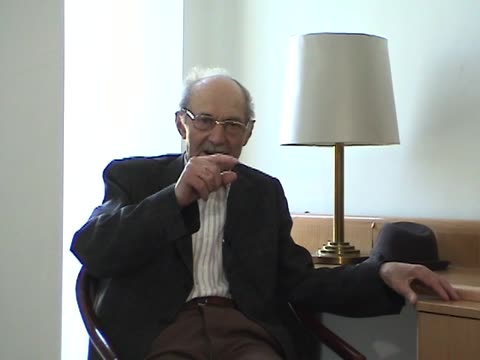
One conversation with Eugen Grunfeld, continuing over MDV 233, MDV 234.
Grunfeld provides personal information.
Grunfeld gives his official surname and his Yiddish name and patronymic while Lemster checks the spelling and the pronunciation of each.
Grunfeld provides personal information and talks about his family. Before the war, Grunfeld also lived in Bukarest. After the war, he moved to Cluj-Napoca in 1945. His father was born in Ileanda and was a merchant. Grunfeld explains that his father moved to Israel after the war. His mother was born in Zău.
Grunfeld says he was born in Zău and attended school in Cluj and Bucharest before the war, and that after the war he settled in Cluj for good. Answering Lemster, he names his father, born in Ileanda (?), a merchant who later lived in Petah Tikva in Israel, and his mother Gitl, a housewife. He names his grandparents — a paternal grandfather who was a tailor, a paternal grandmother Gitl and a maternal grandfather named Rosenberg — and explains why the name Gitl occurs on both sides. A cousin in London is mentioned in connection with a family document, and Lemster and the others discuss the Yiddish term for such a relative.
adds the grandparents, their occupations and names, and the cousin in London
Grunfeld speaks about his grandparents and their observance. He then talks about his education. He attended a Romanian school in Bukarest, after being a student at a religious school (cheder). According to Grunfeld, he spent three years in cheder in Zău Mureș and one year at a Talmud Torah school in Cluj-Napoca.
Grunfeld describes his pious grandparents, the family Passover seder led by his grandfather, and how he learned much from his maternal grandfather. He then answers Lemster's questions about his schooling: three or four years in cheder in Zău, one year in the Talmud Torah in Cluj, and Romanian-language gymnasium in Bucharest. He names the melamed in Zău.
adds the melamed's name and the grandfather's role in teaching him
Grunfeld discusses his childhood memories. In particular, he recalls how his grandfather quizzed him about the Torah while other children played together. He then speaks about his Talmud studies at a Talmud Torah school.
Asked about his childhood games, Grunfeld recalls being upset on Sabbath afternoons when the other children played while his grandfather made him recite from the Pentateuch. He then explains the difference between cheder in Zău and the Talmud Torah in Cluj, where he began Gemara at nine or ten and studied only a little.
Grunfeld talks about holiday celebration at home before the war. He addresses Passover, including food customs and singing the final hymn "Khad Gadyo." He also remembers how he played nuts with non-Jews on Sukkoth.
Grunfeld recalls the Passover seder at home, led by his grandfather, with the four questions asked by the child and his younger sister stealing the afikoman. He answers Lemster's questions about special Passover dishes and utensils, stuffed goose and potato foods, and recites parts of Khad Gadyo. He describes the cup for Elijah and the opened door, and mentions playing with nuts at Sukkot with Jewish and non-Jewish children.
Grunfeld speaks about prewar life and non-Jews who spoke Yiddish. In particular, he describes an encounter with a Romanian soldier in Tighina during the war, when Grunfeld was a forced laborer. He then addresses customs of Havdalah (bidding farewell the Sabbath) and recalls the family's sabbath goy.
Grunfeld says that in Zău non-Jews did not speak Yiddish but that in Maramureș they did, and recalls a Romanian policeman in Tighina who spoke excellent Yiddish. He describes how Romanian peasant women sat outside the Jewish shops on Friday night waiting to count three stars so that the shops could open, and Lemster asks about the term for the peasants. He also mentions the Sabbath goy who lit the fire.
adds the terminology discussion about the Romanian peasants
Grunfeld talks about Purim celebrations and Jewish life before the war. He maintains that twenty Jewish families lived in Zău. Grunfeld then describes how he dresses up as a Romanian child during Purim.
Grunfeld says about twenty Jewish families lived in Zău, with a synagogue, cheder and mikveh, and he lived there until about the age of ten. He recalls Purim customs: sending gifts between families and going masked as a Romanian peasant child, with short Purim plays and visits to the Romanian teacher. Lemster asks for a Purim song, but Grunfeld says he cannot sing and recalls only a few words.
adds the Purim plays and Lemster's request for a song
Grunfeld discusses Hanukkah celebrations. He also provides a parody of the four letters on a dreydl. He then addresses food customs.
Grunfeld describes playing dreydl at Hanukkah and recites a children's parody of the letters on the dreydl. Lemster asks about holiday foods, such as baked goods and potato latkes, and Grunfeld gives local terms and explains that Transylvania is called Zimbergn (Siebenbürgen). He begins to speak about Shavuot.
Grunfeld talks about Shavuot and Tisha B'av celebrations.
Grunfeld recalls learning a Shavuot poem as a child, then describes Tisha B'Av customs, when worshippers sat on the floor without shoes in the synagogue. He answers a question about a children's custom with a Romanian word. Asked what else he remembers, he says childhood years are the best and speaks of his failing eyesight and difficulty reading prayers.
Grunfeld talks about his family. He grew up with two brothers and three sisters.
Grunfeld names his siblings: three brothers and three sisters in all, with birth years given for some, and one who died at thirteen after his bar mitzvah. One sister has died and one brother lives in Israel (?).
Grunfeld talks about his work. He worked as a chief trained cellulose insulation technician at a factory for 35 years during the postwar Soviet period.
Grunfeld says he is now a pensioner and describes his postwar career as a technician in cellulose and paper, trained at a technical school. He was head of a section with a large workforce under Ceaușescu and worked at the factory for thirty-five years.
Grunfeld answers questions about cultural terminology. He also addresses religious observance and recalls people talking about the Ştefăneşti and Vizhnitzer rebbes. Grunfeld also states that his uncle was part of the Satmarer Hasidim.
Grunfeld answers Lemster's questions about the terms "a good Jew" and the Baal Shem Tov. He says he grew up in a religious home and talks about what he heard of the Ștefănești and Vizhnitz rebbes, as well as Satmar. His mother's brother studied at the Satmar yeshiva as a follower of Rabbi Yoilish, and he says he himself is a Cluj Hasid. He briefly discusses Ashkenazi and Sephardi prayer customs.
adds the Baal Shem Tov question and the uncle at the Satmar yeshiva
Grunfeld discusses prewar Sabbath celebrations and prayer customs. He then talks about Sabbath food customs and Sabbath zemirot (songs).
Grunfeld describes Sabbath eve in his grandparents' home, with a grandfather reminding his wife to light the candles, the fish from the local river, gefilte fish, soup and meat with noodles. He recalls the family singing Sabbath songs at the table and kugel on Sabbath day, and says Yiddish was spoken there although he did not study it in school. He also speaks of Yiddish speakers he met in Israel (?).
Grunfeld speaks about life today. He then turns to prewar Jewish life in Zău and occupational structure.
Grunfeld names the occupations of the Jews in Zău: timber merchants, a butcher shop, a tailor and a shoemaker, and none in hard manual labor. Lemster asks the term for peasants, and the term for mother tongue. He says Yiddish was his mother tongue until the age of ten and he also knows Romanian and Hungarian, but now speaks only those at home.
adds the questions on terms for peasants and mother tongue
Grunfeld talks about his life after the war. He got married in 1949. He then mentions prewar Jewish life in Cluj-Napoca, including synagogue structure. According to Grunfeld, 18,000 Jews lived in Cluj before the war and approximately 2,000 Jews after the war.
Grunfeld says he married in 1949 and speaks Romanian with his wife. Answering Lemster, he says there was one synagogue in Zău but many in Cluj, including small prayer houses in each quarter, artisans' synagogues and a workers' synagogue, and he explains the word quarter (kvartir). He says about eighteen thousand Jews lived in Cluj before the war and about two thousand afterwards, and now about two hundred.
adds his marriage and the synagogue structure of Cluj
Grunfeld talks about his life during the war as forced laborer. He worked at the Tighina fortress and other places in Romania.
Grunfeld says he spent the war doing forced labor in Tighina fortress and other places in Romania. He mentions that Cluj Jews were sent elsewhere, some to Transnistria, and that his mother lived in Turda near the Hungarian border during the war, then Hungarian-ruled.
adds Cluj Jews sent elsewhere and the mother in Turda