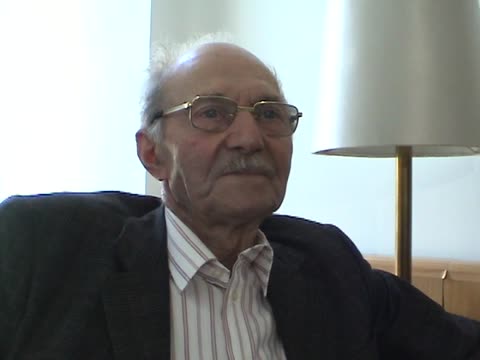
Grunfeld talks about Jewish life of the region during World War II. He also addresses his family's fate during the war period. His parents were imprisoned in the Turda ghetto. His aunts were sent Auschwitz.
Grunfeld explains that the Romanian–Hungarian border of wartime Transylvania lay a few kilometres from where he lived, and that Jews on the Hungarian side were deported to Auschwitz in 1944 (?), while those on the Romanian side stayed. His parents were on the Romanian side, in Turda. Of his aunts on both sides only one, his father's sister Hana, returned from Auschwitz, with a camp number on her arm. Lemster asks why they went to a village, and Grunfeld explains that Jews were expelled from villages and pushed into the town.
Explains the border and why the family on the Romanian side escaped deportation.
Grunfeld describes a traditional Jewish wedding, with his sister's in mind: a chuppah in the synagogue courtyard, a mitzvah dance, and Hasidic customs he saw. He mentions a Neolog (reformist) synagogue that observant Jews did not attend. Asked about wedding songs, he names the Hebrew ceremonial song and says Yiddish songs were also sung.
Includes the Neolog (reform) synagogue and wedding songs.
Grunfeld speaks about Jewish observance in Cluj and Hasidim he saw in Cluj, Dej (?) and Oradea, and about distinctions Transylvanian Jews drew between themselves and Jews from Maramureș, Moldavia and Bessarabia. He says Maramureș Jews were more religious. Asked about Lithuanian Jews and which Yiddish is correct, he says everyone considers their own Yiddish the right one, and he recalls adapting to Bessarabian speech. The passage ends with jokes and Chełm stories.
Adds regional distinctions among Jews and attitudes to dialect.
Grunfeld talks about learning to read Yiddish at home as a child, including the Pentateuch, and about Jewish cultural circles and conferences. Writers named include Isaac Bashevis Singer and Itzik Feffer (?), along with Romanian and European authors. He says there was no Jewish library but families kept religious books, and that Jewish schooling was in Romanian. A discussion of the golem, dybbuk and the word 'golem' follows.
Adds the school language and Jewish gymnasium, and the discussion of golem and dybbuk.
Grunfeld speaks about his family and addresses local cemeteries, as well as prayer customs. He then turns to folk customs, including averting the evil eye.
Grunfeld says his mother is buried in Cluj and his grandmother in Turda; he visits the grave, says a short Hebrew prayer from a special prayer book and some Psalms, and his sister asks her mother in Yiddish to intercede for them. Lemster then asks about folk customs: the evil eye (ayin hara), pouring coals into water, and a childhood remedy. Grunfeld says Yiddish is hardly spoken in Cluj today, even at the Jewish community, and recalls visiting his sister in Haifa, then Lemster asks for sayings and anecdotes.
Adds the evil eye and the remedy of pouring coals in water.
Grunfeld answers Lemster's dialectological questionnaire, often explaining the Transylvanian variants in comparison with Moldavian and Bessarabian forms. Items include greetings, thanks and the word for Sabbath, animals, household and body words, colours, comparatives, verbs and sentences, the words for 'erlekh' and 'frum', 'tselem', 'goy' and 'davenen', terms such as house, room, attic, ladder, bridge, enemy and 'need' (darf, broykh). Romanian is used for many explanations, and the transcript is garbled throughout.
Grunfeld talks about life today. He then talks about his family. He raised one daughter. His father and sister moved to Israel in 1950. Grunfeld maintains that he was not allowed to leave the country because he was a specialist. He then addresses emigration.
Grunfeld says he has one daughter, who lives in Cluj. His father and sister emigrated to Israel in 1950; he was on the list too but was not allowed to leave because he was a specialist. Lemster asks why so many Romanian Jews emigrated, and Grunfeld cites economic and social change, the socialization of trades and professions, and the loss of a future, since Jewish life as it had been before the war was ended.
Grunfeld speaks about prewar Jewish and non-Jewish relations before and after the war. He then talks about Romanian attitudes during the war. He also briefly addresses Hasidism and contemporary religious life.
Grunfeld says relations between Jews and Romanians were normal, though there was always some antisemitism and there were strict laws against Jews; the situation before and after the war was almost the same. He answers Lemster's question about Hasidism, saying he saw Hasidim in Cluj and had a friend from Maramureș, and says he is considered religious in Cluj and attends synagogue.
Adds Hasidism and the interviewee's own present synagogue attendance.