0:00
Grunfeld tells a joke.
From the machine transcript
Grunfeld tells a joke that his grandfather used to quote, about the best joke, followed by a short exchange with the interviewers over a word for something a man makes for himself.
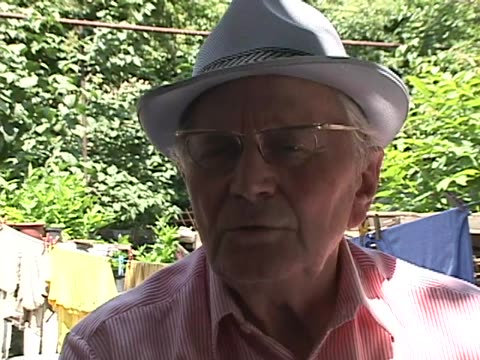
One conversation with Solomon Hershkovich; Eugen Kraus, continuing over MDV 235, MDV 236, MDV 237, MDV 238, MDV 239.
Grunfeld tells a joke.
Grunfeld tells a joke that his grandfather used to quote, about the best joke, followed by a short exchange with the interviewers over a word for something a man makes for himself.
The formal interview with Kraus begins. He provides personal information.
The formal interview begins. Kerler and Lemster settle the date of the recording and the microphone, and Kraus gives his name. The interviewers ask the name of the street.
mostly settling the date and name rather than detailed personal information
Kraus provides personal information and talks about his family. He studied at the Cîmpia Turzii yeshiva in 1939/40. His father was also born in Zorein and worked in agriculture. He owned land and horses. Kraus' mother was born in the nearby village Feldioara and worked as a seamstress. He grew up with four sisters and two brothers.
Kraus gives his birth in October 1923 in Zorein, a village some sixty kilometres from Bistrița (?), and says he studied in Cîmpia Turzii in 1939/40. His father Zelik was also born in Zorein and was deported; he worked the land and kept horses. His mother Golda, a seamstress, was born in nearby Feldioara. He names his grandfathers and siblings: three brothers and four sisters, with one brother killed in a labor battalion. He says that Yiddish was spoken at home and that the village had a minyan.
adds the grandfathers, the siblings' names and the home language
Kraus speaks about prewar Jewish life in Zorein and Cîmpia Turzii. He then addresses his childhood memories. He attended a religious school (cheder). Kraus completed an apprenticeship between the age of 14 and 18 in Cîmpia Turzii.
Kraus compares prewar Jewish life in Zorein and Cîmpia Turzii, the latter with a yeshiva, a rabbi and many Jewish families. He says his maternal grandfather is buried in Zorein, where the grave is now only marked off. He describes cheder in Zorein with a melamed and a shoykhet, and the education of girls. From age 14 to 18 he learned a trade as an apprentice in Cîmpia Turzii.
Kraus talks about prewar Sabbath celebrations, including food customs. He recalls how women read the Yiddish Bible for women (tsene-rene).
Kraus describes prewar Sabbath customs: his mother's candle-lighting, the cholent carried to the baker's oven, challah, and the father's havdalah. He says that women read the tsene-rene and psalms, which he did not read himself. He compares this with the decline of such practice today.
Kraus speaks about contemporary religious services. He then describes how his mother koshered meat and speaks about food customs.
Kraus mentions that he reads from the Torah at services today. In answer to Lemster he describes how his mother koshered meat after the village shoykhet slaughtered it, salting it on a board. He briefly mentions cholent.
adds how his mother koshered meat
Kraus discusses holiday celebrations, including Purim. Kraus shares that he blows the shofar during contemporary services.
Asked about holidays, Kraus says he blows the shofar at services today. He recalls Purim in the village as eating and drinking, masking, and a man who made an amusing rabbi's sermon, and a Purim song with a request for money. He then says he spent the war in Ukraine and Transnistria.
Kraus speaks about his work. He worked in the plastic processing industry for thirty years. He then talks about his yeshiva education.
Kraus says that he worked for thirty years in plastics processing, and retired as a technician. Questions about his yeshiva schooling follow: he was not a yeshiva student but learned a trade near the yeshiva in Cîmpia Turzii, and had been to cheder in Zorein until about age fourteen. The segment ends with a short exchange about the name Blackman.
Kraus talks about Passover celebrations, including food customs and matzo baking, before the war. He then explains the recipe for "ibergetsoygene matsos" (coated matzo). He also recalls his family's "shabbos goy."
Kraus describes prewar Passover: matzo baked at home from flour milled on stones, soup, meat, kneidlach (?), potato dishes and "ibergetsoygene matsos" coated with eggs and goose fat. He recalls his mother force-feeding geese for the fat, and a Christian who lit the fire for the family on Sabbath, whom he says was called a shabes goy (?) by the Jews in the village. Kerler also asks about turkey and a food term.
Kraus speaks about food customs for Purim, before he recites the morning prayer "moyde ani." Kraus discusses prewar Jewish life in the surrounding towns.
Kraus names meat eaten at Purim, then recites the morning prayer modeh ani learned as a boy. Kerler asks about yeshivas in the surrounding area, and Kraus names Satu Mare and Sighet and Maramureș with many Jews, and says he heard of a Vizhnitser rebbe but never met him. His family did not travel to rebbes.
Kraus speaks about his life during the war. He was sent to do forced labor in various places, including Tighina, Chernivtsi, Orhei, Bălți, Balta and Tiraspol. Kraus returned to Cluj-Napoca in 1945. He then speaks about his family's fate during the war. His siblings and parents were deported to Auschwitz.
Kraus recounts the war years: forced labor in Transnistria and Ukraine in places including Tiraspol, Chernivtsi, Bălți, Bukovina and Tighina, and the end of the war in Bălți (?). He returned alone to Cluj in 1945 after his parents, brothers and sisters had been deported. Kerler then asks whether elderly Yiddish-speaking Jewish women live in the city, and Kraus says an elderly woman from Satu Mare lives there but does not speak Yiddish, since in Transylvania people spoke Hungarian and German.
adds the question about Yiddish-speaking elderly women in Cluj
Kraus answers questions about cultural terminology. He then addresses the custom "shlogn kapures" on Yom Kippur.
Answering Lemster's and Kerler's questions about terminology, Kraus says he knows the word golem, and describes the Yom Kippur custom of shlogn kapores, with a rooster for men and a hen for women. He speaks about Yiddish texts and letters, the term "a gut ort" for a cemetery, and the word for the cemetery used by the community. He says that Romanian and Hungarian are spoken in the community today.
Kraus addresses prewar Yiddish culture in Bukarest. He then talks about prewar Jewish life in Cluj-Napoca, including synagogues. He also addresses prewar Hasidism.
Kraus says that Yiddish theater in Bucharest is rare today, and mentions a rabbi from France who visited. He says that before the war there were about seventeen thousand Jews in Cluj, with a number of synagogues and associations, and that Christians there spoke Yiddish. He says he first saw Hasidim at the yeshiva in Cîmpia Turzii. Kerler and Kraus then discuss the word shofer/sofer (the scribe).
Kraus talks about contemporary religious services. He then talks about his work as a the head of the community for twenty years.
Kraus speaks about the Jewish community in Cluj today, where non-Jews come to the services, and about the shrinking minyan. He served on the community board for twenty years and organized the storehouse, Sabbath meals and prayers. He explains that many Jewish men married Christian women after the war.
Kraus talks about postwar Jewish life, as well as his life after the war. Kraus then speaks about his wedding in 1955. He raised two daughters.
Kraus describes the postwar years: most young people left for kibbutz or Israel, he spent a year in a kibbutz, and he stayed in Romania. His sister lives in Israel. He married in 1955 and has two daughters, an engineer and a doctor. He says his wife speaks Yiddish only weakly. He then discusses what is Yiddish and what is German, calling Yiddish a jargon, and Hebrew.
adds the discussion of what counts as Yiddish
Kraus addresses Yiddish dialects. He then talks about food customs, including onions with egg. He then answers dialectological questions from the AHEYM Yiddish linguistic questionnaire.
Kraus answers questions about Yiddish dialects: he says Yiddish in Maramureș, Bukovina and Iași is much like his own. Questionnaire items follow on food terms (gefilte fish, onion with egg, oysters (?), vinegar meat), the words for the hand, apple, water, milk and money, and for the dreidel; Grunfeld disputes whether the word "tenderl" is from Maramureș.
adds food terms and the dialect discussion