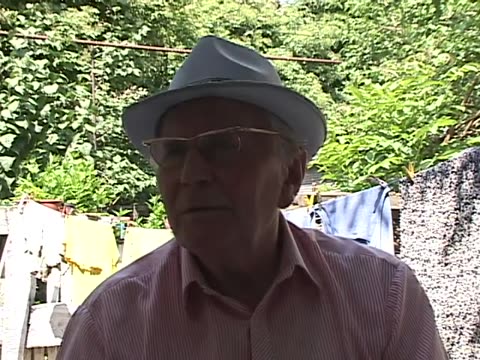
Answers questions from the dialectological questionnaire on the word for the spinning top (tenderl, drenderl, dreidel, dreiderl) and on the nut game played at Sukkot. Kerler then asks about a comic named Zaldi/Zeldik (?) and the word for 'green'. This leads to a discussion of colour words, red and fair hair, and the surname Grunfeld.
Includes a discussion of a comic named Zaldi/Zeldik (?), colour words and the name Grunfeld.
Kraus is asked about Yiddish songs such as 'Papirene kinder'. He says he heard such songs in Cluj in the 1940s after returning from deportation, at the Tarbut school, and forgot them within a year or two. He says he does not like singing or dancing and recalls no Hungarian or Romanian songs. Lemster then asks about weddings: there was no chuppah at his own wedding, which was modern, though a chuppah is arranged today through the community.
Kraus says he recalls no songs, and gives his own modern wedding without a chuppah; the catalogue's 'contemporary weddings' is only partly supported.
Long dialectological questionnaire session in which Lemster, often prompting with Romanian words, and Kerler ask for Yiddish equivalents. Items include greetings and thanks, small and belly, house and room words, window glass, floor, attic and beam, building and wall, ear and deaf, earlier and later, quick, sick and weak, to run away, pious, reliable, cross and convert, bridge, potatoes, shop and clothes. They also ask for prepositions ('in' or 'on' the street) and for translation sentences such as 'he said to him/her', and compare usage in Maramureș (?) and Moldova.
The second man sings a Hungarian-language song, then a Hasidic song attributed to the Kaliver rebbe. He says his grandfather used to sing it. He tells how the rebbe is said to have heard the melody from a shepherd child and bought it from him. Kerler praises the singing and begins to thank the interviewees.
The speaker is the second man, not Kraus; a Hungarian song precedes it, and he tells the story of how the rebbe acquired the melody.
Kerler and Lemster thank the two men for sharing their Yiddish, and the men say how much they value hearing it. Lemster then asks for sayings; they give drinking toasts and wishes for the sick, including one about a cloudburst. They mention Bessarabian Jews whom the second man knew from the army or work, and he compares words such as pocket (kesene and tash). A woman in the town who also knows Yiddish is mentioned, and the second man begins to recall a Havdalah song learned from Bessarabians.
The catalogue's 'proverbs' include toasts and wishes, with talk of Bessarabian Jews and a woman who speaks Yiddish.
Grunfeld and Kraus sing Yiddish songs for Havdalah, they learned from Bessarabian Jews. They also address contemporary Jewish life. Grunfeld has relatives in Israel.
The second man performs or describes Havdalah songs learned from Bessarabian/Moldovan Jews, with Kraus adding lines. They say they have spoken little Yiddish in recent years, since synagogue announcements and community talk are in Romanian or Hungarian and few know Yiddish. The second man mentions visiting Israel every few years, where he has relatives. Lemster closes by asking about Jewish weddings.
Includes the decline of spoken Yiddish in the community, with Romanian and Hungarian used in the synagogue.
Talk of a traditional Jewish wedding held in the town a few years earlier, involving a woman with ties to America and a required chuppah. This is followed by an exchange about the word for pouring (anshitn) a little wine and an offer of food. Kerler and the men then discuss a woman from Satu Mare (Satmar), about eighty, who speaks good Yiddish but not English, and the second man gives his business address and telephone. The details of the wedding story are unclear.
Adds a woman from Satmar, about eighty, who speaks Yiddish, and an exchange of contact details.
The team chats with Kraus and Grunfeld informally and then the camera collects town footage, including the Jewish Studies department of the university. The team is headed to the next interview with Freundlich and informally chats with Grunfeld.
Informal chat among the team and the two men, with much overlap and some Russian. It touches on the aims of the project and the interviewers' own Yiddish. The second man mentions a son who visited from Israel and found Cluj a cultured city, and there is mention of the central post office. Lemster says they would like to speak with a woman, since they have met only men. Large parts are garbled or looped, and the camera's town footage is not visible in the transcript.
The transcript shows only conversation, with a visiting son from Israel; the footage of the Jewish Studies department is not visible.
The team arrives at Freundlich's apartment. Kerler introduces himself as Berl and Lemster as Moshe, saying they have come to do an interview in Yiddish. Greetings are exchanged and the photographer is introduced. They discuss how to enter the apartment and the practice of holding weddings there.
Freundlich briefly says that quiet chuppahs were held: people came to a religious family, took a tallit and made the chuppah. Lemster comments on the wedding connection and offers help, and she thanks him.
The Soviet-period setting named in the catalogue is not clearly stated in the transcript.