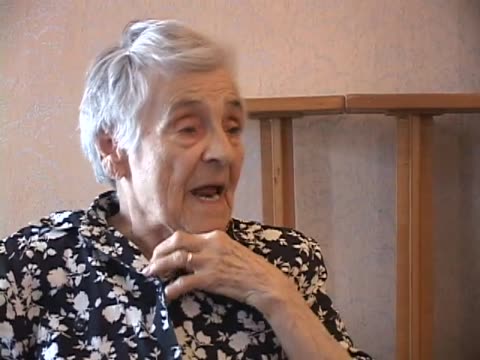
Freundlich addresses linguistic questions and then talks about her family. Her father owned a store in Satu Mare. Freundlich also recalls the moment her grandfather passed away. Freundlich maintains that her grandfathers gave her a Torah when she was a child.
Opens with a short exchange on Hebrew versus the holy tongue and the Judaic studies department. Freundlich gives her Yiddish name and talks about her father's family: her father was a merchant with a shop in Satu Mare and had studied in Pressburg (Bratislava) with his brothers. She recalls in detail her grandfather's death on a Friday in Hanukkah (a year in the 1920s is heard) and his funeral. She mentions the rabbinic Weisz/Welz family connections and her grandfathers donating a Torah scroll.
adds her Yiddish name, the rabbinic Welz family and the grandfathers' Torah donation
Freundlich describes her father's religious life in Satu Mare: the seats he held in the Hasidic and other prayer houses, the garden he donated for the Bixad rebbe's beis midrash, and his daily attendance at prayer and study. She talks about the Talmud volumes in leather bindings in the family library, and about the dowry gifts he gave his four daughters. Kerler asks about who studied with whom, and the passage ends with a Hungarian aside.
Freundlich talks about a recently built synagogue in a Hungarian town, reported on television and attended by the chief rabbi of Hungary, and about a speech by the mayor. The passage is partly garbled and includes Hungarian side remarks on the synagogue's purpose, and Kerler comments on the interviewee's Yiddish.
specifies that the passage concerns a new synagogue built in a Hungarian town
Asked what she remembers of childhood in Satu Mare, Freundlich describes a strictly observant home with honest Sabbath keeping and simple parents. She tells of her parents' and siblings' deportation, a married sister deported with her husband and three children, and her youngest sister now seriously ill in a hospital in the United States (Florida/New York).
Freundlich explains that her father did not follow a certain Hasidic rebbe (R. Yoyle, the Satmar rebbe) but went to the Bixad rebbe, and why he disapproved of the other's customs. She recounts a story of Emperor Charles passing through Satu Mare and the religions coming to bless him, with her father's comments.
adds the story of the emperor's visit and the father's reasons for following the Bixad rebbe
Freundlich lists Sabbath food at home, including fish, soup, meat and plum compote, and discusses the word for plums. She speaks of her father's custom of bringing a poor guest home for the Sabbath and of the Bixad rebbe's austere eating. There are Hungarian side exchanges about acquaintances in Cluj.
Freundlich mentions a rabbi (Schonfeld) who left Cluj in 1958 and how her own family applied to emigrate and was harassed. She talks about her children: a son and a daughter in Canada and Israel, a grandson, and a daughter who is a piano teacher and a leader of the Jewish community. She speaks of her husband's grave, a memorial in Satu Mare for her parents and sister, and her father's saying on keeping a Jewish name.
adds her children and grandson, a memorial in Satu Mare and the Canada emigration
Kerler asks whether gefilte fish was eaten on Sabbath. Freundlich answers that she now makes fish in aspic, shows a photograph from her grandson's bar mitzvah and discusses the name for the dish in different languages.
Freundlich describes the seder at home before the war, which lasted until morning, with counting of the omer the next night, and the Passover foods. Kerler asks about the Yiddish word for 'to try' (prombirn). The rest of the passage is Hungarian talk about photographs and her grandchildren's musical careers, with Kerler asking to copy them on camera.
adds the Hungarian talk about photographs and the grandchildren's music
Freundlich talks about her lessons with a female Yiddish teacher, as well as her school education. She also mentions her sister's letter press (Klein's printing press), printing Hebrew letters, black letters and the Latin alphabet.
Freundlich says a governess taught the daughters at home, while the sons went to cheder, and that she did not read Yiddish books but read Bashevis and Holocaust literature in Hungarian. She learned German at school and mentions her sister Hinde's husband Klein, who ran a bookshop and printing press in Kisvárda (?) that printed Hebrew, Gothic and Latin letters.
Freundlich says that no Jews are left in Kisvárda and the surviving Hungarian Jews are in Budapest. Kerler asks about the meaning of the Hungarian expression she uses. She then talks about the chief rabbi of Jerusalem and the closing of women's sections, and about a Sabbath meeting at which she was asked to attend.
Freundlich speaks about her family life before the war. Her family conversed in Hungarian during the week, but, Freundlich maintains, on Sabbath they only spoke Yiddish. She also addresses Purim celebrations and costumes.
Freundlich explains that at home the family spoke Hungarian on weekdays but only Yiddish on Sabbath, and that everyone knew Yiddish, the mother tongue. She describes her father's Purim meal and the Purim play, with youths dressed as women and a Purim rabbi, the charity given, and says she has a Hungarian translation of the megillah.