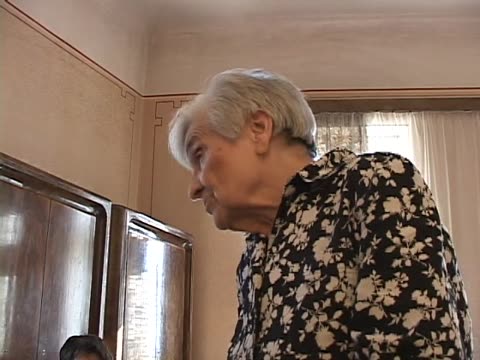
Freundlich and Kerler look at a Megillah. It is from Satu Mare and was read at home by her father; the details are only partly clear. A long, garbled stretch in Hungarian and Yiddish follows about a bishop who was driven out of the town for condemning killing. Kerler then asks about books printed at the local printing house.
The passage also includes a story about a bishop driven out for speaking against killing.
Freundlich talks about her sister's printing house in Satu Mare. It printed the town newspaper, toys, books, prayer books and other items, in Hungarian, Latin and Hebrew scripts. She mentions a book by her brother-in-law and a Hungarian children's tale, and then her son's invitation to the Metropolitan (Opera) in New York.
Freundlich mentions her son as a singer who performed at the Metropolitan, and a radio interview with her. Kerler asks about Jewish weddings. She talks about her son's circumcision in 1956, which was held at home with a rabbi because few Jews were left. She also mentions his bar mitzvah meal, to which the non-Jewish officials did not come.
The passage also covers her son's bar mitzvah meal.
Freundlich recalls prewar Jewish weddings with the 'mitzvah dance' and the hired announcer. She then talks about relatives in Várdan (?), about Jews left in Satu Mare and Cluj and the community's problems. She goes on at length, partly in Hungarian, about her husband's family (Weinstock) and their business, an uncle in Nyíregyháza who was head of the Judenrat, and a minister who helped them. Kerler also asks about a humorist who was paid to amuse guests at weddings.
The passage also includes a long Hungarian account of the husband's family business and its wartime fate.
Freundlich talks about life today. She then speaks about her babysitter in Satu Mare, who taught her Yiddish songs. She also addresses a contemporary wedding.
Freundlich speaks about life today and Hungarian radio, saying she can no longer sing. She then recalls her nursemaid from Maramureș, a Ruthenian-speaking woman who taught her Yiddish songs and refused to wear shoes on Shabbat. She also talks about wedding customs and a choir led by her daughter, and says that nowadays only Purim songs are sung.
The passage also includes the explanation of the word for a nursemaid and the choir.
Freundlich mentions songs sung at Passover and a haggadah she gave to her grandchildren. The talk turns to people from the community who are still alive, and to the lack of a minyan in Satu Mare. She goes on in Hungarian about the Jewish population of the region, the ghettos and rabbis driven out of Székely towns, and a landowner's fate. The latter part is in a long Hungarian monologue about the Weinstock family dryer and a minister.
The catalogue's 'contemporary Jewish life' is only partly visible; the transcript shows mostly Hungarian monologue on the region's Jews and her husband's family.
Kerler asks about the 'brogez' dance and other dances, and Freundlich explains that it is a comic dance done on happy occasions and distinguishes it from the mitzvah dance. She speaks about her grandfathers: one was a regular visitor to the Belz rabbi, and the other gave a Torah scroll. She also describes her daughter's religious teaching of women in English and Hebrew, and a visit to Jerusalem.
The passage also includes her daughter's teaching and a Jerusalem visit.
Freundlich answers Kerler's terminology questions on what 'a good Jew' means, and on words for a non-Jewish cemetery, a church and Christmas. She says her maternal grandfather went to the Belz rabbi, her father was observant without Hasidic dress, and he ran a grocery and ironware shop that was closed on Sabbath and holidays. At the end she talks about Jewish studies at the university.
The passage also has her father's occupation and a note on the university.
Freundlich talks about contemporary Jewish Studies and her education. Freundlich attended a Hungarian school. She then recalls book sales during her childhood.
Freundlich talks about Jewish studies students at the university today and the languages taught there. She says she went to a Hungarian school and learned Romanian later, when her children began school, and that Hungarian is her better language. She recalls the Hungarian book days in July and the bookshop of her sister, with authors signing autographs.
Freundlich answers questions about the difference between a rav and a rebbe, and says that only the rav was recognised and paid by the state. She tells how a rabbi shaved on a day when it was forbidden because he was asked about it. She also tells a story about a man who built two prayer houses, and answers questions on Ashkenazi prayer and the women's prayers, which were sung beautifully.
The passage also has two religious anecdotes and the Ashkenazi/Sephardi question.
Freundlich answers Kerler's question about a Dybbuk play performed recently in Cluj. Kerler asks the meaning of 'golem' and of 'baal shem', and she answers briefly. She mentions a professor, Abraham Braham (?), who wrote a book on the Holocaust in Hungarian and came to Cluj.
The passage also includes a Hungarian-language book on the Holocaust by a visiting professor.
Kerler asks about women's prayer. Freundlich explains that women read the techines at home and the tsenerene in Yiddish, and that the techines were in Hebrew with translation. She says that women sat in a women's section at the synagogue and listened to the cantor. She then talks, in Hungarian, about a CD of her radio interview in Hungarian.
Freundlich tells jokes: two Jews and a baker and a tailor, and a competition among forest animals. Kerler asks the Yiddish word for a monument. She says she was at a memorial and a Jewish monument in Dej (?) and visited the site of a mass killing of Jews, and a pilgrimage with a Swiss visitor. The place is partly unclear in the transcript.
The catalogue's memorialization topic appears, but the place name is unclear in the transcript.