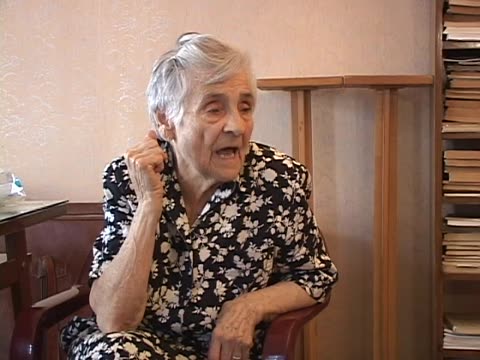
Freundlich visited Auschwitz in 1969, where she was imprisoned during World War II. She then sings a Yiddish song about departing for a long journey, before returning to her Auschwitz visit experience.
Freundlich says she visited Auschwitz in 1969. At Kerler's request a Yiddish travel song about taking food for a journey is sung, apparently by another woman. Freundlich then speaks, partly in Hungarian, about Satmar, a mass killing and burial in a pit, and a history professor in Jerusalem originally from Satmar whose father was a shochet.
The song is sung by another voice, and Freundlich also talks about Satmar and a professor in Jerusalem.
Freundlich describes a Sabbath table song sung at the rebbe's tish, which her father attended, and a woman's voice sings it. Kerler asks when the earlier travel song was known; Freundlich recalls a priest from Leipzig who taught Jewish history and a conversation about the mezuzah. The passage ends with Hungarian talk about a klezmer band in Budapest.
Includes a story about a priest teaching Jewish history and the mezuzah, and talk of klezmer.
Kerler asks about terms such as converts to and from Judaism, and Freundlich answers about whether Satmar had converts and about apostates. Much of the second half is Hungarian talk among the others.
Freundlich and the others discuss Jewish life today in Bistrița and Cluj: whether anyone is left in Bistrița, a planned trip there, and contacts with community members. Much of the passage is Hungarian talk about street names, the synagogue and community office in Cluj, and arrangements for the visitors.
Freundlich answers dialectological questions from the AHEYM Yiddish linguistic questionnaire. She then addresses folk and healing customs. Freundlich explains how to avert the evil eye.
Kerler elicits how to say 'pour a glass of wine', after which he asks about older women's remedy against the evil eye. Freundlich explains the cure with bread crumbs or coals counted into a glass of water, with salt and a formula, and the water poured at the door.
Freundlich and others discuss the few remaining Jews and their lack of interest in Yiddish or Jewish life in Cluj, Bistrița, Târgu Mureș, Timișoara, Oradea, Satu Mare and Sighet, with much of it in Hungarian. Kerler asks about community presidents and places to visit. There is also a story of a wedding and a Passover seder that needed thirty people, a Yiddish term asked by Kerler, and a story about declaring Yiddish as mother tongue under Ceaușescu.
Includes talk of other towns, a wedding and the seder, and Ceaușescu.
Freundlich recalls the census question about mother tongue: nobody answered Yiddish, though some did later, and she could not deny being Jewish. Kerler then asks about a name, Avraham Yankl, which Freundlich says was a Wallachian nobleman. The passage ends with Hungarian talk about visitors from Indiana University.
Concerns the mother-tongue question and the name Avraham Yankl, not the Soviet period.
Freundlich answers questions about cultural terminology and speaks about life today. She also addresses Yiddish-speaking communities in the region before the war.
Kerler asks about yeshiva terms such as hoyz bokher and khazer bokher, and Freundlich explains them. Hungarian discussion about community leaders and visits follows. Freundlich states that in Timișoara, Oradea, Cluj and Bistrița people did not speak Yiddish, unlike Satmar, and Kerler discusses sending a recording by post and planning a further session.
Includes talk of the Yiddish-speaking regions and postal arrangements.
Freundlich says she was a soloist and that her husband was a precentor. A woman sings a Yiddish folk song about longing for the mother, and Freundlich then tells of a Hungarian-language theatrical production of Shir HaShirim that she criticised.
Freundlich talks about Shir HaShirim as a folk song, which she says was sung in Yiddish and Hungarian and which she recited in Hungarian. Kerler asks what she remembers of it in Yiddish, and she also recalls a Hungarian song about the messiah's coming. The passage ends in Hungarian talk about a hospital.