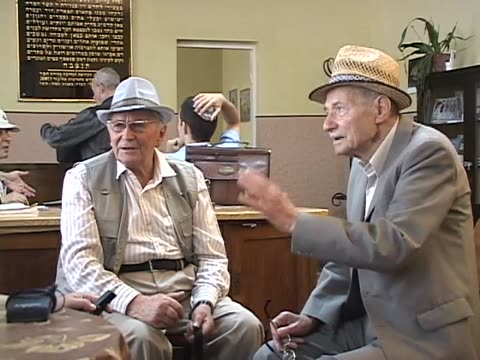
Conversation about how many Jews in Cluj and Dej still speak Yiddish, and plans for the team's drive to Dej, Bistrița and Gura Vadului(?). A bar mitzvah attended by a visitor from America whose grandfather came from Dej is mentioned, with the synagogue there and the former Jewish population of Dej.
mostly planning the team's route and Yiddish in Dej, with little on the bar mitzvah itself
Talk about Luduș and the Jewish villages around it, and which languages were spoken at home. Some of Kerler's questions are about terms: the Yiddish name of Luduș, a word for cemetery and the names for non-Jews. The speakers explain that Hungarians and Romanians were distinguished in speech.
terminology and language questions, and the Jewish villages near Luduș
Describes Sabbath meals before the war: cholent, kugel and Friday fish, including carp from the river by his birthplace and sweet gefilte fish. Kerler also asks about the tashlikh custom on Rosh Hashanah.
Talks about his family and the Jewish families in the village, with a mother of the Levite line. He explains a custom of a firstborn washing the hands in the absence of a Levite and mentions counting families by tallitot. Kerler also asks about stories told at weddings, involving a wedding jester.
Recalls his sister's wedding in 1946, two years after the war, attended by guests from Cluj and Maramureș. Kerler asks about the wedding jester and a word for him.
Miller joins; Kerler introduces himself and explains the aim of the fieldwork. Miller describes a planned visit to Bistrița to mark the memorial of Moyshe Grin, a former prayer leader in Cluj, and says Bistrița had a large Jewish community.
Kerler's explanation of the project and the Bistrița memorial plan
The formal interview with Miller begins. He provides personal information and discusses prewar Jewish life, including community structure, of Cluj-Napoca. According to Miller, 16,000 Jews lived in town.
The formal interview with Miller begins; he gives his birth year as 1922(?) and says he was born in Cluj. He describes Cluj as a large Jewish cultural centre with about sixteen thousand Jews and six large synagogues, with Orthodox, Reform and Sephardic(?) congregations and hasidim. He mentions languages spoken, Hungarian, Romanian and Yiddish, and Jews who came from Maramureș.
Miller speaks about his father, who came from Czechoslovakia (Uzhhorod) to Cluj, and his grandfather. He recalls weddings with a poor fiddler who played Yiddish songs, and Purim with a purim play and charity collections.
Miller speaks about his education at a religious school (cheder). He then talks about the difficulty to keep Jewishness today and contemporary Jewish life, as well as Jewish Studies.
Miller speaks about studying in cheder and about how hard it is to keep Jewishness alive today, with mixed families and few young people. He describes community efforts such as a talmud torah course and a Jewish studies institute at the Cluj university, formerly a Jewish school, whose students are mostly not Jewish.
Kerler asks about the father's tefillin, and Miller recites or sings parts of the Sabbath songs, including 'Shalom Aleichem'. He recalls few Yiddish songs.
Kerler's question about tefillin and Miller's recollection of few Yiddish songs
Footage of the Bistrița cemetery with a memorial service for Moyshe Grin, with prayers in Hebrew and Romanian by two men, apparently including Miller, and El Male Rachamim and Kaddish. Interspersed are introductions, remarks in Russian and Hungarian and brief comments on tradition.