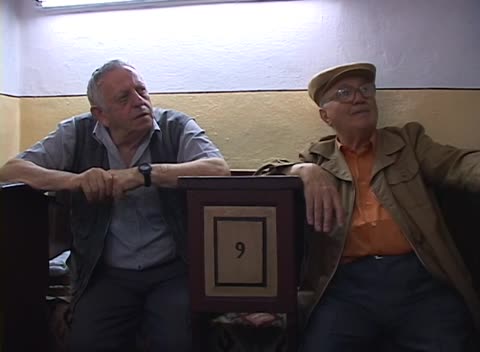
Informal conversation with two local men, partly in Romanian, about money, currency terms and how they are said in Yiddish. They also discuss pensions, hospital care and bribes for doctors in Romania compared with Israel, and the Joint's support for the elderly. The talk turns to sanatoria and spas (kurort), and then to arranging to meet Grimberg.
Besides the Joint and dialectology, the passage covers pensions, hospital bribery and sanatoria.
The camera collects town footage of Dorohoi while headed to the next interview with Grimberg. The team greets Grimberg in her apartment and sets up the interview with her.
The team arrives at Grimberg's apartment and greets her and her family. Kerler explains that they will do a short interview about Jewish life in Dorohoi. Grimberg says she is unwell after two years in hospital but will tell what she remembers.
The transcript covers only the greeting and setup in the apartment, with little of the town footage.
Grimberg and the interviewers exchange a few words in Yiddish and Romanian while the interview is set up. The content is thin and the transcript is unclear.
The transcript shows little personal information, mainly Romanian words and setup talk.
Grimberg provides personal information and talks about her education. She graduated from a pedagogical institute in Dorohoi and worked as teacher. Grimberg attended a Romanian Jewish school for two years before the war.
Grimberg says she was born, studied and worked in Dorohoi, and she trained as a teacher at a Romanian pedagogical school. She attended the Jewish school for the first two classes before being sent to Transnistria; no Jewish school existed after her return. She remembers a little Hebrew and has two sisters in Israel, with whom she speaks by phone.
Grimberg talks about her family. She has two sisters who live in Israel. Her father was a worker and born in Dorohoi. Grimberg mentions that her grandfather built a synagogue and arranged to bring a Sefer Torah from Chernivtsi.
Grimberg speaks about her family. Her father Iosl worked as a carpenter or workman and died in 1970 (?). Her mother Sara did not work, and there were three daughters. She names her grandparents: her maternal grandfather Elokim was a ritual slaughterer near Răpăciune (?). Her paternal grandmother Kune Leah and grandfather Avrom built a synagogue, and the grandmother went to Chernivtsi to buy a Torah scroll. Two of her father's brothers died in Transnistria.
The transcript adds the maternal grandfather as a ritual slaughterer and the family's names, as well as the two uncles who died in Transnistria.
Grimberg talks about her and her family's life during World War II. They were imprisoned in Mohyliv-Podilskyy ghetto. Her father was forced laborer in the Romanian Worker Army.
Grimberg recalls being deported to Transnistria as a child of about eight with her mother and sisters, while her father stayed in Romania in the labor service. She remembers the Mohyliv ghetto, her mother's severe illness, the family that traveled with them, and children going out to find food. She starts to talk about songs she learned there.
Grimberg describes hardship in Transnistria, such as sleeping in a pit and drinking salted tea. She says she does not remember a particular Yiddish song. Kerler asks about her role as a prayer-reader in the synagogue; she says she reads from the chumash and tkhines, and she is asked to show her tkhine. The segment ends with talk in Romanian and Yiddish about transport.
The singing is minimal; the transcript shows she denies remembering a song, and the segment moves to the tkhine and to practical arrangements.
Grimberg shows her Yiddish tkhine book, which she inherited from her mother, and says it contains prayers for weekdays, Sabbath and Passover. Kerler notes that it looks printed in Przemyśl. She then reads aloud a Sabbath morning prayer. Asked who taught her, she talks about her mother's practice of saying a prayer at the end of the Sabbath.
Gimberg speaks about her mother's observance and family. She raised a son, who lives in Satu Mare. Gimberg states that her son and grandson are circumcised and her daughter-in-law is not Jewish. She then addresses contemporary Jewish life in Satu Mare.
Grimberg speaks about her observance compared with her mother's, and how she keeps Passover and a kosher home as far as her strength allows. Her son lives in Satu Mare, was circumcised, and married a non-Jewish woman; her grandson is also circumcised and wore tefillin. She describes the few Jews of Satu Mare, who speak Hungarian and Romanian, not Yiddish, and her own prayer-reading there.
Grimberg explains that as prayer-reader she says the tkhine for others at memorial prayers, since the others do not know how and only listen. She describes prewar Dorohoi as a Jewish town with some twenty-odd synagogues, a mikveh and a poultry slaughterhouse. Jews outnumbered non-Jews, and many non-Jews spoke some Yiddish.
Gimberg talks about her life after the war. Her family returned in 1943. She speaks more about her role as firzogerin and explains how to kosher meat. Gimberg then addresses more food customs, including baking challah.
Grimberg says the family went to Transnistria in 1941 and returned in 1943, when friends and acquaintances helped them and her father came back. Lemster asks about her role as prayer-reader and consultant, and she gives an example. She describes how meat is kashered by soaking, rinsing and salting, and recalls her mother's Friday baking of challah and cracklings.
The transcript adds the kashering of meat and her mother's Friday baking details.
Gimberg talks about her life today and how she supports the community. She then reads the blessing over the Challah from the Tkhine. She also addresses Sabbath and individual prayers.
Grimberg speaks about how she supports others, in particular Lipovitch (?). Kerler asks about the blessing over the challah, and she reads it from her tkhine and explains it. She describes her Sabbath candle-lighting prayers, in which she asks for health for her family and friends and for peace in Israel and the world. She does not say a prayer at the end of the Sabbath.
Gimberg speaks about postwar religious life. She explains how she attended services at her grandfather's synagogue up to the 1960s. She also talks about her work as teacher.
Grimberg talks about postwar synagogues in Dorohoi: two remain now, and before there were three on her street. She attended her grandfather's synagogue until about the 1960s, after which it fell into ruin. She says her mother went elsewhere for a good cantor after her father's death, and her husband prayed at another synagogue. She says she worked as a teacher, including of Russian. They ask about earlier women prayer-readers, whose names she cannot recall.
The transcript adds her husband's trade and the question about earlier women prayer-readers.
Grimberg answers questions about folk beliefs and healing, in particular a remedy against the evil eye that she learned from her mother. It involves three women sitting on a stone and a charm repeated three times, and she describes burning sulfur and sprinkling water. She mentions a prayer said when a mother takes a child to cheder for the first time.
Grimberg answers Kerler's questions about holiday customs, saying she does not recall Hanukkah food but mentions latkes and other Passover dishes of matzo meal and potatoes. She describes her Purim baking today and her mother's custom, and recalls children with masks going from house to house singing greetings. She talks about the Tishah b'Av customs and about visiting graves, and she is asked about postwar Purim celebrations in the 1950s.
The transcript adds Passover dishes and customs at the cemetery.
Gimberg answers questions about cultural terminology. She then addresses prewar cultural life, in particular Yiddish theater. She then mentions the Ştefăneşti rebbe and describes how his father was involved when the rebbe was carried over to Israel. Gimberg also shares anecdotes about her visit to Israel.
Grimberg answers questions about terms such as dybbuk and golem, and connects dybbuk to the play she knew. She recalls Yiddish theater companies visiting Dorohoi from Bucharest and Iași. She describes how her father took part in moving the Ştefăneşti rebbe's remains to Israel and how she brought an item from Israel. She also tells about her visits to Israel and her sisters in Jerusalem.
The transcript adds the terminology questions about dybbuk and golem and theater visits from Bucharest and Iași.
Gimberg talks about her grandfather, a kosher butcher, who was a religious authority in town, according to her. She then recalls her visits of the Ştefăneşti rebbe's grave.
Grimberg says her grandfather, a ritual slaughterer, was consulted in the town as an authority and wise man. She is asked whether her family were Ştefăneşti Hasidim, and she recalls visiting the rebbe's yortsayt and his grave, and throwing in notes (kvitlekh) written in Yiddish with Romanian letters. Kerler asks in which year the remains were taken to Israel.
The transcript adds the notes written in Yiddish with Romanian letters and the question about the year of the remains' transfer.