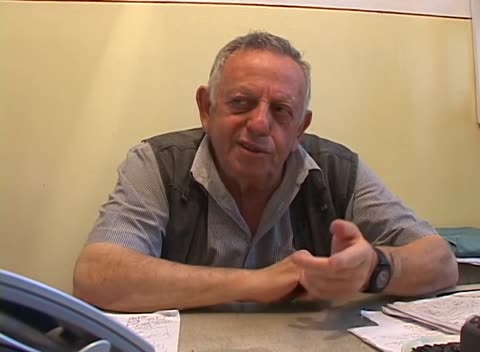
Isidor talks about the contemporary Jewish community of Dorohoi and his activities as the head of the community. Isidor states that he only spoke to his mother in Yiddish.
Isidor talks about the present Jewish community of Dorohoi and his work as its head: a cantor brought in, a Torah scroll bought, a club set up for cards and coffee, and difficulties with some congregants. Asked by Kerler, he says he spoke Romanian with his mother more than Yiddish. He mentions non-Jews in nearby towns who spoke Yiddish from working with Jews, and a few women in Dorohoi who still speak good Yiddish.
adds non-Jews who spoke Yiddish and the few women in Dorohoi who still speak it
Isidor talks about his education. He studied at the Pedagogical Institute in Iaşi, before studying at the University of Bukarest. He addresses Jewish student life in Iaşi. He was a teacher for thirty-seven years.
Isidor talks about his studies: first the pedagogical institute in Iași, then university in Bucharest by correspondence while already working as a teacher. He recalls Jewish student societies and a cultural house in Iași, and a Jewish scholar's manuscripts of sayings and jokes that were never published. He says a teacher's service lasts thirty-seven years, fourteen of them in a village, and that he also led the Pioneers.
adds the unpublished manuscripts of sayings and jokes and his Pioneer leadership
Isidor shares an episode about an encounter between the Kolomyya Rabbi and himself, his mother arranged in the late 1940s. He explains how the rov blessed a coin. He then explains how his school education was affected after the visit.
Isidor tells how, as a boy facing the fourth-class exam, he was taken by his mother to the Kolomyya rabbi, who spoke Yiddish with him, asked about saying kaddish for his father and blessed a coin. He kept the coin for many years. At the exam he did well, reciting poems, and he passed. Kerler asks about the exam and about when the rabbi lived.
adds the exam itself and the rabbi's insistence on speaking Yiddish
Isidor talks about his life during World War II. He was confined to the Mohyliv-Podilskyy and Sharhorod ghettos. His mother worked in a kolkhoz kitchen. He then describes how he learned Yiddish and shares an episode when he was a student at the religious school and the conflict with the rebbe about drinking unkosher water.
Isidor recalls the war years: crowded quarters, the dead carried out each morning in Mohyliv and Sharhorod, and his mother working in a canteen where staff could take nothing home. Asked about Yiddish, he says he learned it over time among Jewish children at school. He tells of a Passover when he and other boys drank water from a barrel, and of the rabbi's penalty for it. He then talks about kashrut, the need for a Jew to be present at milking, and his present household.
adds the kashrut talk, the milking rule and his present household
Isidor talks about his life today and his non-Jewish wife. He then talks about his father, who was a the victim of an antisemitic attack in 1944 in Dorohoi.
Isidor talks briefly about his life today, including his non-Jewish partner, and about meeting someone with a beard. Kerler asks about his father, who, Isidor says, was attacked in November 1944 straight after the war. It was not a pogrom but an attack by robbers.
adds that it was a bandit attack, not a pogrom, in November 1944
Kerler asks Isidor a few dialectological questions, such as how a particular word is said and what a certain thing is called. The answers are mixed with talk about a telephone and arrangements for filming, in which others also speak.
The camera collects town footage, when the team and Isidor are headed to the synagogue. The camera then collects footage of the community, while the team talks to Yisroel. Yisroel was born 1930 in Dorohoi.
The team moves toward the synagogue, with talk about where to sit and where someone is. The camera then records people in the community while a second man talks with the team about Dorohoi, Israel and his own background. Much of the speech is garbled, and the second man's birth year and place are unclear in the transcript.
adds the exchange with a second man about Dorohoi and Israel
The team chats with Isidor and Meir about the community and life today. Isidor explains how he met his non-Jewish wife, who was born in Suceava. Isidor's cousins live in Israel.
In an informal chat Isidor tells at length how he met his non-Jewish wife, a young woman working at a hospital who came to Dorohoi from a village. He describes their meetings, her family, and his teaching her Jewish customs such as keeping milk and meat apart. He also talks about the life of his household, a daughter who now lives in Italy, and his cousins in Israel. Kerler and a second man join in.
adds the story of how Isidor met his non-Jewish wife, and the detail that cousins live in Israel