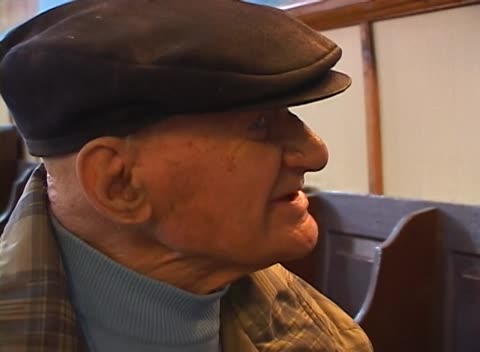
Chajim says his sister is three years younger than he is, nearly blind and living in Botoșani, and that he himself is hard of hearing and half blind but can still walk. He says he still blows the shofar in the synagogue on Yom Kippur. He recites rhymed cheder alphabet lessons and retells a Sholem Aleichem story about the difficulty of being a Jew, including a story about a minyan of nine. Kerler and Lemster ask him to pray.
Retells Sholem Aleichem stories and speaks of his sister in Botoșani.
Chajim chants kaddish and prayers for the dead while others in the room prompt him and call out names of the deceased. The speech is largely unintelligible and mixes with Romanian remarks from other speakers.
The passage is mostly Romanian side talk and indistinct speech; the transcript does not show a synagogue or community collection. Near the end Kerler asks a question, and Chajim mentions a prayer book thrown out in Briceni and a cemetery.
Chajim and Lemster discuss his wartime labor in Briceni, Edineț, Rujniţa (?) and Hotin; Chajim says some 800 Jews were there. Lemster asks how many Jews lived in Hîrlău before the war. Chajim tells of a boy from Moscow whose parents were taken to Auschwitz and whom he befriended. The boy later died in Radauți (?) at about eighty, and the local rabbi wrote to Chajim to say so.
Chajim says he was born in Podu Iloaiei but married in Hîrlău, where he worked with local Jews, and that it was a joyful wedding. He explains a wedding blessing and the "kiddushin" formula, and mentions Moses. Asked what was sung at the wedding, he says he played trumpet in a military band.
Asked about Yiddish songs, Chajim says he remembers only verses he composed himself, about the old prices compared with today and about workers' hardship. He speaks of his age (nearly 100) and good health, and of his father's sayings about what to keep silent. He mentions his late wife and again recites cheder letter lessons.
Chajim performs his own verses and recalls his father's sayings.
Lemster asks what he remembers of songs, including Romanian ones. Chajim says he sang much but has forgotten most, recites a few lines of a song, and talks about a rich employer who paid late. He recalls his father telling him as a boy to go to the synagogue and then make Friday-night kiddush.
Includes a remembered song fragment and an anecdote about an employer.
Chajim describes Friday-night family observance in his childhood, with kiddush and Sabbath dishes such as kugel, and his father's wishes concerning kaddish. He says he cannot recite kiddush any more. He tells Kerler and Lemster, who are from Edineț, how glad he is to talk to someone from there, recalling work in Galați and in Rujniţa, Briceni and a village near Edineț.
Mentions Galați and his forced work around Edineț.
Lemster asks where Chajim worked as a forced laborer. Chajim says he walked about 70 kilometers from Edineț to Bălți. He tells how the Jews of Edineț were shot and buried when Romanian forces entered Bessarabia, and says he visited the cemetery and said kaddish there. Asked about wedding songs, he says he has forgotten them and speaks of his hope to live to a hundred.
Chajim discusses his childhood memories, including education. He also briefly returns to his work as forced laborer and then speaks about his family's observance.
Asked about his childhood, Chajim recalls cheder, work with wagons and hauling wood to Tuzac (?), and says he does not remember his grandparents. He talks about his father taking him to the synagogue on Rosh Hashanah and about prayers he still knows. Kerler asks about customs such as beating Haman during the reading of Esther (Purim) and about the Edineț bath and mikveh. He says he was in Edineț from 1941 and again mentions work in forced labor.
Covers the mikveh and bath in Edineț and Purim customs.
Chajim addresses his life before the war in Podu Iloaiei. He also speaks about his life during World War II, before addressing prewar religious life, including synagogues in Podu Iloaiei.
Lemster and Kerler ask about Podu Iloaiei. Chajim names a rabbi there, Rabbi Benzin (?), and tells how the Russians bombed Iași. He says Podu Iloaiei had five synagogues, including the great synagogue, which was sold, and the tailors' synagogue. No Jews remain there now.
Adds the rabbi of Podu Iloaiei and the number of synagogues.
Chajim talks about having been a foreman in Hîrlău under the Communists, and about problems with payment. He then speaks of a visit to Israel, where he stayed with a Polish Jew and bathed in Bat Yam, and of a brother in Israel. Lemster asks how he met his wife, but he answers about speaking with Jews from Edineț.
The Israel visit is accompanied by an address of his brother.
Chajim speaks about his marriage and family: his wife was born in a year not clear in the transcript, and their daughter is a judge in Iași. She has two engineer sons, one a university lecturer, and neither will marry a non-Jewish woman. He names his son-in-law as Chaim Zeigel (?).
Adds his daughter and grandsons; the year of the wedding is unclear in the transcript.
Chajim talks about prewar Sabbath celebrations, before mentioning friends, who attended his wedding. He then refers to religious life today, including a prayer for Yom Kippur.
Chajim recalls singing Sabbath songs on Friday evening and says he is glad to be nearly a hundred and healthy. He says he held the wedding canopy, that two best men were killed or died, and that he says kaddish for Jews who no longer know it. He sings a hymn from Yom Kippur night and says he still blows the shofar. He says he is preparing for the next world and discusses whether there is one.
Adds a sung hymn and a discussion of belief and the next world.
Chajim tells of playing in the military band in the army and of Passover with German soldiers and Jews, and of being locked up for several nights. He answers questions about Christian terms and sayings, and about a custom, apparently against an evil spirit (?), of placing a stone in water at night. He seems to say he was born in 1906, but this is not clear.
Adds Lemster's questions about sayings and a folk custom with a stone.
Chajim gives his birth in Podu Iloaiei, about October 1906 and his age as nearly 100, and says he remembers everything. His father was Chaim, and he himself is Chaim Itsik. He recalls Sabbath kugel his mother made and a customs-related remark on Purim.
Chajim talks about Purim and its customs, mentioning gifts, and says he spoke with an old Jew in Bat Yam over 100 years old. He tells of his youth, when he played music and liked girls, and says he would not marry a rich girl.
Adds how he decided on a bride, which the catalogue gives only in s0018.
Chajim mentions how he met his wife and states that he picked her over a girl from a wealthy family. He then speaks his life today and describes his home and animals.
Chajim says he chose his wife as a poor girl, not a rich one, and gave wine at the wedding, with a shoykhet slaughtering for the meal. He describes his home today, with a vineyard, apples and a garden, and his wood for heating. He says he leaves enough money to his daughter, and mentions a relative in Germany.
Asked about kosher meat, Chajim says he buys meat slaughtered by a Jewish butcher and never ate from a Christian. His wife observed the same custom. He speaks about the mezuzah on every door and about blessing the Friday-night candles. He tells of an heirloom Hanukkah lamp from his father's father that an American wished to buy, and of going on errands before Rosh Hashanah.