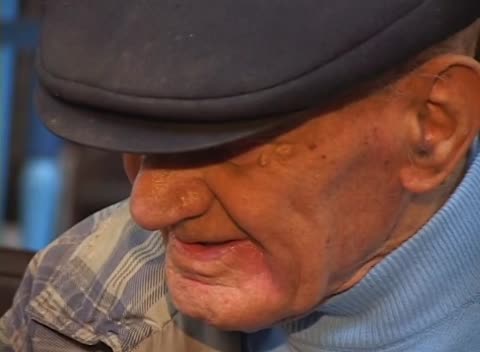
Chajim begins with a remark about a Jewish woman married to a non-Jew, then asks whether a car has come for him. Lemster says it has. Chajim mentions Jews he knew who went to America, and an American Jew who used to visit every year but now stays away. He mentions a Hanukkah lamp said to be two hundred years old.
Chajim talks about his great age and says he is nearly a hundred. His daughter wanted to take him to Iași, and he recalls saying grace after meals at his father's prompting. Kerler asks about his surname and then asks him to tell about the Passover seder.
adds his age, grace after meals and the surname question
Chajim recalls the seder at home before the war, where his father presided and he asked the four questions, and mentions wine and bitter herbs. He tells how he shlogn kapores. Kerler and Lemster then ask whether he knows the words gramer and badkhn at weddings, and he answers uncertainly.
Chajim says that the people around him were mostly Jews but also Christians. He says he can read and speak Yiddish and used to sing Yiddish songs. He reflects on how hard it is to be a Jew, naming Kiddush, the Shema, candle-blessing and Hanukkah. The wedding is hardly addressed. Kerler then asks about life under the Communists.
adds Yiddish reading and singing and the reflection on being a Jew
Chajim speaks about his life under Soviet rule and his family. His father moved to Israel. Chajim then remembers his mother's cooking. He grew up with six brothers and two sisters. His father was a tailor 13:27. Chajim also worked as tailor and was president of a cooperative.
Chajim explains that he was a Communist because they gave him bread, and speaks of escaping from a camp. His father died in Israel, and he mentions sitting shiva for his wife. He names his mother, remembers her cooking (kugel, fish, gefilte fish on Sabbath eve) and her candle-lighting. He had six brothers and two sisters, and all the brothers are dead. His father and grandfather were tailors. He was also a tailor and president of a cooperative. Lemster asks about Yiddish theatre, which he does not remember.
adds his mother's name, the theatre question and the family name Chajim
Chajim speaks about life today and recalls his mother's cooking. Chajim worked in several towns as forced laborer during the war, including Edineț, Brînzeni,Rujniţa, Bălţi and Halahora de Sus.
Chajim says he used to sing while sewing. He recalls that his mother did not sew but cooked, including Passover food. He says he still gets matzo each year, sent by the Bucharest rabbi, and mentions his small pension. He recalls working during the war in several Bessarabian towns and a cemetery, and speaks of Jews from Edineț, whom he can still talk with.
adds the pension, Passover matzo and the Bucharest rabbi
The talk turns to Chajim's Hanukkah lamp. Lemster and Kerler examine it and discuss where oil is put in. Chajim explains how Hanukkah candles were set in it and lit. Lemster mentions thirty dollars already given, and the visitors seem to want to take it.
Chajim says he refuses to sell the Hanukkah lamp to an American offering money, because he used it in Edineț. He describes his well-furnished house with two rooms. He repeats that he is a man of over a hundred, and Kerler thanks him at the end.