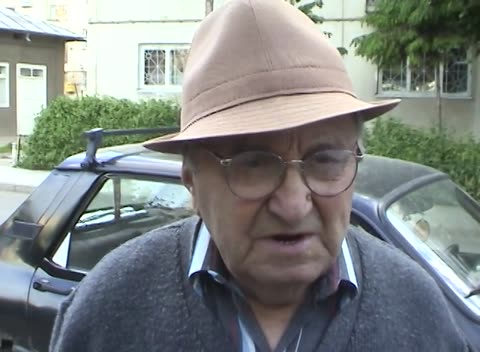
Greetings and chat at the Hîrlău synagogue; Lemster and Kerler ask the man's age, name (Abramovich) and whether he was born in the town. Abramovich says the synagogue is nearly two hundred years old, that there were once six or seven synagogues and this was the great one, and that it was a Hasidic town with several rabbis and shochtim. Kerler asks how many Jews lived there before the war.
Includes the synagogue's age and the number of synagogues and shochtim; the catalogue's 'footage' is only the short opening.
Abramovich briefly talks about his life during World War II. He was confined to a ghetto in the Transnistria region. He then speaks about prewar Jewish life in Hîrlău, as well as his family. Abramovich's father and mother were both born in Hîrlău.
Abramovich gives the prewar Jewish population of Hîrlău as over a thousand families (about three thousand Jews), and says he spent three years in a camp or ghetto in Transnistria while the town's Jews were deported. Kerler then asks about his childhood: a Jewish town of merchants and craftsmen where making a living was hard. His father was Baruch Abramovich and both parents were born in Hîrlău. A closing remark about a bundle and a coat is unclear.
Gives the population figure and his father's name.
The team and Abramovich enter the synagogue. He briefly recites a prayer and gives a tour of the former Great Synagogue. Abramovich points out the marks of Russian weapons. Abramovich then talks about the the use of the synagogue building as horse stable during the war. Returnees, he explains, fixed up the building.
The group goes inside the synagogue. Abramovich recites a few words of prayer and shows the women's gallery upstairs and the holes in the wall where Russian troops shot at a royal crown or emblem when they entered during the war. He recalls that on returning after the war the Jews found horses and straw, so the building had been used as a stable, and that they cleaned and repaired it, including the roof, with little money from the federation. Kerler and Lemster tell him they come from Israel (born in Moscow) and from Bessarabia.
Adds the bullet holes in the wall, the stable and the roof repairs, and the interviewers' own origins.
Abramovich briefly speaks about Jewish life before the war, including occupational structure. He also mentions that people would visit rebbes in Belceşti 11:45, Pașcani, Satu Mare and Ştefăneşti. Abramovich then recalls how he visited the Ştefăneşti rebbe as child.
Abramovich describes Jewish Hîrlău before the war: tailors, shoemakers and other craftsmen, only a few rich men, seven synagogues including a tailors' synagogue, a Jewish street, and several rabbis and shochtim. The synagogue was spared when the town was bombed. People travelled to rebbes in Belcești, Pașcani, Satu Mare, Transylvania and Ștefănești; as a child he went to the Ștefănești rebbe with his mother, who asked for blessings for livelihood and health. Iași, with some sixty thousand Jews, and a question about burial customs are also touched on.
Adds the tailors' synagogue, bombing survived by the synagogue, and Iași's Jewish population.
Abramovich answers questions about cultural terminology and speaks about his Yiddish-language education. He also mentions prewar culture, including organizations (Hashomer Hatzair and Gordonia).
Answers Lemster's questions on cemetery terms (holy place, field, beis-oylem). Abramovich says he spoke only Yiddish at home and learned Yiddish and Hebrew in a Jewish school, though he could not fully follow Yiddish books. He mentions Jewish libraries with works by Sholem Aleichem and Sholem Asch that were destroyed in the war, and prewar organizations such as Hashomer Hatzair and Gordonia.
Abramovich addresses the history of the synagogue building. He remembers an artist who decorated the synagogue during his childhood. Abramovich then addresses folk customs to avert the evil eye.
Abramovich says the synagogue was built with money sent by American Jews and later repainted; as a boy he watched the painter at work and was chased away. The painter was a Romanian Jew from elsewhere. Lemster and Kerler then ask Yiddish terms such as pious Jew, honest Jew and serious Jew, and about removing the evil eye with quenched coals and water; Abramovich does not remember the details.
Adds the terminology questions and the evil-eye question; the painter is recalled as a visitor from elsewhere.
Kerler introduces the team to a woman, Shifra, who says she saw them in Iași the day before; they speak of passing through Hîrlău without knowing Jews lived there. Abramovich then talks about the Yiddish school with teachers brought by the community committee, and about the prewar kehile. He also went to cheder, where the rebbe's name sounds like Glik; he recalls the rebbe's strictness and mothers bringing food, and Kerler asks whether he remembers the modeh ani prayer.
Adds the Yiddish school with committee-appointed teachers and the community committee.
Abramovich says he has children and grandchildren, one a student, who know Hebrew better than Yiddish, and that his wife is also from the town. He has been to Bucharest and Hungary. Kerler and Lemster ask whether his wife and mother blessed the candles and what they said; the exchange is partly garbled, with Shifra and a woman's voice putting in remarks. The group then looks for somewhere to sit.
Adds that the grandchildren's Hebrew exceeds their Yiddish.
The team greets Chajim and sets up the interview with him. He speaks about his life today and compares to life before the war. Chajim then provides personal information and speaks about a friend whom he helped in Auschwitz.
Kerler greets Chajim, who says he is almost a hundred (a few months short). He sets up the interview with talk of his operation and memory, and compares prices and shopping now with long ago. Chajim says he was born in Podu Iloaiei and learns Kerler is from Israel, born in Moscow. He recalls helping a Jewish friend (Shmuel, whose parents were sent to Auschwitz) and mentions a cemetery near Bat Yam; Kerler asks the Yiddish word for cemetery, and Chajim recalls being shut in train wagons.
Chajim speaks about his life during World War II. In particular, he mentions the transportation to do forced labor in Vyzhnytsya, Ukraine. He also speaks about his musical interests and states that he played in the military band in Botoșani.
Chajim says he was held and made to work in Vyzhnytsya (Ukraine) during the war, in transports and wagons. He tells of a young friend whose father was taken to a camp and mother to Auschwitz, where she was killed, and the boy died at about eighty in Rădăuți (Bukovina); the rabbi there sent a letter and Chajim said kaddish for him. He says he played trumpet in the military band and used to sing, and Kerler asks about a Purim play.
Adds the story of the young friend and the kaddish; the band is said here to be military but its town is not clear in this passage.
Chajim remembers a song about flirting. He then recites the Rabbis' Kaddish, before talking about his family. Chajim has a sister, who lives in Israel. Chajim mentions that he blows the shofar on Yom Kippur and he attended religious school (cheder).
Chajim sings a short verse about flirting, says he is ninety-nine, a few months short of a hundred, and tries to say the Rabbis' Kaddish at Kerler's request. He has a sister three years younger who lives in Botoșani, nearly blind and trembling, and he is himself half-blind and hard of hearing. He still blows the shofar at synagogue on Yom Kippur. He recites a cheder alphabet rhyme and Kerler asks about modeh ani.
Adds the sister in Botoșani, the shofar blowing and the cheder rhyme.
Chajim retells a Sholem Aleichem story about why it is hard to be a Jew and the tale of the arendar who needed a ninth man for a minyan, and a story of a man who could not reach the synagogue for Kol Nidre. He says Sholem Aleichem died poor while Sholem Asch had better luck. Kerler and others then urge him to pray, and a garbled kaddish or kiddush follows, with the Romanian-speaking bystander moving the chair.
Chajim recites kaddish, mostly unintelligible in the transcript, for several people, with the woman Shifra and a Romanian-speaking bystander supplying names. The names heard include Malbin, Ben-Tsvi, Avraham, Leyzer, a Simon ben Khayim and Khayim Itsik. Kerler also asks that a tallit be put on him.
Informal moments outside the interview: Kerler greets Feyge, who says she grew up in Hîrlău, and the others talk about songs and the old Jewish residents. There is banter about coffee and some Russian talk. Chajim says a few words about hunger and blindness and starts repeating Sholem Aleichem's line about being a Jew.
Shows Feyge's introduction is brief and the passage mixes coffee talk, Russian remarks and Chajim returning to Sholem Aleichem.
Chajim repeats the Sholem Aleichem story about why it is hard to be a Jew: circumcision, tefillin and studying in the Jewish and Romanian schools. He retells the arendar and minyan anecdote, and notes that kaddish cannot be said with fewer than ten. Lemster asks where he is from, and the others look for another bench.
Chajim tells of working as a forced laborer in the Romanian army during the war, in and around Edineț, building bridges and doing other labor. He recalls Jews shot and buried in a pit there, among them his uncle. Lemster asks how many Jews lived in Hîrlău before the war. Chajim also mentions his friend Shmuel (whose father was sent to Auschwitz), with whom he worked in a Poland-related place, and that the boy later died in Rădăuți.
Adds the killing and pit at Edineț, the uncle shot there, and the question about Hîrlău's Jewish population.
Asked where he was born, Chajim says Podu Iloaiei; he settled in Hîrlău, married there and worked with Hîrlău Jews. He says it was a happy wedding. He recites kaddish for Moses and says he played trumpet in the military band at the wedding.
Asked for a Yiddish song, Chajim says he remembers only verses he composed himself, comparing earlier times with the present, as he did earlier. He repeats that he lacks five months to reach a hundred, says he knows no Purim play, and recalls a saying from his father about not taking back what one spits out and keeping silent about what one gives.