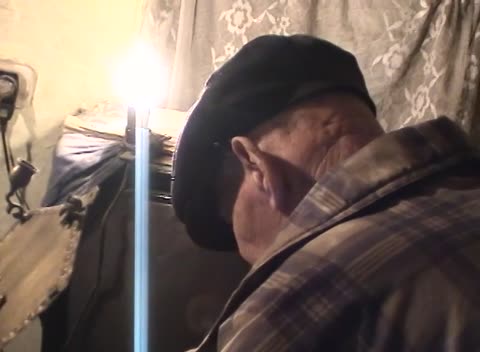
Camera-side talk as the team arrives at Chajim's home. Kerler and Lemster talk in short, garbled exchanges, mixed with Russian crew remarks about filming. The content is hard to follow.
Chajim shows the family hanukiah, and the interviewers ask how old it is. He says it is about two hundred years old, inherited from his grandfather and father. He recalls blessing and lighting the candles himself and, in the past, his father and brothers lighting them, and the interviewers help repair the object.
adds the memory of his father and brothers lighting the lights, and the repair of the hanukiah
Chajim talks about his life today. The team then concludes the formal interview with Chajim, before the camera collects footage of his house and courtyard.
Chajim says an American once offered money for the old hanukiah and he refused to sell. He describes living alone in a house with furnished rooms, which came from his father-in-law, and recalls having worked in Yedinets (?). The interviewers thank him and say goodbye, and the crew then discusses footage and repeats a line for the camera.
adds the house inherited through his father-in-law and the American's offer for the hanukiah
Chirilau talks with Kerler about the project's contact with her. A musicologist visited her last summer and wrote about her in an online journal. They discuss how to record her address, since she lives on a street with only a few houses. Kerler shows her the project description and tells her how highly he rates her Yiddish. She is also told about compensation for the project's interviews.
adds the earlier visit by a musicologist and the discussion of her address and of the project
Chirilau speaks about her life today and provides personal information. She then speaks about her family. Chirilau raised two children and grew up with one sister.
Chirilau says how the project found her: someone from Botoșani came to Mihăileni and asked who could speak Yiddish. She says she is 74 and finds old age hard. Her parents have died and she has a sister in Brașov. She has two children and three grandchildren: one in the French army, an engineer, and a granddaughter studying psychology in Iași. Kerler asks about a Yiddish word for joy from children, and they speak about forgetting one's mother tongue.
adds the details of her sister, her grandchildren and the discussion of the Yiddish word for joy from children
A brief, largely garbled exchange as the team begins filming in Rădăuți. There is talk of marking some occasion or anniversary, and the voices are hard to attribute.
the transcript shows little of the synagogue tour itself
The team and Grinberg enter the synagogue, while she speaks about local Jewish history during World War II. Grinberg then talks about the history of the synagogue, including rabbis.
Grinberg and the team enter the synagogue. She speaks about what the Germans took over during the war and about a rabbi buried in Jerusalem who served in Safed. She recounts his career, in which he came to Rădăuți from other towns, and the interviewers read names from the commemorative text, with dates they do not agree on. The details are uncertain in the transcript.
adds the discussion of a rabbi and his career, and names read from the text
The camera films the synagogue interior while the interviewers remark on an iron ark. Grinberg compares the Rădăuți synagogue with the great synagogue of Fălticeni, with more painted decoration, and tells a legend of a ship and Emperor Franz Joseph. She asked a Suceava university historian to check the archives. She also talks about an ethnographic museum that has nothing from the Jews, and about wanting to keep the synagogue's contents there.
adds the Franz Joseph ship story, the university historian and the ethnographic museum
Grinberg shares information about her amibitions to establish a museum about the history of Bukovinian Jews in Rădăuţi. Grinberg then speaks about her family.
Grinberg describes her plan for a museum in Rădăuți about the Jews of Bukovina, gathering photographs and family items from Jews worldwide. She says the Jews deported to Transnistria took no photographs with them. She talks about her religious family, her father's prayer shawl and kittel, and her ability to blow the shofar though she cannot sing. The talk turns to the interviewers' wish to record her and to Yiddish teaching in Romania.
adds her family's piety, her father's tallit and her shofar blowing
Grinberg provides information about local schools in Romania that teach Yiddish. She then speaks about her school education at a Romanian school, which included Yiddish language lessons.
Grinberg says schools in Romania, perhaps in Bucharest, teach Yiddish to children. She recalls that in the fifth class at her Romanian school there were mother-tongue Yiddish lessons with a teacher called Mara (?), but she learned little because the school had taught her a different Yiddish from the one she spoke at home. She and Kerler compare Yiddish terms for family members and mention the schoolteacher and the community.
adds her Yiddish lessons in the fifth class and the comparison of kinship terms
Grinberg talks about taking over the community and the synagogue building and having its roof rebuilt. She wants the painted interior renewed by a specialist, but the community lacks money. She describes seeking funds from the prefect, the mayor and the Ministry of Culture, since the synagogue is a protected monument, and the figures run to several hundred million lei. She mentions the days of Gura Humorului, where she brings sugar for the minorities' food gathering, a subscription to a Jewish newspaper, and a seminar in Constanța.
adds the funding requests to the prefect, mayor and ministry, the Gura Humorului event and the Constanța seminar
Chat in the synagogue about the painted decoration and the painters, a name such as Steigman, and names of fathers and sons, with some dates. Grinberg and Kerler discuss whether the Yiddish word means painter or is a surname, and she refers to texts in Hebrew and English. Some of the content is unclear.
Grinberg points out things that were damaged or removed in the synagogue. She and Kerler discuss the Yiddish word for the little objects, and she mentions a meeting where the area's officials came. Kerler asks about a Star of David that has to be glued back on. She explains that the benches come from another synagogue and carry names of former worshippers.