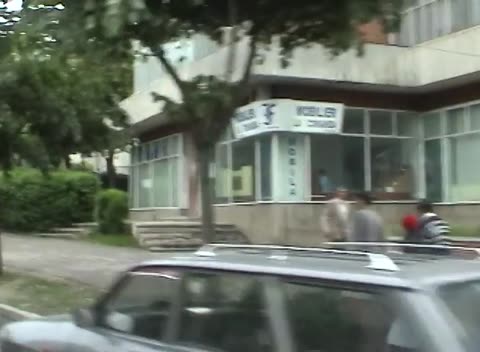
The team drives through Iași with Finkelshteyn, who points out a former Jewish street in the area between Păcurari(?)/Podul Roș(?)-type districts. The transcript is largely a recogniser loop, and little else is readable.
At a stop by a memorial, Finkelshteyn and Kerler discuss the Yiddish theater in Iași. He says the building was not closed and describes a small hall with a stage and a garden, the national theater opposite, and an anecdote about rain and a procession from the metropolitan's monastery. Kerler asks what people before the war knew of Goldfaden's theater; Finkelshteyn says many Jews went to the Yiddish theater, which hosted great actors from America and Poland.
Adds the anecdote about rain and the procession and the guest actors from America and Poland.
The group talks about the Yiddish theater under the communists and the distance to Bucharest. Finkelshteyn then shows the former Jewish hospital and says that it is now an ordinary hospital. He describes an old people's home for the childless elderly, called an "azil" (?). The rest is camera positioning and talk among the team in Russian and Romanian, and Kerler arranges a gathering of Yiddish speakers.
Adds the old people's home, the former hospital, and Kerler's arrangements for Yiddish speakers; the Goldfaden memorial is not clearly shown.
Finkelshteyn tells a joke about a pregnant woman who consults a rebbe about her child's future; the prophecies for each birth are that the child will be a thief and a great politician. He then tells another joke about a tailor and a priest, in which a priest wants a suit made quickly and the tailor compares it to creation of the world. Lemster retells a part. The team then discusses going to see the theater and a Romanian-language exchange.
Adds the second joke, about a tailor and a priest.
The team and Finkelshteyn stop at another memorial, which is located at the site of the former Jewish hospital, commemorating the murder of local Jews during the Iaşi pogrom. He then speaks about the former hospital, as well as orphanage, and answers questions about cultural terminology. Finkelshteyn explains that he completed jobs at the hospital during his carpenter apprenticeship.
At the memorial by the former Jewish hospital, Finkelshteyn and Kerler discuss the monument erected in 1947 for the Jews murdered in the 1941 Iași pogrom, and Finkelshteyn describes the large hospital and an orphanage. Kerler asks about expressions, such as "a Jewish head" and "a goyish mazl", and Finkelshteyn explains them. Finkelshteyn says he worked in hospitals and schools in Iași during his apprenticeship.
Adds questions on expressions such as 'Jewish head' and 'goyish mazl', the orphanage, and the date of the monument.
Finkelshteyn speaks about his family: an uncle in America, Aunt Sara (?), sent food parcels soon after the war, and the father wrote to his brother in thanks. The uncle replied that American Jews owe help to European Jews because of Hitler.
Adds the uncle's food parcels from America and the uncle's attitude to European Jews.