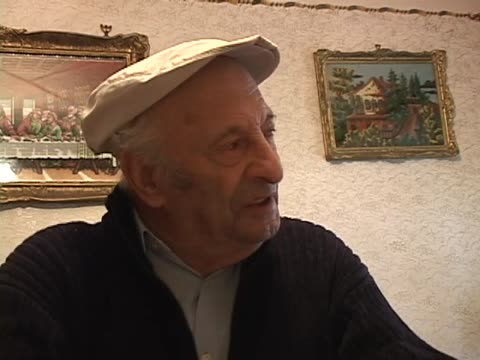
The team greets Leichtner in front of his home and sets up the interview with him.
From the machine transcript
The interviewers greet Leichtner at the door of his house and explain that they record interviews in Yiddish about earlier life. A woman and others present are introduced, and there is light chat about who lives in Israel and abroad and about knowing some Romanian and Yiddish.
A woman and other people present are introduced and speak, and the talk includes a joke about languages.
Leichtner speaks about life today.
From the machine transcript
Leichtner talks about current events: Israel, the Arabs, the attitude of the world to Jews, and the shooting of a professor in America. The professor is described as a Romanian Jew who had lived in Israel. At the end he is asked where he was born and answers that he was born here.
The content is a discussion of current news (Israel, a shooting in America) rather than Leichtner's own life today.
The formal part of the interview begins. Leichtner provides personal information and speaks about prewar Jewish life. According to him, twenty-five Jewish families lived in Ocna Şugatag. Leichtner was a soldier doing forced labor during World War II.
From the machine transcript
Leichtner gives his basic personal information. He was born in Ocna Șugatag, which was a salt-mining place, in 1922, and he gives the street and the distance to Sighet. He says about 25 Jewish families lived there and lived well until they were taken to camps. He himself was not in a camp but served as a soldier in forced labor.
Leichtner provides personal information and speaks about his family. His father was born in Sârbi and worked as kosher butcher. His mother was born in Rina 8:08. Leichtner grew up with three sisters and three brothers.
From the machine transcript
Kerler explains the project: interviews in Yiddish about life before the war. Leichtner then names his parents, Zelig and Esther. His father, from a nearby village (transcribed Serp, i.e. Sârbi), was a kosher butcher, and his mother came from Rina. He grew up with three sisters and three brothers. Family members were taken to Auschwitz and only his father and two brothers returned.
Includes Kerler's explanation of the project's purpose.
Leichtner speaks about his family's life during the war. His father and two brothers returned from Auschwitz. Both of Leichtner's brothers emigrated; one moved to Israel and the other to America. He then speaks about Jewish life before the war, including occupational structure, as well as about his family.
From the machine transcript
Leichtner says one brother went to America and has died, and the other lives in Israel. Asked about the time before the war, he describes a good life in the village among 25 Jewish families who all had a livelihood, including a shoemaker, a carpenter and a tailor. His paternal grandfather, Moshe Leib, lived in a nearby village and farmed and kept sheep. He says he rebuilt the family house, and that after returning he worked for a cooperative buying produce.
The family-life sketch includes his grandfather's farming and the rebuilding of the family house.
Leichtner speaks about his life and work after the war. He worked in an agricultural cooperative and provided building material. He then speaks about prewar Jewish life.
From the machine transcript
Leichtner describes his postwar work: purchasing for the cooperative, then supplying building material for people's houses, with a car for travelling. In answer to Lemster he says the village had one synagogue, a rabbi before the war, and a shoykhet. He is then asked about childhood friends and games.
Adds the synagogue, rabbi and shoykhet of the prewar village.
Leichtner discusses his childhood memories, in particular education. He attended a religious school (cheder) at the age of six. He explains that when he started his primary school education at a Romanian school when he was seven years old, Leichtner went to cheder in the mornings and afternoons and primary school during the day.
From the machine transcript
Leichtner recalls his childhood schooling. He began cheder at six, and from seven he went to cheder early in the morning, then to the state school, and back to cheder in the afternoon until evening. He says it was hard to be a Jew. He counts the Jewish households in the village by the number of tallitot, 25, many with large families.
Also gives the 25 tallitot/families count and a remark that it was hard to be a Jew.
Leichtner addresses prewar Jewish life in Ocna Şugatag, including occupational structure. He then speaks about his family.
From the machine transcript
Leichtner says all the Jews in the village had a livelihood: tailors, carpenters, shoemakers. He then names his siblings: three sisters who did not return, including an eldest who was married with three children, and brothers in America and Israel (Bnei Brak). The transcript is unclear on which brother was killed. He explains that names were given after relatives. A grandson filming and his daughter are mentioned, and his first wife Miriam died of cancer. The passage ends with a question about the cheder teacher.
Includes the names of his siblings, his two marriages and a family member filming.
Leichtner speaks about his cheder education.
From the machine transcript
Leichtner describes his cheder: the teacher had a beard and sidelocks, was a good man and did not use a whip. The boys studied Humash with Rashi, and he remembers little else. On Sabbaths the boys were examined at the home of a family where the father could lead the prayers. Lemster then asks about the Jewish holidays in the village.
Leichtner addresses holiday celebration before the war, including Yom Kippur, Purim and Passover. He describes a Purim shpiel and a childhood game.
From the machine transcript
Leichtner describes holidays before the war. On Yom Kippur children went to the synagogue and did not fast fully. He recalls the Purim shpiel and its rhymed lines. For Passover he talks about preparations and about the carob (boxer) pods that children used in a counting game of odd and even. He attended cheder until fifteen, then learned a trade, and was taken at eighteen to forced labor.
Gives the Purim shpiel verses, the carob pod game and his path after cheder.
Leichtner talks about his education and work as kosher butcher. He then talks about traditional weddings and religious customs before the war.
From the machine transcript
Leichtner says he learned the butcher's trade from his father before being taken to forced labor. He describes traditional Jewish weddings: the blessings, drinking wine, breaking a plate, shouting mazl tov, and men and women dancing separately. His family did not travel to rebbes. On holidays people visited relatives, travelling by wagon since there were no cars.
Adds his butcher training with his father and visiting relatives rather than a rebbe.
Leichtner speaks about Sabbath celebrations, including food customs, before the war.
From the machine transcript
Leichtner describes the Sabbath meals of his childhood. His mother was a good housewife, and after the synagogue the family had brandy and cake. The meal included challah, fish with the head for the father, onion with egg and liver, jellied calf's foot, cholent, and compote. The Friday-night meal was fish, chicken soup with noodles and farfel. Lemster compares some dish names with Romanian ones.
Leichtner chants a Sabbath blessing and then addresses Sabbath food customs, including recipes for potato kugel and gefilte fish.
From the machine transcript
Leichtner sings a Sabbath blessing and the interviewers praise his singing. He explains the Yiddish word for potato and gives a recipe for potato kugel, baked Friday in the oven and taken out Saturday. He describes gefilte fish, sweet and sour fish, and brandy, and says wine was not made at home. Then he is asked about Sukkot.
Leichtner speaks about Sukkot celebrations and prewar populational structure in Ocna Şugatag.
From the machine transcript
Leichtner says people did not sleep in the sukkah because it was too cold, but they ate there and made kiddush. He says there were no songs about the messiah. There were both Hasidic and non-Hasidic Jews, and both Ashkenazic and Sephardic prayer rites were used. There was no Jewish pharmacy or library, and no Christians spoke Yiddish. They discuss the share of Jews among the villagers and where they lived.
Adds the prayer rites, the absence of Jewish institutions and Christians speaking Yiddish.
Leichtner addresses Sabbath songs (zemirot) and food customs on Shavuot.
From the machine transcript
Leichtner recalls fragments of Sabbath table songs (zemirot), then Shavuot food: pastry (kipferlekh) with plum and walnut filling, and delkelekh with sweet cheese or brinze. The interviewers compare these with Romanian and other terms such as palatschinken and ask what the foods were made from. He then describes Purim hamantashen, filled with plum jam.
Leichtner talks about foods for the winter season.
From the machine transcript
Leichtner lists winter preparations: pickled cucumbers, preserves, compotes, jams and barrels, and says no sausage was made at home. They killed a lamb or calf and ate meat, and made goose fat, cracklings and liver. He is asked about Romanian songs and mentions that he has a cassette.
Leichtner sings the beginning of a Yiddish song about mamaliga and then talks about his life before the war, as well as traditional weddings. Leichtner recalls a wedding jester and musicians.
From the machine transcript
Leichtner says Jews lived well in prewar Romania, and that Sighet was a large city with many Jews, which he visited by train until he was taken into service at eighteen. He talks about weddings: the wedding jester who announced the dancers and collected gift money from them, and the klezmer band from a nearby village, with fiddle, drum, accordion and clarinet. He recalls storytelling in the evenings and has heard of Hershele Ostropolyer.
The transcript does not clearly show singing; it adds Sighet and his visits there, and Hershele Ostropolyer.
Leichtner speaks about prewar Yiddish cultural life, in particular theater perfomances. He then addresses Hanukkah celebrations and answers questions about cultural terminology.
From the machine transcript
Leichtner says a Yiddish theater came to the city rather than the village. He says his parents and other Jews were not originally from the village and had come from the area. On Hanukkah he recalls children playing with the dreidel and its four letters, and says latkes were not made on Passover. Lemster asks him about words such as dybbuk and golem, and Leichtner glosses golem and other words for a fool.
Adds the origins of the village's Jews and a short list of terminology questions (dybbuk, golem).
Leichtner speaks about prewar Jewish life, as well as his life as an adolescent. Leichtner married a Christian for the first time in 1952.
From the machine transcript
Leichtner speaks about youth before the war: after prayers young people went home, and older boys went to the girls. He recalls his own girlfriend. He says he married in 1952 at about thirty, to a woman from the village whose parents were also local and who was Christian. At home they spoke Yiddish, and everyone knew Hungarian and Romanian.
Adds the marriage in 1952 to a local Christian woman and the languages spoken at home.