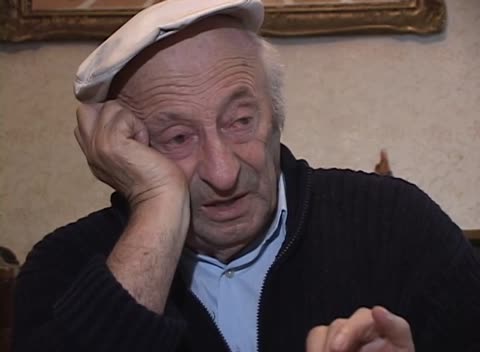
Leichtner says he wrote letters in Yiddish and received some, but none are preserved, and he has not read Yiddish books or newspapers. He recalls singing nigunim at the Sabbath table with his father and brothers. He says he liked all the tunes and cannot name a particular one.
Also covers Sabbath table songs, which the catalogue sentence does not mention.
Leichtner speaks about Jewish life after the war. He states that his father and two brothers were the only family members who returned from World War II.
Leichtner says only a dozen or fifteen Jewish children and young people were in the town after the war, and they soon left for Israel and America. The parents, brothers and sisters did not come back, apart from his father, who returned and lived on for some years (the year of his death is unclear in the transcript). The synagogue building was sold and he discusses whether the building still stands.
Also covers the emigration of the young survivors and the sale of the synagogue.
Leichtner speaks about folk and healing customs to avert the evil eye. He then answers questions about cultural terminology and addresses prewar religious customs. He recalls how his father would visit with him the local rebbe.
Leichtner describes a remedy against the evil eye: coals dropped into water, with bread crumbs added, and the patient drinking. He explains the sense of terms for the evil eye and for "a good place" (a cemetery or sacred place). He recalls that a rebbe visited villages and people travelled to him for Sabbath, and that as a boy he went with his father to the rebbe, who wrote a kvitl and gave blessings.
Includes explanation of the terms "a good place" and "a good Jew" and the kvitl practice.
Leichtner answers questions about cultural terminology: converts, mad people, a well, and the muddy water given to geese. Romanian equivalents and the non-kosher status of sausage come up, and he does not know a word for fortune-tellers. He says there was no Jewish market in the area, only the Thursday market in Sighet.
Includes questions on specific words and the market in Sighet.
Leichtner describes how his mother koshered meat by soaking and salting it, and how she baked challah and bread at home for the week. He answers questions about grandmothers, Friday-night candle blessing and fasting on the Ninth of Av, when children threw burrs from the garden. He is also asked for Yiddish sayings and some Yiddish greeting phrases.
Adds Sabbath baking, Friday candles and the Ninth of Av burr custom.
Leichtner answers the dialectological questionnaire, with Lemster giving many Romanian prompts. Items include greetings and farewells, wishes, a glass and window panes, adverbs and comparatives, pronouns and number agreement, days counted up to twelve, praying versus monks' devotions, midwife, road and street, household words (storeroom, shop, put in order), and a wartime sentence about beating the enemy. Near the end he explains the Purim-play mask and some Yiddish phrases and curses.
Asked to tell a story or sing, Leichtner instead says he still works a little as a cattle dealer, sending cattle to Cluj (Kolozsvár) and another town (unclear), though business is weak and he has lost money. He then discusses imported meat, eggs and whether they are kosher, and Yiddish terms for the "unslaughtered" or not properly salted.
Adds questions about the kosher status of imported meat and eggs.
The interviewers wrap up the formal interview and, partly in Russian and Romanian, discuss where to get coffee or palinka. The talk drifts to the project and to whether business could be done with Israel.
The conversation is informal. Leichtner makes his own palinka, offers a little and says he has a long pension. One interviewer says he was born in Moscow, lived in America and Israel, and has a flat in Jerusalem; he explains the project, whose recordings go into an archive. They talk about visitors from Israel, the political situation, the Yiddish words for peasant, and a Hebrew word that also means hay; the session ends with thanks.