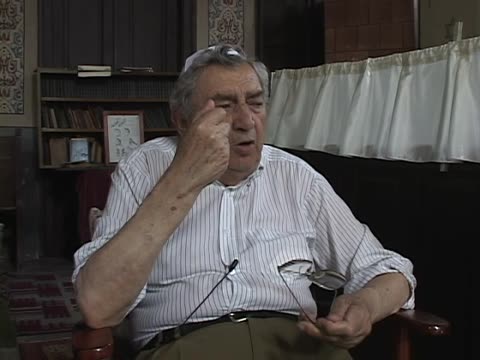
Freundlich tells of a night when a light was left burning and neighbors were asked in Hungarian to put it out, noting that many people around him spoke Hungarian. Lemster asks whether Yiddish weddings had badkhn-style rhymers and about Purim plays; Freundlich recalls a visiting troupe performing in Yiddish at Purim once, and says there were no klezmer-type performers at weddings.
Opening is an anecdote about a burning light and Hungarian-speaking neighbors, and wedding entertainers are discussed.
Freundlich talks about Purim plays in the community, which mocked communal figures such as the head of the community, the gabbai, the shamash and the rabbi, sometimes causing offence. As a child he dressed up as a bridegroom or hasid with a kaftan and shtraymel; he recalls that he and his brothers tried to put on performances but could not pay for talent.
Also covers the satire of communal officials and the brothers' attempts at performing.
Freundlich addresses holiday food customs and his childhood memories of how his mother prepared food and baked bread, as well as mamaliga. Freundlich states that his mother or he brought six kilogram dough for bread and challah to the bakery every week.
Freundlich describes how his mother baked for a family of seven children: the dough, about six kilograms, was prepared at the end of Sabbath and carried to the baker, and he as a boy carried it there and back. He explains the weekly rhythm of bread, mamaliga and the large challah made on Thursday for Friday night, which the children kept eating; the family had no oven at home. Lemster asks about how challah was baked.
Details the weekly bread cycle and the lack of a home oven.
Freundlich describes how his mother salted meat and stuffed geese, and recalls as a boy of ten to twelve carrying the goose's gizzard (?) to the shoykhet and to the rabbi to be checked for kashrut. He then talks about fish dishes, including falshe fish made from goose meat as a Friday-night starter, and the head and jellied fish. Lemster asks for the Romanian terms and prods him to recall a Purim play.
Includes the kosher inspection of the goose's gizzard, which the catalogue does not mention.
Freundlich answers questions about cultural terminology. He then addresses prewar Yiddish culture, in particular performances by Sidi Tal. He then addresses his childhood memories and how locals would gather to listen to the radio.
Freundlich answers Lemster's questions on the terms dybbuk, golem and the words for a cemetery. He mentions having seen Sidi Tal perform in Sighet (?) or Baia Mare (?), his father's love of cantors and operettas, and neighbors gathering around the first radio in the street.
Includes elicitation of terms for dybbuk, golem and cemetery as well as his father's musical tastes.
Freundlich says that he read Yiddish authors only in Hungarian translation and recalls no Yiddish newspaper or library before the war; after the war the world was different. He comments on his own Yiddish and on his difficulty expressing himself, and mentions learning Hebrew in the Zionist organization before becoming a Communist.
Also mentions studying Hebrew in a Zionist organization.
Freundlich speaks briefly addresses the local Zionist organization, he joined before the war. He then speaks about his life and family after the war. Freundlich visited Israel for the first time in 1968, where he met siblings. He then recalls his experiences and use of Hebrew in Israel. Freundlich mentions that he studied Hebrew at home after his visit to Israel.
Freundlich recalls his first visit to Israel in 1968 (as heard), where the five brothers met; a sister had ended up in Argentina after deportation. He tells of a jeep ride to Beer Sheva sent by a relative who was a military commander, during which he managed to converse with a young soldier driver in broken Hebrew, and of his decision to study Hebrew at home afterward.
Gives the jeep trip with a young soldier driver and the sister who went to Argentina.
Freundlich recalls that his mother taught him the prayer modeh ani at age five, and tells of her checking whether he said his morning prayers properly. He says that as a Communist he was imprisoned and then sent to labor, which he regards as luck, and that he still prays daily and knows the services by heart.
Also mentions his Communist imprisonment and labor service.
Freundlich speaks about the war years, when his part of the country belonged to Hungary and he was taken to the border area. He describes working in villages between Hungary and Moldavia on the Carpathian side, being interned as a Communist in a ruined building at Garan (?), and his luck in not being deported or seeing the dead.
Mentions his Communist internment and that his brother was in Poland and Russia.
Freundlich addresses different Yiddish dialects within praying customs. He then answers dialectological questions from the AHEYM Yiddish linguistic questionnaire.
Freundlich describes his Sighet-area Yiddish and the differences in pronouncing prayers compared with Hasidic and Hungarian Jews. Lemster then conducts the questionnaire with Romanian prompts, covering greetings, thanks, animal and body words, house and colour words, adverbs, and the terms for a pious versus honest person, a Christian and a convert. Freundlich also relates the story of a Jewish girl who converted, talks about words for peasants and Yiddish-speaking non-Jews, and Maramureș peasants who lived among Jews.
Besides dialect pronunciation, it covers the story of a convert and peasants who spoke Yiddish.
Freundlich speaks about prewar Jewish life in the Maramureş region, where poorest Jewish families lived according to Freundlich. He then continues to answer dialectological questions from the AHEYM Yiddish linguistic questionnaire.
Freundlich describes the poor Maramureș Jews who traveled as guests from town to town and were hosted for the Sabbath, and the way Maramureș Jews were seen. He then answers further questionnaire items, including words for grandmother, potato, flowers, bridge, telephone, and prayer, as well as 'or' and 'but'. At the end, he says he knows Zionist songs and a Yiddish mother's song but is not a singer.
Gives details on poor wandering Jews hosted for the Sabbath.