Recordings › Oradea

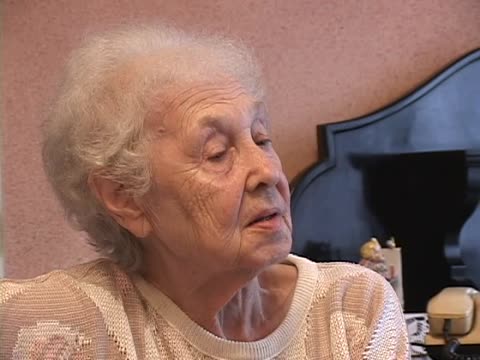
MDV 293 · Margit (Malke) Mezei

Oradea, Romania 7 July 2008 Interviewed by Dov-Ber Kerler Part 1 of 3 62 min · 9 passages

One conversation with Margit Mezei, continuing over MDV 293, MDV 294, MDV 295.

Loading the player…
Passages

0:00

Mezei provides personal information and speaks about her family. She and her husband were deported to Auschwitz in 1944 and returned to Sighetu Marmaţiei after the war. Mezei mentions that she and her husband moved to Oradea in 1958. Her brother made aliyah after the war. Mezei visited Israel three times. Her father owned a textile shop and was born in the Maramureș province. Mezei grew up with one sister and one brother. She explains that she and her sister returned home from the war and her brother was sent to Donbas, Russia, as POW. Her brother was a forced laborer serving in the Hungarian Second Army. He returned home in 1948.

From the machine transcript

Mezei looks at a photograph of her sister and her sister's husband, says that she and her husband, both from Sighet, were taken to Auschwitz, and mentions that she has lived in Oradea for almost fifty years. She names her parents, grandmothers and the work of her father, who had a textile shop. She says she was the eldest of three children, with a sister and a brother. Her brother was taken as a laborer, was held by the Russians in the Donbas until his return in 1948, and later married and lived in Oradea. Her sister-in-law lives in Israel, where Mezei has visited three times.

Names her parents and both grandmothers, and her grandfather as a timber merchant; the sister-in-law's name and where she lives.

8:27

Mezei speaks about her childhood memories. She explains how her family lived with her grandmother in a poor neighborhood and then moved to a different house in a better off area. Mezei attended a preschool at three and then a Romanian school, which she finished in 1939.

From the machine transcript

Mezei recalls her childhood in Sighet: the family lived with her widowed grandmother in a poor street and later moved to a better house her father bought. She describes caring for her sick grandmother, going to a preschool at three, and learning Romanian, Hungarian and Yiddish, and some German. She mentions her brother's passion for football and her own school graduation in 1939. She says antisemitism grew once the Hungarians arrived.

Mentions the grandmother's illness, her languages and her brother's football, and the growth of antisemitism under the Hungarians.

13:41

Mezei speaks about her life during World War II, in particular the Hungarian occupation (1940), then ghettoization (April 1944) and deportation to Birkenau (May 1944).

From the machine transcript

Mezei and the others briefly speak about the war years: the last Passover seder at home in April 1944, the family being taken into the ghetto in mid-April, and arrival in Birkenau in May. Others in the room also talk about showing a photograph to the camera.

15:28

Mezei explains her school grade photo of 1939. She then speaks about her school education at a Romanian school and prewar Jewish life in Sighetu Marmaţiei. Mezei also addresses her activities as adolescent, including dancing and attending meetings Hashomer Hatzair, Hanoar Hatzioni and Trumpeldor. Mezei then speaks about her husband's family. Her husband held a doctorate in law and worked as lawyer.

From the machine transcript

Mezei explains her school photograph from 1939, found at home after her return from Auschwitz, and the languages taught at her Romanian lyceum. She speaks about Jewish life in prewar Sighet: observance in her parents' home, Yiddish games with other children, and the youth organizations she attended, including Hashomer Hatzair, Hanoar Hatzioni and a Trumpeldor club. She then describes her husband's background: he was poor, lost his father early, and studied law in Cluj. His mother came from Vienna, spoke German and was a music teacher. Her husband worked as a lawyer and held a doctorate.

Gives her husband's family background: his Viennese mother, his father's early death and his poverty.

25:31

Mezei speaks about prewar Jewish life in Sighetu Marmaţiei and addresses holiday celebration, including Sabbath. According to Mezei, fifty percent of the population was Jewish. She then addresses Sabbath food customs and recalls how strictly her grandmother observed kashrut. She then talks about her husband's life during the war. He was a laborer serving in the Second Hungarian Army and Mezei explains how he was not identified as a Jew and worked at a stone factory.

From the machine transcript

Mezei discusses prewar Sighet, where about half of the population was Jewish and few were rich, and the poor street where she grew up. She describes Sabbath customs in her home, including the cholent taken to the baker, Sabbath foods, and her grandmother's strict kashrut. She then tells of her husband's labor service, his survival in Budapest under a Hungarian name, his work at a stone factory, and his walking home to Sighet in January 1945.

Covers the Jewish share of the population, Sabbath foods and terms, and her husband's labor service and return on foot.

35:18

Mezei speaks about her husband's return to Sighetu Marmaţiei. Mezei also mentions how the Jewish community was assembled in the Great Synagogue before deportation to Auschwitz-Birkenau. Mezei then speaks about her father who founded a Zionist prayer house before the war.

From the machine transcript

Mezei says what the husband and his friends found in Sighet on returning, the burnt Reform synagogue, and the Great Synagogue where the Jews were held before deportation. A memorial now stands there. She then recalls her father, a committed Zionist who set up a small Zionist prayer house, and her taking her grandmother to services.

Adds the burnt Reform synagogue, the deportation memorial and her father's Zionist prayer house.

38:03

Mezei speaks about Passover celebrations, including food customs, before the war. She also addresses her neighbors and family. Mezei's father learned in the textile industry in Budapest. She then shows a photograph of her father in World War I uniform.

From the machine transcript

Answering Kerler, Mezei talks about Passover in her prewar home: matzo dishes, borscht made by her grandmother, and whether matzo was soaked. She mentions her uncle and a relative who was a Vizhnitz Hasid, and says that her father studied textiles in Budapest and served as a Hungarian soldier in the First World War. She then shows photographs of her father, her school days, her sisters and relatives who died at Auschwitz or live abroad.

Includes the uncle and the Vizhnitz Hasid relative, her father's WWI service, and photographs of relatives abroad.

49:02

Mezei speaks about contemporary Jewish press and life, as well as her childhood friends.

From the machine transcript

Kerler asks whether a Yiddish newspaper appeared in Sighet; Mezei says she receives a Hungarian paper from Israel. She shows photographs of friends, including a man from Sighet whom everyone knows and his wife. She also recounts an interview given to students from the university in Cluj about the ghetto and Auschwitz, which lasted for hours.

53:19

Mezei speaks about her imprisonment in the Birkenau c-sector and her encounter with Josef Mengele while undergoing selection. Mezei also mentions encounters with other prisoners.

during the war Camps and forced labor · MCO
From the machine transcript

Asked by Kerler whether she saw Mengele, Mezei describes being in the Birkenau C sector near the infirmary block, where Mengele came a few times a week and the women feared a selection. She tells how her mother was taken by Mengele in October. She reflects that the world knew and stayed silent, and that men suffered more in the camp, including the Sonderkommando and Russian prisoners of war. She tells of a friend's brother, a lawyer in the Sonderkommando, who asked her through the fence about his sister.