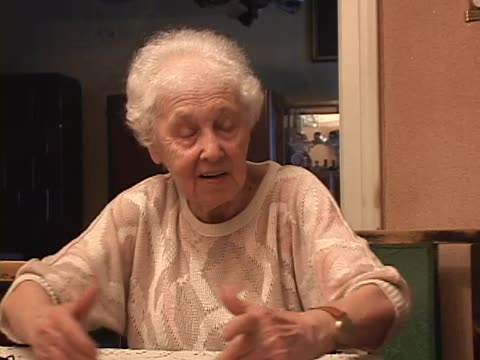
Mezei speaks about her life in Birkenau and then forced labor at a factory in Thuringia, Germany. She also addresses her living conditions and work in Thuringia.
Mezei concludes her account of Auschwitz, where she stayed six months, and then describes being moved to a factory in Thuringia. She talks about the mild climate, the heated quarters in an SS garrison, the washing facilities, and the poor clothing issued to the prisoners. She describes the camp barracks and the selection of women by their hands for lighter or heavier work. She had an easy inspection job and says she was liberated by the Americans in April 1945.
Mentions the threat of being sent to Buchenwald for those who failed their work quota.
Mezei speaks about her liberation by the American Army and the previous death march to Waldenburg, Thuringia, with six hundred fellow prisoners. Mezei then mentions that she fell ill with pneumonia three days after the liberation and states that she was therefore saved from "overeating."
Mezei recounts the night march from the camp in April 1945 to a village and then to the woods near Waldenburg, where air-raid alarms sounded. Some 600 prisoners, mostly women with a few men, hid in the forest overnight. In the morning the prisoners went down and found American soldiers, which she describes as their liberation. Two or three days later she fell ill with pneumonia and a high fever, which she says kept her from overeating the tinned food, from which many died. Kerler then steers back to the holidays discussed earlier.
Includes the night spent in the forest with her sister and the sister's tea during her illness.
Mezei speaks about holiday celebration, including Passover, Hanukkah and Purim. During Purim, Mezei describes how she dressed up. She also addresses holiday food customs and recalls local boys bringing large baskets of matzo.
Answers questions from Kerler about prewar holidays: Passover with two seders, new clothes for children, and the father conducting the seder. She mentions Hanukkah games with the dreidel and gelt for the children, and dressing up on Purim to visit grandmothers and bring gifts of food. She discusses baked goods for Purim and Hanukkah and Passover dishes, and recalls young men bringing large baskets of matzo and an uncle who ate only shmurah matzo.
Also covers Hanukkah dreidel play and gelt, and Kerler's questions about the Yiddish words for potato and for ingredients of Purim pastries.
Mezei sings the song "Vos iz geven iz geven" (What was, was) and addresses prewar cultural performances and a wedding. Mezei then sings the song "A yidish meydl darf a yidishn boy" (a Jewish girl needs a Jewish boy). Mezei also mentions the fate of friends during the war.
Sings the song about how what was is gone, with Kerler asking about the refrain's wording. She recalls the summer theater in Sighet, the Hungarian and Yiddish actors Strömer and his wife, and an actress who sang there. She sings a song that a Jewish girl needs a Jewish boy, tied to a woman who married a Romanian and later died in Auschwitz. She mentions her friends' fates after the war, including those who went to Israel, and the judge husband of the woman.
Includes the theater visits in Sighet and the story of a woman who married a Romanian judge.
Mezei shares an episode about a shidduch in her family. She then recalls how women sang Romanian and Hungarian songs during forced labor and then talks about aquaintances from Auschwitz. Mezei also shares episodes about selection for forced labor in Auschwitz, as well as her daily work routine.
Mezei tells of an elderly relative's marriage match and her Romanian lesson, then answers Kerler about singing in Auschwitz. She tells in detail of Miri, a Slovakian or Hungarian block elder from Birkenau, who knew her fiancé's family and helped her and her sister with food while they were in forced labor. She describes selections, the transport, twelve-hour day and night shifts, singing Hungarian and Romanian songs with other women, and the final evening when Miri decided not to leave with them. The part also touches on an uprising by the Sonderkommando and her friendship with a rabbi's wife.
Beyond the shidduch and the songs, the passage covers the helping block elder Miri and a fiancé's cousin link.
Mezei speaks about her life before the war and shares an episode about her grandmother's observance. Mezei then talks about the literature she read before the war.
Answers Kerler's question on the language spoken at home: her parents spoke Yiddish and Hungarian, the children Hungarian and Romanian, and the grandmother Yiddish only. She recalls her grandmother's shock at her using an umbrella on the Sabbath and a sister who smoked. She says she read in Hungarian and Romanian, including Gorky and Dostoevsky from her father's library, and she begins a joke attributed to Sholem Aleichem about a widow's daughter.
Adds the languages spoken at home, her reading list and a joke.
Mezei tells jokes, some in Yiddish and some in Hungarian, with the second woman and a third voice helping her translate for Kerler. They include one about two men and their wife and lover and a taxi joke that turns on a brothel. Kerler asks about Yiddish joke tellers of the region and how to say the word for brothel in Yiddish.