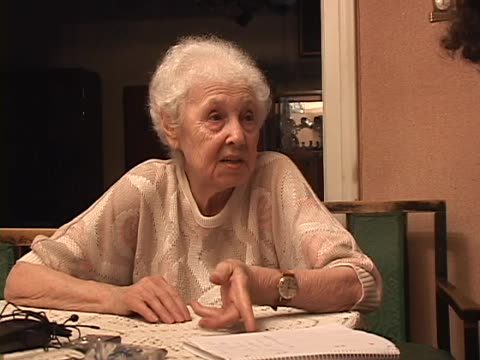
Mezei speaks about her return home by train after the war, via Prague, Buda and Timișoara. She recalls how she met her aunt in Buda and cousin in Timișoara. Mezei got married in 1945.
Mezei recounts her journey home after Auschwitz, by way of Prague and then Budapest, where she was put up in a hospital. In the yard there she unexpectedly met two cousins, who took her to their mother, her aunt. The aunt gave her a bath and fresh clothes. She goes on to Timișoara, where relatives of hers lived and had not been deported, and travels on by train toward home. She says she had heard in Prague that her fiancé was back; she returned on the first of July and married him on the first of September, and they lived together until his death nine years ago.
Adds the cousins met in the hospital yard, the relatives in Timișoara who were not deported, and the date of her marriage.
Mezei describes what she found at her home after returning: a woman and a young man were living there. He had asked for the apartment when the family was deported. He found very little in it. She then points out something she made on the wall of the apartment, before she went to the synagogue, at about fifteen. The passage is partly unclear.
Adds the young man who asked for the apartment, and the object she made as a girl on the wall.
The talk about the object she made as a girl continues briefly. It then turns into Hungarian-language talk about Budapest: a villa, an aunt, a walk along the boulevard in 1948 and a postcard sent to a friend. The recogniser makes much of this passage unintelligible. At the end the speakers seem to be arranging how to carry on. The catalogue mentions family photographs, but they are not evident in the transcript.
Adds the Hungarian-language talk about Budapest and an aunt, which the catalogue sentence does not mention.