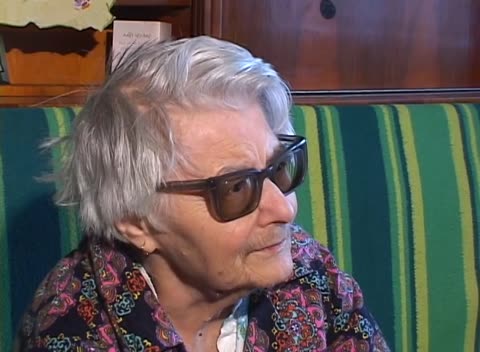
Informal chat at the start. S2 says the interviewer wants to show he knows a few Romanian words, and Grinberg thanks him. Lemster then asks for a telephone number, which S2 gives.
Brief talk with Grinberg and S2 about whether Kerler remembers a Romanian word or phrase he has been learning. This is not a real terminology exchange.
The transcript shows only light chat about Kerler's Romanian, not terminology questions.
Grinberg and Kerler talk about differences between their Yiddish and the Yiddish she knows. She gives her Yiddish name, Mishke, and her maiden name, Kerner, and Kerler compares it with his own name. She refuses to say her age or birth year, and Kerler jokes about it. She says she lived in Fălticeni before the war and was born there.
The transcript shows a discussion of Kerler's Yiddish and her refusal to give her age, beyond the personal data.
Grinberg speaks about her family. Her father, who owned a shop, passed away in 1936. She grew up as only child because her brother died shortly after his birth. Her mother grew up in Lespezi.
Grinberg gives her father's name (Borukh) and his shop, where he sold cloth. She and S2 distinguish the Yiddish, German and Romanian words for a shop. She names her mother (Brokhe) and says she herself was an only child, since a baby brother died after a few weeks. She names her maternal grandfather, Khayim, from Lespezi, and recalls a grandmother who died when her mother was young.
The transcript adds the discussion of Yiddish, German and Romanian words for a shop.
Grinberg discusses her childhood memories and addresses prewar Jewish life in Fălticeni. She then addresses her education. She attended a Romanian Jewish school and was taught by a private tutor. She also speaks about her life today.
Grinberg recalls playing as a child with Jewish children on her street in Fălticeni, which she calls an almost entirely Jewish town with a single Christian on the street. She describes learning at a Jewish school and at home with a private teacher who taught her to write Yiddish. She talks about her age, her health in recent years, and her only daughter. She also talks with Kerler about whether he will return to Romania.
The transcript adds her illness, her daughter and Kerler's remarks about his family and love of Romania.
Grinberg addresses her childhood memories, including her parents and holiday celebration. She recalls how her father helped out a poor neighbor and mentions that her father founded a prayer house.
Grinberg talks about her good parents and being an only child. She says her father, a pious man, led the prayers, and recalls Sabbath at home. She tells how he founded a prayer house next to their home and brought food to a poor old neighbor. She also talks about the name Borukh being shared by father and husband, and Kerler's Yiddish.
The transcript adds talk of Kerler's Yiddish and that her father had died long before her marriage.
Grinberg speaks about her life before the war. She mentions a German family, whose daughter attended the local Jewish school. She then addresses daily prayers and her life today.
Grinberg tells of a German neighbor girl who attended the Jewish school and wrote Yiddish for her. Lemster and Kerler then ask about her mother's blessings and her own daily prayers. She recites parts of the Sabbath-night prayer, says the modeh ani every morning and the Shema at night, and says she prays for her daughter and for a sick Christian professor.
The transcript adds Lemster's questions on her mother's blessings and the content of her prayers.
Grinberg talks about prewar Purim celebrations, including food customs. She recalls how children from poor families dressed up and went from door to door.
Lemster and Kerler ask how Purim was celebrated in Fălticeni. Grinberg talks about masked children and food, including sending gifts. She says only poor children dressed up and went from house to house to perform. She recalls that the poor were later sent to Eretz Yisrael.
Grinberg answers Lemster's questions on Passover in her home, saying her father and later her husband led a fine seder. She talks about her father, who was orphaned young, and her family's observance. She says her father was not a Hasid, though a Fălticeni rabbi (Tversky) is mentioned. She mentions her mother's Yiddish songs, her own lack of a singing voice, and her daughter's accented Yiddish.
The transcript adds her father's background, her mother's songs and the talk about her daughter's Yiddish.
Grinberg talks about her life during World War II. She was evacuated to Suceava (Yiddish: Shots) and stayed there for six months. Grinberg also maintains that all Fălticeni Jews returned home after the war. She then describes how she was evacuated, as well as her return home.
Lemster asks where she was during the war, and Grinberg says she was evacuated to Suceava (Shots) for six months before returning to Fălticeni. She says almost all Jews came back and then many emigrated to Eretz Yisrael. The Christian Popovich, the only one on their street, is mentioned. She describes the state-ordered evacuation and finding her house dirty on return.
The transcript adds the condition of her house on return and the name Popovich.
Grinberg mentions a positive relationship between her and her non-Jewish neighbors. She then answers questions about cultural terminology and addresses Yiddish dialects.
Grinberg says she lived on good terms with Christian neighbors and keeps kosher. Kerler asks about words for sausage and money, including a Russian word, a German word and Yiddish words for money. S2 and Grinberg discuss S2's Romanian-accented Yiddish and the languages S2 speaks well.
The transcript adds the discussion of S2's accented Yiddish and the other languages she speaks.
Lemster and Kerler ask about Jewish weddings in Fălticeni before the war, and Grinberg describes the huppah, who performed it, and the musicians. She and S3 say Christian klezmers played together with Jews. She recalls a violinist named Stainer who also taught children, and the pianist Lazar Offenberg, a pharmacist who played for himself. Lemster begins a question about Yiddish libraries.
The transcript adds the discussion of music teachers and mixed Jewish and Christian bands.
Grinberg talks about Yiddish books and traveling Yiddish theater in prewar Fălticeni. S2 mentions a Jewish revue theater run by students. Grinberg says she read Yiddish books mostly in Romanian translation and read Sholem Aleichem twice, finding him humorous. Kerler asks in what language he wrote, and the matter stays unclear. Kerler then asks about visitors from other places.
The transcript adds the traveling Yiddish theater and student revue, as well as her reading Sholem Aleichem in Romanian.
Grinberg remembers visitors from Eretz Yisrael before the war. She has cousins who live in America. Grinberg addresses food customs, particularly a recipe for gefilte fish. She also addresses Passover food customs.
Grinberg says visitors from Eretz Yisrael were rare but her father welcomed them, and mentions a cousin in America (Cleveland). Kerler asks how her mother made gefilte fish, and she describes the chopped fish stuffed into the skin and boiled with onion and a sweetish broth. They discuss terms for the fish broth. She also says that her family ate turkey on Passover rather than goose.
The transcript adds Grinberg's description of the gefilte fish method and her turkey-on-Passover custom.
Grinberg says her parents' marriage is unknown to her, and she married her cousin for love without a matchmaker. She says matchmaking happened among more pious families. She names a German neighbor, Wagner, who attended the Jewish school. She describes the Jewish school as taught in Romanian, with Hebrew, and then Kerler and Lemster ask about the words dibuk and golem.
The transcript adds the matchmaking talk and the questions about dibuk and golem.