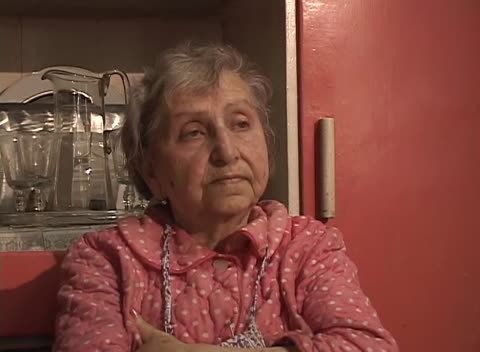
Salamon discusses her childhood memories, in particular education. She studied with a private religious tutor at the age of sixteen. She describes a lesson together with eleven fellow classmates. Salamon then talks about her family life in the early 1940s and mentions her siblings.
Salamon recalls how, at about sixteen, she and around a dozen girls learned the Hebrew alphabet and months from a young tutor, since the boys attended cheder. She explains that her father examined the boys on Sabbath, and that there was a talmud torah but no yeshiva in Sighet. She speaks of her grandmother's wish for her granddaughter's wedding and of her older siblings, and names her brothers and her youngest sister. She also describes her parents' appearance in a photograph.
The catalogue's tutor and lesson are confirmed. The transcript adds her father's examination of the boys, her grandmother's wedding story and the siblings' names.
Salamon addresses food customs, including gefilte and falshe fish, at home before the war. She also discusses her childhood memories, particularly how to milk a cow and Sabbath celebrations.
Salamon describes weekday meals before the war, such as milk, coffee and cornmeal porridge, and says meat was eaten only on Friday and Sabbath. The family kept four cows, and she tells how she learned to milk and to feed a calf after her marriage. She explains how she made gefilte fish and "false fish" from chicken, and answers Lemster's questions about the recipe and cooking time.
Adds the porridge breakfasts, the four cows, the recipe questions and the start of the cholent talk.
Salamon describes Sabbath food before the war: cholent carried to the baker's oven in a clay pot, kugel and a stuffed derma, and fruit compote. She and Kerler discuss the dialect words for these dishes and for stuffed cabbage, and she describes who sat where at the Friday table. She recalls her mother's challah baking and the separation of challah, and explains how meat is salted to make it kosher.
Adds the dialect discussion of dish names and the challah-baking customs.
Salamon speaks about her family. She then talks about prewar Jewish life, as well as her education. Salamon also speaks about contemporary hasidic visitors. Salamon mentions that her grandmothers were sisters.
Salamon talks about her grandparents, Esther and Yankl, and her grandfather's yeshiva study. Yankl was taken to Auschwitz, and he came from a village near Sighet (the name is unclear in the transcript). She describes her father telling the weekly Torah portion at the table and the absence of Yiddish theater and press in Sighet. She says she attended a Romanian school, while girls of the Beis Yaakov school learned in Yiddish. She explains that Hasidic visitors do not enter the Sephardic (?) synagogue, and that her two grandmothers were sisters.
Adds the grandparents' names and origins, the Beis Yaakov school and the absence of Yiddish press and theater.
Salamon speaks about her contemporary religious customs and holiday celebration. Salamon then addresses aliyah and mentions her visit to Israel, where she has relatives. Salamon also visited her relatives in Canada.
Salamon describes how she lights Sabbath candles today and says only the blessing. She says her mother knew the old prayer and that she herself was not taught, because of the deportation. She explains why Jews left for Israel, recalls her visit there, including Bnei Brak, Jerusalem and Sukkot, and recalls how Sukkot supplies were once sent from Bucharest. Lemster asks about Christians who spoke Yiddish and about Jews who converted.
Adds the Sukkot supplies from Bucharest and the question about non-Jews who spoke Yiddish.
Salamon speaks about the contemporary Jewish community, as well as prewar and postwar religious life. Salamon recalls how the community hired a cantor for the Great Synagogue on holidays and her father would stop praying in order to listen to him.
Salamon discusses who counts as Jewish in the small present-day community, the difficulty of forming a minyan and why Hasidim do not use the synagogue. She recalls the prewar rabbi Dantziger, the small prayer houses with cheder, and the old synagogue with its mikveh, which was demolished after the war. She says the community brought in a cantor for the holidays and her father would finish praying quickly to hear him. She also describes why Jews emigrated and her visit to Canada, where the children knew little Yiddish.
Adds the rabbi Dantziger, the mikveh and the Canada visit.
Lemster asks about Yiddish writers and theater. Salamon knows Sholem Aleichem's name and says a theater company visited Sighet, but she has read nothing by him. She says she can read Yiddish only partly, and that she has prayer books with Yiddish translation. She shows prayer books and a wedding photograph with her first husband and parents. Kerler asks about names in one prayer book, including a person from a village near Sighet (the name is unclear in the transcript).
Adds the wedding photograph and the prayer-book inscriptions.
Salamon answers terminology questions about a dybbuk and a golem. She says she cannot read a text for the interviewers because of her eyesight. She says few people come to the synagogue now and mentions Shimon Leichter, who can lead the prayers. Kerler asks her for words of old Yiddish songs and she cannot recall any. She mentions a song about rent money and a salt bath near Sighet, and says her acquaintance in America sends cassettes.
Adds the golem and dybbuk questions and the request for song texts.
Salamon says her mother sang Hungarian songs, and that her own theater experience was a Hungarian performance, as an uncle took her to the theater. She mentions that there was Yiddish theater before the war, although she never attended it. She names her mother's brothers and her father's brother, and her father's sisters. She also says prewar life was a beautiful dream and she found no one after the war.
Adds the Hungarian theater visit and the long list of uncles and aunts.
Salamon recalls that as a child she was not made to help much at home, because her mother let her sleep and said she would work enough once married. She says her parents were first cousins who married for love without a matchmaker. She explains that the children of two sisters could marry, and that the home was peaceful. Kerler thanks her for the long interview.
The team concludes the interview with Salamon. The camera then collects footage of her garden while the team chats with Salamon outside about her yard.
The interview closes and the talk moves to Salamon's house and garden, where she recalls her brothers, the railway visible beyond the garden, and the large cow stable. She says her first husband kept horses and wagons, and she describes the summer kitchen and winter kitchen and how many rooms the house has. Kerler also asks about photographing the yard.
Adds the outbuildings, the horses and the railway view.