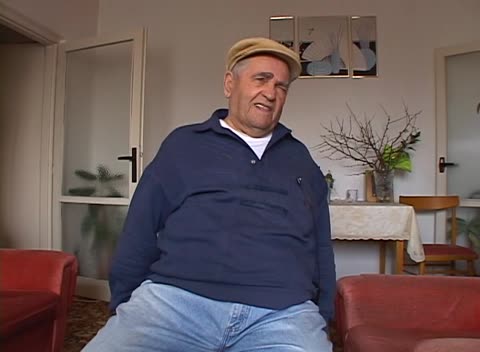
The team greets Chaimović and sets up the interview with him.
From the machine transcript
Greeting and setup: Kerler introduces a colleague who understands Yiddish, the participants settle on seating, and Kerler explains that the expedition has come from America and is working in Košice. He asks how Košice is said in Yiddish.
The formal interview begins. Chaimović talks about his hometown Hanušovce nad Topl'ou and antisemitic attacks in 1938. According to him, fifty Jewish families lived there before the war.
From the machine transcript
Chaimovic names his hometown Hanušovce and mentions its yeshiva, whose rabbi had five sons who became rabbis. He says the synagogue was burned on the eve of Yom Kippur in 1938 by Germans or local nationalists. He gives the village population as nine hundred, with about fifty Jewish families, and says a servant spoke Yiddish. He answers Kerler's questions about the town's location, 60 km from Košice, near Prešov and Vranov, and about the border.
adds the question of Yiddish-speaking non-Jews and the town's location and distance
Chaimovic provides personal information and talks about his family. His father was a wood merchant and owned a lumbermill. Chaimovic grew up with five brothers and one sister. Chaimovic's father taught his sons how to pray. His mother was born in Oleksandrivka (Shandorova), Ukraine, and his father was born in Monastyrets', Ukraine.
From the machine transcript
Chaimovic gives personal information and talks about his family. His father was an entrepreneur who dealt in timber from the forests and ran a sawmill. There were six sons and one daughter, and he names the brothers and his mother Hanna. He gives his birth year as 1922 and the years of his parents' birth. He tells how his father lost a hand while fishing, and says the sons were taught to pray and read the Torah. His parents came from places in what is now Ukraine near Khust, which he names as Shandorova and a town that seems to be Monastyrets (?).
adds his brothers' names and the story of his father's lost hand
Chaimović discusses his childhood memories and education. He attended a religious school (cheder) at the age of five. He recites the morning prayer "Moyde ani." He then recalls childhood games.
From the machine transcript
Chaimovic talks about his childhood: his family was not rich and not poor, and he went to cheder from age five and to state school from seven. He describes what he learned at home, such as the morning prayer and blessings. He played with non-Jewish children in Slovak, and S2 explains a Slovak word for a ball game.
Chaimović speaks about Sabbath celebrations, including food customs, at home before the war. He also sings a Sabbath song and talks about his family. Chaimović recalls how his mother prepared gefilte and falshe fish and addresses fasting.
From the machine transcript
Chaimovic describes the Sabbath at home before the war: his mother baked three challahs, kiddush, and zemirot, and he gives details of cholent and other Sabbath dishes. He sings a little of the table songs and talks about his mother's workload and the fourth meal. His mother made fish on Sabbath, including false fish, and he answers Kerler's questions about terms for the dishes. He also mentions the fasts and the nine days without meat.
adds the dish terminology and the fasts and nine days without meat
Chaimović addresses holiday celebrations and food customs. He then speaks about his cheder education, including his teachers (melamdim). When Chaimović was ten years old, he moved to Prešov and attended cheder there. He then speaks about prewar Jewish life in Prešov, including synagogues.
From the machine transcript
Chaimovic describes Hoshana Rabba customs and the cheese-filled dough he calls deltlekh (?). He names his cheder teachers and the Etz Chaim cheder in Prešov, where he went at ten to twelve. He then says Prešov had four synagogues, including an orthodox one and a Sephardic one, and explains the Sephardic prayer rite.
adds Hoshana Rabba and the synagogues of Prešov
Chaimović explains how his mother would visit the Spinka rebbe in Mukacheve to deliver kvitlakh (prayers placed on pieces of paper). He then addresses folk and healing customs.
From the machine transcript
Chaimovic says his mother would travel to the Spinka rebbe in Mukachevo with kvitlekh, requests for health or exemption from military service. He answers Kerler's questions about folk healing: pouring out coals, cupping, leeches, and the Slovak currency used in the cupping rite. Kerler also asks how long he stayed in Prešov.
adds the cupping and leech remedies
Chaimović talks about his education. After he finished his school education in Prešov after three years, he attended a yeshiva in Hanušovce . He then addresses prewar religious life in Prešov. According to Chaimović, approximately 6,000 Jews lived there.
From the machine transcript
Chaimovic says that after three years in Prešov he studied at the yeshiva in Hanušovce, 65 km from Košice. He describes Prešov as a Jewish city of six to seven thousand Jews, mentions its rabbis and its Hasidic synagogues, and talks about a rabbi's dispute. He explains the expression for a good Jew, and Kerler asks whether he remembers a Hasidic melody.
adds the rabbis and Hasidic synagogues of Prešov and the explanation of the term for a good Jew
Chaimović speaks about contemporary Jewish life in Košice, before addressing prewar Jewish life in Prešov. Chaimović did not have any relatives Prešov and ate food with different families.
From the machine transcript
Chaimovic speaks about the Košice rabbi, who comes from Israel, is intelligent and organizes Hanukkah events, and says only two people in Košice speak Yiddish. He then recalls Prešov, where he had no relatives and ate each day at a different family's table. He says visiting preachers (magidim) came to town.
adds the visiting preachers
Chaimović recalls how his mother read from the tsene rene. He then speaks about his yeshiva education in Hanušovce and answers questions about religious terminology.
From the machine transcript
Chaimovic says his mother read the Yiddish Tsene-rene on Sabbath to women. He says he studied at the Hanušovce yeshiva with about sixty to seventy students and a rabbi who inspected them. He gives the town's Jewish population as 1,200, tells how it is said in Yiddish, and answers questions about newspapers, Hungarian, the term ba'al shem, and a wooden synagogue.
adds the questions about the press, ba'al shem and the Yiddish name of the town
Chaimović talks about religious life before the war in Hanušovce nad Topľou. He recalls how members from the surrounding villages would get together for services in Hanušovce, Bystrý, Vyšný Žipov and Sol' for instance.
From the machine transcript
Chaimovic describes religious life around Hanušovce before the war: the Selichot service, people walking from villages to form a minyan, and the synagogue in Hanušovce. He lists shuls and mikvehs in the nearby villages, including Bystré, Vyšný Žipov (?) and Sol', and notes that the Vranov synagogue was destroyed. Kerler asks the Slovak name of Sol' and then for a prayer.
Chaimović chants the Hebrew-language liturgical song "Lekha Dodi."
From the machine transcript
Chaimovic chants Lekha Dodi at Kerler's request. Kerler offers to send him a cassette, and he talks about how his brothers took turns leading prayers and how his father immersed in a stream on Sabbath. Kerler and S2 discuss the Slovak and Yiddish words for stream and lake.
adds the talk about the stream and the cassette
Chaimović speaks about prewar Hanukkah celebrations.
From the machine transcript
Chaimovic describes Hanukkah customs before the war: the menorah, the dreidel made of wood, and the letters on it with their meanings, which S2 helps with. He says only Maoz Tsur was sung, and he knows no Yiddish songs but names Ernest Klein, a Yiddish speaker in Košice aged 93, and offers to phone him.
Chaimović speaks about contemporary Jewish life.
From the machine transcript
The talk concerns arranging contact with the rabbi and with Ernest Klein, including phone numbers and a time to visit. Chaimovic offers the interviewers food, which they decline. S2 speaks on the phone in another language.
Chaimović addresses prewar holiday celebration, including Sukkoth and Purim. He recalls snippets of Purim shpiels and performances of the Yosef Shpiel. He then addresses prewar theater performances by children.
From the machine transcript
Chaimovic talks about Rosh Hashanah prayer and building the sukkah, and about Purim customs: shalakhmones and fragments of a Purim play. He says the Joseph play was performed, lasting two or three hours, and that Jewish children acted in plays at Hanukkah and Purim in a large cheder room in Prešov. He also tells of four shochtim in Prešov who served as cantors.
adds the Joseph play, the Hanukkah plays and the cantor-shochtim
Chaimović speaks about prewar traditional weddings.
From the machine transcript
Chaimovic talks briefly about prewar Jewish weddings: Jewish weddings with beautiful huppot and a marshalik, and the mitzvah dance. The rest of the passage is Kerler, S2 and S3 working to reach someone by phone, who is said to speak Slovak and Hungarian, and who may be deaf (?).