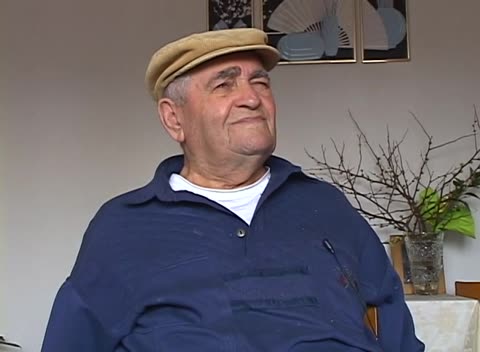
Kerler and Chaimovic discuss another man present who refuses to speak Yiddish or sing old songs; the speech is partly in Polish and largely garbled. Kerler then turns to Hanukkah and asks what kind of theater was played.
The passage is mostly about a man who will not speak Yiddish, not community members as such.
Chaimovic recalls Hanukkah games with paper and printed Yiddish booklets from Poland. Kerler asks about plays and customs at weddings, about a game, and about dancing.
Kerler's questions on other games and wedding dancing.
Chaimović talks about dance evenings at Jewish inns before the war, before he addresses Passover celebrations. He recalls how the community baked matzos. Chaimović then shares a recipe for chremslach.
Chaimovic describes Jewish inns with Gypsy musicians where people drank and danced. He tells of Passover preparations: home baking of matzo in household ovens two weeks before the holiday, shmura matzo and matzo for the pious, Passover foods and cakes, borscht from beets, and chremslach, with a recipe. Kerler asks for the names of terms and dishes, and the passage ends with a question about who spoke Yiddish in Prešov.
The passage includes elicitation of food terms such as potato names and latkes.
Chaimović addresses life and people in Prešov before the war. He also recalls Jews who converted to Christianity and Christians who converted to Judaism.
Chaimovic speaks about languages in Prešov, where Hasidim spoke Yiddish and others German or Hungarian. Kerler asks about coded Hebrew-based words, a baptized priest of Jewish origin, and gentile converts to Judaism, which Chaimovic describes briefly. Kerler also elicits dialect usage and then asks him to tell where he lived before the war.
Chaimović speaks about his life during the war. After he was caught in 1944, Chaimović explains, he was sent to the Sered' ghetto, where he witnessed the shooting of the Prešov Rabbi, Katz. He then speaks about prewar Jewish life in Košice.
Chaimovic recalls being caught and sent to the Sered' camp in 1944, where he saw Germans shoot the Prešov rabbi, named Katz. He names Prešov and another town as places he knew, then recalls Košice as a place with good people who invited the poor to Sabbath meals.
Includes his recollections of Košice's Jewish hospitality.
Chaimović speaks about his travels in Transcarpathia after the war. He then addresses prewar occupational structure and the sport club Maccabi in Prešov. Chaimović then lists prewar youth organizations, including Betar, Shomrim, Mizrachi and Agude. He states that he was a member of the Mizrachi organization.
Chaimovic says he visited Munkács and other Transcarpathian towns after the war, and Kerler asks about a rabbi of Munkács. He speaks about Jewish trades in Prešov, the Maccabi sport club and Zionist youth groups such as Shomrim, Betar, Mizrachi and Agudah. He says he was a member of Mizrachi, where they sang and danced.
Chaimović sings a song, he recalls from the Zionist organization, Mizrachi. He then answers questions about cultural terminology and mentions cemeteries in Prešov. Chaimović also addresses Yiddish dialects.
Chaimovic recalls a Mizrachi song, dancing the hora and learning some Hebrew. Kerler then asks terminology questions: dybbuk, the difference between rabbi and rebbe, Hasidim, Galician and Lithuanian Jews, and a Prešov cemetery. They also touch on Lithuanian Yiddish, folk tales and a comic character.
Adds the Hebrew learning and Kerler's terminology questions.
Chaimovic tells the legend of the Golem of Prague, who was made from clay, protected the Jews and lies in the synagogue attic, as he heard it long ago. Kerler then puts dialectological questions about words for attic, ceiling and floor; Chaimovic gives Slovak equivalents.
Chaimovic says he worked in the forests, taking over and recording the wood the workers prepared, for his father. He says that until 1938 things were better and then troubles began. Kerler asks about a song and then asks him to tell about the war years.
Chaimović talks about his life during the war, in particular the year 1938. He explains that local Jews were either confined to the Sered' or Nováky ghettos in 1942. Chaimović was imprisoned in the Sered' (from September 1944 to March 1945) and Terezín (from March to May 1945), Czech Republic, ghettos. He then describes his life during that period. He recalls individuals and shootings. He then talks about his family's fate and escapes during the war.
Chaimovic describes the restrictions and the star under the Germans and Hungarians and the camps at Sered' and Nováky; he says he was caught in September and held at Sered' until March 1945, then was sent on. He recalls shootings there, including a man saved by tallit and tefillin, the shooting of the Prešov rabbi and other cruelty, and nightmares that follow. His three brothers and a sister did not return; he tells of escaping from the police into the forest and of a Yom Kippur hiding in the woods with his mother.
Adds the Bardejov survivor, Yom Kippur flight into the forest and lost siblings.
Chaimović talks about his liberation from the Terezín ghetto in 1945 and his and his family's return home. He then addresses his best moments in life before the war.
Chaimovic recalls the Russians' arrival at Terezín, his escape over a wall and journey home with horses. Only his mother and some brothers returned; others stayed lost. The family had lost everything and began working again. Kerler asks for the best time he remembers; he names the time before 1938, with the Mizrachi.
Chaimović answers questions about cultural terminology, before he addresses his life during the Soviet period. He worked in a store of 120 employees for 32 years and recalls antisemitism. Chaimović was imprisoned for two weeks, he explains.
Chaimovic and Kerler discuss the term for a Wirtshaus (inn) in German and Slovak, and a joke figure, Soldier Schweik. Chaimovic then recalls working 32 years (?) in a shop with a hundred twenty employees, where he was the only Jew, and the antisemitism he met. He says he was jailed for two weeks after a false accusation and made Kiddush at home on his release.
Kerler asks Chaimovic to recite Kiddush; he and others present recite Kiddush and other prayers, including a memorial prayer, with garbled text. Passover songs and a melody are mentioned. Chaimovic says he lives alone, is ill with swollen legs, and Kerler wishes him health and mentions his own age.
Chaimovic says he has no children and no relatives in Slovakia; the children of his brother live in Israel. Kerler mentions the rabbi Yosi Stein and the few Yiddish speakers there, and talks of other very old Yiddish speakers interviewed in Ukraine and Romania. At the end Chaimovic gives his address to be written down.
Adds Kerler's remarks about other Yiddish speakers interviewed and the address exchange.