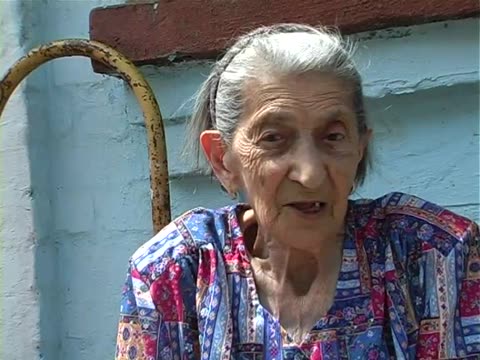
Pivnik discusses Jewish life before the war and talks about her family. Her family frequently attended synagogue services; Pivnik explains that they lived in close proximity. She then discusses prewar weddings and remembers how her mother would dress her up. Her mother was a dressmaker and her father was a baker. Pivnik recalls how her father has business contacts in different towns in Moldova. She then talks about her father’s life during the war in hiding. Pivnik explains how he was reported to the Germans by a fellow Jew.
Pivnik answers questions about her family: stepsiblings, a stepmother and a stepbrother Misha who stayed close to her. Her family lived with a landlord near the synagogues and went often. She recalls her sister's wedding and being dressed up in clothes her mother sewed. Her mother worked at home as a dressmaker and her father was a baker who traveled for business and organized free kitchens in the 1930s. He was killed in the war; the transcript says that after refusing non-Jewish neighbors' offer to hide him and his daughter he was betrayed in the ghetto by a Jew. She also says Yiddish was spoken at home and recalls an aunt who spoke only Yiddish and friendly non-Jewish neighbors.
Also covers her stepmother and stepbrother, her father's food kitchens, and Yiddish-speaking neighbors.
Pivnik discusses prewar Jewish life in Balta. She addresses the negative relationship to her neighbors before the war and the positive ones today. Pivnik remembers the beautiful voice of the cantor Slivke and his family. Slivke would put on concerts after the service in the synagogue. Pivnik addresses prewar Jewish occupations.
Pivnik discusses relations with non-Jewish neighbors before the war and after it, and neighbors who brought her father produce and invited him to their weddings. She says she saw no Hasidim in Balta, then talks about a rich Jew named Pisarevsky (?) who built the Jewish hospital. She remembers the cantor Slivke, whose wife and children sang with him. Concerts were given in the synagogue after services, and she and other children ran in to listen. She also lists shops, craftsmen and synagogues she remembers.
Adds the Jewish hospital built by a rich man, the synagogue buildings, and the crafts of shoemakers, tailors and bakers.
Pivnik talks about prewar holiday celebrations at home, in particular Purim. She recalls how people would go to a neighbor’s house to get hamantashn (cookies for Purim). Pivnik talks about prewar Jewish life under the Soviets, as well as food customs. She remembers her tailor friend, Khoskl.
Pivnik talks about how holidays were kept at home, with her mother and grandmother, Passover matzo and seder, Purim hamantashn baked by a neighbor and Simchat Torah dancing near the synagogue. She also recalls Jewish streets in Balta and Jewish officials, and the Soviet authorities not interfering. The interviewers ask about potato pancakes (tatshiklekh) and customs after the war: a shoykhet, and the old tailor Khoskl, who went to read prayers. A discussion of songs at the seder follows. The talk turns to Jewish weddings.
Adds Passover, Simchat Torah, Jewish streets and officials, potato dishes, and the postwar shoykhet.
Pivnik describes her sister's prewar wedding ceremony under the huppah, with the rabbi and customs such as seating the bride on a bench and circling her. Discussion of the custom of giving 'makes' (?) to the in-laws, with Kerler asking where the term comes from and what it means. The talk moves to folk beliefs: the evil eye and its remedies, and extinguishing coals. She then recalls childhood: Jewish children in her courtyard, games of acting and dancing, and her Yiddish school.
Pivnik talks about her school education at a Yiddish school, which she attended for five years. In particular, she remembers her first grade teacher Grobman. Pivnik then talks about Yiddish journals.
Pivnik says she studied for five years at a Yiddish school and remembers her first-grade teacher, Grobman, as being like a mother. Lemster asks what was taught there: Yiddish, literature including Peretz and Mendele, and Soviet Yiddish writers such as Markish and Fefer. She does not recall poems but says she read the journal Sovetish Heymland.
Adds the literature taught and the Soviet Yiddish writers and journals she read.
Pivnik talks about her life before the war. She lived in the Jewish autonomous region Birobidzhan in 1938 and 1939, working as school inspector (?). She lived with her sister, who moved to the region after it was founded in 1938. Pivka then talks about Jewish culture life before the war. She remembers a performance by Clara Young.
Pivnik talks about her time in the Jewish autonomous region of Birobidzhan around 1938–39, where her sister had moved and where Yiddish was spoken; she worked there in a school-related job (unclear). Lemster mentions the poet Lyuba Vasserman. She recalls a prewar concert in Balta by Clara Young, a performer from America, and an acting couple who settled in Balta. Many Jews attended. The conversation turns to Balta's size and to Hershl Polyanker's writings, then to her reading in Russian and Yiddish.
Adds Birobidzhan details and Polyanker and the Kolomyia baker.
Pivnik talks about her life before the war. She studied to be a flour miller in Odesa at a technical school. She was in the Komsomol. After the war, she worked as a cleaner. Pivnik then talks about her family, before she talks about life today. Pivnik lived in Israel for eight years.
Pivnik says she studied milling at a technical school in Odesa, a Jewish technical school, and was in the Komsomol and sent to courses. Lemster asks about Jewish kolkhozes before the war. She speaks about her sister's daughter and grandchildren, who study at a Jewish university in Odesa, and her own eight years in Israel, where she managed with Yiddish and some Hebrew. She talks about being old and staying home, the family's trips to Uman, and her reflections on memory. The interviewers talk about where they themselves live, and Balta's Yiddish name.
Adds the Jewish kolkhozes, her grandchildren's studies, her time in Israel, and the interviewers' own backgrounds.
Pivnik addresses life before the war. She does not recall antisemitism. She then talks about life after the war and housing, before Pivnik addresses her life in evacuation. She worked in a sugar shop. Pivnik then talks about her husband, who was an actor. She got married in 1942. Her daughter Ala Pivnik joins the conversation and explains how she learned to speak Yiddish from her aunts. Ala came to Balta at the age of three, when Pivnik moved back from Birodbidzhan.
Pivnik says she does not remember antisemitism before the war, and a Russian remark says there is none now. She and her daughter describe their housing and privatization, then life in the Soviet Far East during evacuation, where goods were cheap and she worked. She says her husband was an actor named Misha Petrov (?) whom she married in 1942. Her daughter explains she came to Balta at age three in 1947 and learned Yiddish from the large family of aunts, not her mother. Kerler urges them to speak more Yiddish.
Adds her housing and privatization, her marriage in 1942, and the family's Yiddish language use.
Pivnik and her daughter answer questions about cultural terminology and Yiddish words, such as dibbuk, golem, a nickname, 'latke'-type terms and the word for a convert (meshumed). They discuss the origin of some terms. Kerler asks about the prayer modeh ani and her mother's candle-blessing, and she says her mother died young. Lemster ends by asking about Jewish life in Birobidzhan and why it declined; she mentions her sister Khana.