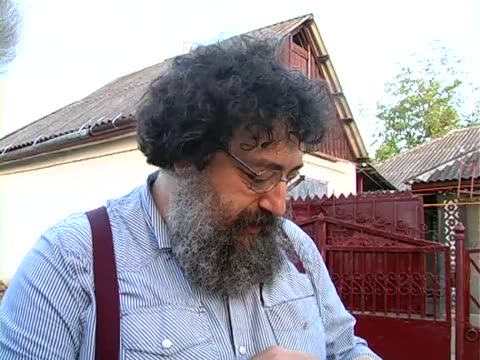
The first part of the tape is a brief encounter with Anna who provides information about potential interviewees of the region and talks about her family in Russian.
Informal talk, mostly in Russian, between the team and a woman, Anna, outside a house. The researchers explain that they are recording elderly Yiddish speakers for an American university and ask where such people live, including in Balta, Kotovsk and Bratslav. Anna speaks of her family, her parents in Germany, the old family house and the wartime ghetto in that district of Balta. She gives an email address, and a neighbour is mentioned.
The catalogue says Anna talks about her family; the transcript also shows a search for informants in Kotovsk, Bratslav and elsewhere, a mention of the Balta ghetto, and the contact details being taken.
Short stretch with little intelligible speech: a repeated question about how something was said, then the team moving on, with no content that could be described beyond the filming of the town.
The transcript shows only a recogniser loop and no usable speech.
The second part of the tape is a formal interview with Ester (Esfir) Srulevna Borukaeva, nee Mulerman, born 1933 in Balta. The team greets Borukaeva and they set up the formal interview with her. She provides personal information.
The team greets Borukaeva and settles in, with talk of languages: she says she speaks mostly Russian but understands Yiddish, and mentions a visit to Israel. She states that she was born in Balta in 1933, that she lived in the ghetto there, and she gives her name Ester (Esfir) Srulevna, her maiden name Mulerman and her married name Borukaeva. Kerler then begins asking about her childhood years.
The catalogue says she provides personal information; the transcript also shows talk about which languages she speaks and a mention of her trip to Israel.
Borukaeva discusses her childhood memories and talks about her family. Her father, born in Pischanka, passed away in 1944. Her father worked as a baker. Borukaeva grew up with four siblings. One brother moved to Israel and one sister to Germany. She then talks about her husband and her parents.
Borukaeva recalls her prewar childhood: playing with other children and going to the cinema, and the language of the home. Her father, born in Pyshchanka (?), worked as a baker and died in 1944; her mother died later. She names siblings, among them two brothers killed in the war and one who died in Israel, and a sister now living in Germany. She also tells of a husband or relative whose character and illness are hard to follow, and of her mother's illness, ritual slaughter and a trip to the Rybnitsa rebbe.
The transcript adds the brothers killed in the war and the father's work at a central bakery, and a story involving the Rybnitsa rebbe; it does not clearly show the husband material.
Borukaeva answers questions about the family and prewar religious life: her grandmother died in the ghetto, and she attended a Russian school, not a Yiddish one. She recalls her mother's cooking for Passover, the Purim pastry, her mother's Sabbath prayer and her father's synagogue attendance. She explains that her father and the father of Mulerman were brothers, and that his family lived in Kharkiv. She also mentions the one remaining Jewish woman in Pyshchanka and says she used to sing.
The catalogue's remark on Kharkiv fits the cousin Mulerman's father; the transcript also shows the school language, a remaining Jewish woman in Pyshchanka, and talk of her own singing.
Borukaeva discusses life after the war. She worked in the Balta sewing factory working with computers, before her husband arranged work for her as a photographer. She addresses the hard work at night and later on a kolkhoz. Borukaeva then talks about her family and how she met her husband, originally from the Caucasus, on a train. Borukaeva recalls her cousin Vadim Mulerman, who professionally sang Yiddish songs. Borukaeva also used to sing.
Borukaeva talks about her postwar working life, including night work and a photographer's job, and how she met her husband on a train from Odessa; he spoke pure Russian. She then speaks about her cousin Vadim Mulerman, a singer who performed Yiddish songs and was reportedly forbidden to sing for about twenty years, and who later visited Balta and her home. She also mentions his Yiddish, his brother and the family burial in Kharkiv. Her own singing is brought up.
The transcript shows the cousin's twenty-year ban on Yiddish singing and his visit to Balta, in addition to her work and how she met her husband.
Borukaeva talks about her life during the war, when she was forced to live in the Balta ghetto. She recalls shootings in 1943, as well as episodes regarding postwar antisemitism. She remembers how Romanians soldiers helped the ghetto prisoners out with food. Borukaeva briefly recalls the day of the liberation of the Balta ghetto in 1944, and addresses the episode, when Jews were burnt in a barn during the war.
Borukaeva describes the war in the Balta ghetto and finds it hard to tell. She recalls a shooting, a mother and child killed in the yard, and an episode of a policeman and a staged Soviet song. She also tells of Italian and Romanian soldiers who helped, of Bessarabian Jews in the ghetto, and of liberation on 29 March 1944. After Kerler and Lemster ask, she speaks of the shootings in 1943, of a girl who was killed, and of a barn where Jews were burned. Some of the account is given in Russian.
The catalogue lists shootings in 1943, helpful Romanian soldiers and the liberation; the transcript shows she credits Italians and also tells of a staged Soviet song and a film about the Warsaw ghetto.
Borukaeva talks briefly about life today, including the family cat and a television programme, partly in Russian. Lemster asks her to sing, but she says she can no longer sing. She speaks of her brother who died two years ago and who had lived in Israel. The interview ends with thanks.