0:00
The first brief part of the recording includes town footage.
The division was proposed from the catalogue's descriptions and the machine transcript, not stated by the catalogue (how).
The first brief part of the recording includes town footage.
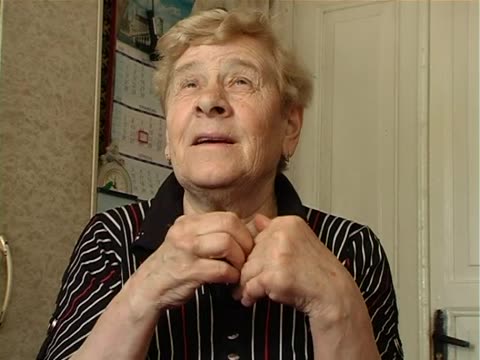
The team greets Miaskovskaia outside her home and sets up the interview with her. Then the formal interview begins and Miaskovskaia provides personal information.
Kerler greets Miaskovskaia and begins the interview. She gives her date and place of birth in Balta, her Russian and Yiddish names and her father's name.
The greeting outside the house is not visible in the transcript; the personal details are mainly names and birthdate.
Miaskovskaia talks about the house she lives in. She then speaks about her family. Miaskovskaia then describes her work as teacher at a Russian school in Balta and mentions how people made fun of her patronymic.
Miaskovskaia talks about the brick house she lives in, left by her parents and rebuilt by the family after the war. She gives her mother's name and the birth years of her parents. She says she worked in a Russian school teaching the younger classes, and explains how her name was made fun of.
Details of the house, including rebuilding and the building rules, and the parents' birth years.
Miaskovskaia speaks about her family's life at the beginning of World War II. She describes how her family evacuated to the Donbas region and then Orenburg by foot. Miaskovskaia grew up with one sister, who lives in Germany.
Miaskovskaia recalls the start of the war. Her father was drafted. She, her mother and her older sister left Balta with an uncle on a horse cart toward the Donbas. The horses were killed in the bombing, and they went on foot to Orenburg. She mentions carrying water as a child.
The sister (her 'older sister') is mentioned but her residence in Germany comes later; hardship carrying water is also described.
Miaskovskaia speaks about her family, in particular her grandfather's observance. Miaskovskaia also sings a Yiddish song about an old couple, she remembers from her grandmother. Miaskovskaia raised a daughter and a son, who lives in Germany. Miaskovskaia also speaks about her visits to Germany. Miaskovskaia's father worked as forwarding agent (экспедитор) at a warehouse. Her parents kept pigs, a cow, chickens and ducks. Miaskovskaia mentions that she also kept pigs until five years ago.
Miaskovskaia remembers her grandfather praying and her grandmother, and sings a Yiddish song about an old couple at a sick child's bed. She talks about her children and grandchildren in Rybnitsa and Germany, their languages and her visits to Germany. She gives the names of her grandparents and her father's work as a forwarding agent at a warehouse. Her family kept pigs, a cow and ducks before the war and for selling.
Details of the family in Germany and Moldova, their languages, and a question about eating pork.
Miaskovskaia speaks about her wedding after she had been with her husband for fifty years. She then addresses weddings in general.
Asked about Jewish weddings in Balta, Miaskovskaia says she remembers none. She mentions that she married a second husband after fifty years. Lemster and Kerler ask about cake, dancing and the chuppah, and she only knows a chuppah. The interviewers also explain the project to her.
Wedding customs asked about by the interviewers; the project is explained.
Miaskovskaia talks about contemporary Jewish life in Balta, before speaking about her life after the war. In particular, she recalls her mother-in-law's baking and addresses postwar religious life.
Miaskovskaia talks about Jewish life in Balta today, including Friday-evening prayers and a younger man who speaks Hebrew but no Yiddish. She recalls her mother-in-law's baking, a Russian Passover and Jewish baking, and a postwar shoykhet. She mentions the synagogue and her school, with children of various backgrounds.
Details of a younger Hebrew-speaking man, the shoykhet and the synagogue.
Miaskovskaia addresses prewar Jewish life and talks about the Balta ghetto. She then briefly discusses her childhood memories, including games, before reciting a Russian poem.
Miaskovskaia says Balta was largely Jewish before the war and mentions the ghetto. She talks briefly about childhood games with Jewish children, then recites a long Russian poem about the war dead and an eternal flame.
Recitation of a Russian poem; the ghetto is mentioned briefly.
Miaskovskaia speaks about her family, particularly children and husband. She then shows family photographs.
Miaskovskaia talks about her children, who live in Germany and Rybnitsa, her grandchildren and her late husband, a skilled mechanic. She shows photographs of them, and mentions that her husband died after an operation in Germany.
A photograph of her husband and his death after surgery.
Miaskovskaia sings again the song about an old couple.
Miaskovskaia sings the Yiddish song about the old couple again, as Lemster requests.
The camera collects some street footage of Balta, where a memorial to the victims of the Balta ghetto is located. Then the team proceeds to to Angelova's apartment. She then speaks about her life today.
The scene moves to Angelova's flat, where the interviewers introduce themselves and Angelova speaks about her life today. She talks about her health, operations and a visit to Israel.
Angelova's health and operations; the street footage of Balta is not visible in the transcript.
The formal interview begins. Angelova provides personal information.
The formal interview begins. Angelova says she was born in Topole in a region whose name is unclear in the transcript. She grew up there until the war, in about 1920, and her parents worked in a shop. She also mentions that Jews in Krasne Okny were killed.
Mention of the killing of Jews in a nearby town.
Angelova speaks about her family's life at the beginning of World War II. Her parents owned a shop and sold their produce. She then continues to provide personal information and speaks about her family. Angelova's father was born in the Raşcov province and her mother also in Topole. Her parents owned land, as well as kept cows and pigs. She then describes her family home. Angelova then describes how her mother joined a kolkhoz in the 1920s.
Angelova gives her name and her father's name, Kolman. She says her father came from the Rashkov area (Bessarabia) and her mother from Topole. The family had a house, land, cows and pigs, and her mother also kept a small shop and later joined a kolkhoz.
Father's origin and a brother hiding in an attic.
Angelova talks about prewar Jewish life in Topole. According to her, approximately fifteen families lived there. She then addresses the period of collectivization in the 1930s when the state expropriated her parents. Angelova then speaks about her family. Her father worked at a manufactory and Angelova on a kolkhoz during this period. Angelova grew up with four siblings. They moved to Kotovsk in 1939, where her parents worked in shops.
Angelova says that about fifteen Jewish families lived in Topole and describes collectivization. The family's cows and horses were taken, her father resisted and the family worked on the kolkhoz. She grew up with four siblings. They moved to Kotovsk, where her parents worked in shops.
Mention of a brother's departure.
Angelova speaks about her family's life at the beginning of World War II. She mentions assemblies to gather Jews for forced labor.
Angelova recounts the start of the war. Her older brother left, while her parents and grandmother stayed. The Germans registered families and assembled Jews at a stadium.
Angelova talks about her family, particularly her grandparents. She also addresses her family's life before the war.
Angelova gives the names of her grandfathers and grandmothers, and says one grandfather was a kulak who kept pigs. Lemster and Kerler also ask about the date of collectivization and about her grandfather's origin in the Rashkov area.
Names of the grandparents and the kulak story.