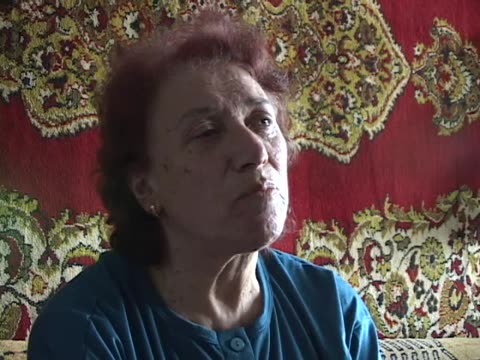
Vaynman explains that after the war her mother and she were allowed to travel only as far as Vinnytsia and could not go on to Lviv. Her mother, widowed, feared bandits (Banderites) there, so she stayed and found work in a kindergarten and later a factory, then remarried in Bar to a veterinarian. Vaynman gives her mother's maiden name Sandler and her father's family name. She says they came to Bar at the end of 1944, and discusses her Yiddish and its closeness to Polish and Lithuanian Yiddish.
Includes her half-brothers and her mother's remarriage and Yiddish dialect.
Kerler asks about the prayers her mother said at home after the war, which Vaynman says were from an old prayer book, in Hebrew and some Yiddish. Questions then turn to whether an old synagogue or its ruins survived in Bar; Vaynman says there was none when they arrived, only a ritual slaughterer. A Russian-speaking local joins in about the Turkish or Polish fortress and where synagogues once stood, with the Germans having destroyed Jewish buildings. Kerler asks for more about the postwar years.
Shifts to a discussion of old synagogue buildings in Bar, with a local helper speaking Russian.
Vaynman describes Jewish life in Bar after the war, when survivors returned and lived in the few remaining old Jewish houses, which Kerler asks about (white walls, benches outside). She says her mother observed the holidays, her stepfather less so, and that she herself still keeps Passover and eats no bread then. Kerler asks about her mother's songs and Yiddish songs known from childhood, and about stealing the afikoman at the seder.
Includes houses, Passover observance, and songs her mother sang.
Vaynman recounts what her mother told her of her own family. Her grandfather returned from war on one leg and died, and her mother was the youngest of seven children, born after his death. She went to a Yiddish school and a Yiddish college. Her mother's brothers were all killed in the war, in a forest near Lviv, where a memorial stone was later put up. She names her grandmother and grandfather and recalls her grandmother's synagogue-going before the war.
Covers grandparents and murdered uncles, which the catalogue label only hints at.
Vaynman answers Kerler's questions on Jewish life in Bar after the war: returnees still spoke Yiddish but few could read it, and they came to her mother's home on holidays to hear her pray. She describes minyans held in houses, gathering ten men for funerals, a local man looking after the community, and how it faded as older people died. She says emigration to Israel began a dozen or so years before and discusses how many Jews were in Bar then and now, with a Russian-speaking local adding figures.
Adds minyans, emigration, and the size of the Jewish community.
Kerler thanks Vaynman for the interview and praises how she has kept her mother's Yiddish; she says she has no one to speak it with. Katz asks about Yiddish periodicals, and she says they receive them and a newspaper from Vinnytsia. Kerler describes the project and leaves her some paper about it.
Footage of the team looking for the address of the next interview. Local helpers speak Russian and Ukrainian, asking people on the street for a house number on a street (Nechaia (?)), with some Yiddish exchanges about Vilna and a name that the transcript does not make clear.
The team arrives at Zhovtis's house and greets him at the gate. He says he understands Yiddish but speaks it poorly, and finds out Kerler is from Khmilnyk. Kerler explains the project and recording, and the interview is arranged.
Kerler opens the interview with Zhovtis, a native of Khmilnyk, asking about his name and his childhood. Zhovtis gives his parents' names and says they were from Khmilnyk. He mentions a brother, a sister, and a grandfather with relatives in America, and that he finished seven classes.
Zhovtis tells in a long and hard-to-follow account of the German occupation. He describes the first killings of Jews and communists near Khmilnyk, and the roundup of Jews from the town and surrounding villages, including his mother, siblings and himself. He escaped while his mother was being beaten and was taken in by a non-Jewish villager, who gave him milk, but a local officer turned him in. He also describes forced labor for German and Romanian commanders, repeated escapes, and falling ill. He was taken to Mohyliv-Podilskyi. He names several places, but their spelling is not clear in the transcript.
Kerler asks whether Zhovtis's parents survived. Zhovtis says that his family were taken to be shot in a village near Khmilnyk, and describes a collective farm there with Jews and Christians. Kerler tries to clarify what he has understood.
Kerler asks Zhovtis to go through the occupation again and Zhovtis explains the killings in January and the forced labor on the roads and in a town. He describes his work, going to Zhmerynka and Murafa, harsh treatment, the dangers of bridge-building near Mykolaiv, being weak and ill, and being taken to the station and to Mohyliv-Podilskyi. When the Red Army arrived he left on foot for Khmilnyk, found no Jews left, and was then drafted. He served seven years, in the north near Murmansk, as the only Jew among many.