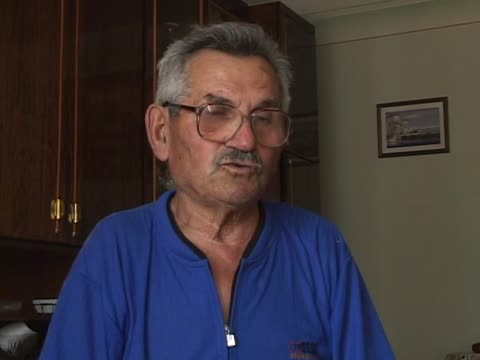
Zhovtis talks about his military service and its end, and about coming back to Litin and Khmelnyk after the war. He tells of marrying in the 1950s and of working in a factory for some thirty years. He also mentions leading a group of families across a border, a bridge over a river and Romanian and German soldiers. He names his children and where they live, including one who is a doctor, and a visitor from America.
also covers the border crossing with families and Romanian soldiers, and his children and their residences
Zhovtis speaks of relatives in Israel and of life there, mentioning Haifa and a place where people travel to work. He says his wife came from Lithuania and speaks Yiddish better than he does. He talks about a flat or plot bought for a large sum, and says he cannot travel because of his health and a daughter's death.
adds that his wife came from Lithuania and that his own health keeps him from travelling
Kerler asks about family. Zhovtis says his mother was a dressmaker and his father worked in a factory. He also names his paternal grandfather as Yankl and his maternal grandmother as Sara. Details of the household furnishings are unclear.
Asked about life in Khmelnyk before the war, Zhovtis recalls it as good and speaks of low prices. He recalls antisemitic insults, the fear he felt under the Germans and keeping quiet about being Jewish. In reply to Kerler he describes the synagogue, Sabbath and weekday prayer among older men, and not having seen a rebbe. Kerler then asks about Passover, and he describes koshering utensils with a stone and hot water, and pancakes or dumplings made of matzo meal.
adds Passover utensil koshering, antisemitic insults and the synagogue and Sabbath prayers
Zhovtis answers questions about Passover food and the seder: potato and matzo-meal pancakes. His father did not lead the seder, and the household gathered at a relative's, but he does not recall the four questions. He says his father did not teach him the morning prayer, and tefillin are mentioned.
Zhovtis says he attended a Ukrainian school, and recalls childhood friends and speaking Yiddish before the war. He says he came to Bar in the 1960s (?) and talks about a club where Yiddish is spoken and a visit to a memorial to Holocaust victims in Israel. Kerler asks about the interviewee's life, including how the Sabbath was kept.
adds Ukrainian school, Yiddish-speaking club and a memorial visit
Zhovtis describes Sabbath in his parents' home: his father went to prayer, his mother blessed the candles. They talk of children's gifts at Hanukkah, fasting on Yom Kippur, and Purim and its sweets, and of the dreidel. He does not recall Shavuot customs, and Tisha b'Av is only vaguely recalled.
Zhovtis discusses non-Jews who spoke Yiddish, including Romanian soldiers, and their attitude to Jews. He recounts being beaten and the arbitrary violence under the occupation, and being made to wear a cross-like sign (?). There is talk of a mayor, of Purim fare and of Passover utensils, and of not eating pork.
adds food customs and Romanian soldiers who spoke Yiddish
Zhovtis answers Kerler's questions about kashrut: the use of fat, salting meat, the shoykhet and kosher slaughter. His account of the details is unclear.
Zhovtis says he came to Bar in 1954 for work, and mentions Litin. He talks about the Jews who settled there and spoke Yiddish, and says there was no synagogue, so people prayed in a private room. Kerler asks about an old synagogue building, which Zhovtis does not know.
adds Bar's lack of a synagogue and the question about an old synagogue building
Kerler puts a long questionnaire of Russian words and short sentences to Zhovtis, asking him to translate them into Yiddish. Items include a book, house, hole, cat and mouse, window pane, colours, hearing and deafness, 'later' and 'earlier', being ill, 'where are you from', bed and 'please', numbers, thanks, midwife, taste, street and road, potatoes, Hanukkah pancakes, and 'we were seven'.