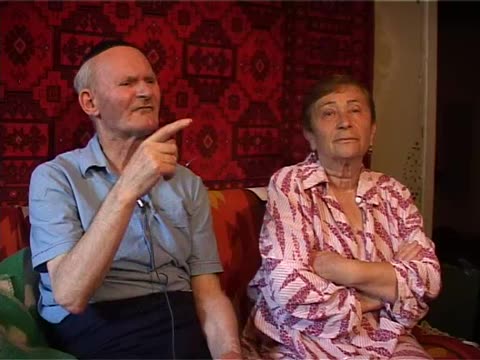
Shor recalls his earliest childhood memory: as a child he fell seriously ill, and his mother's brother took him to a revered Jew in Rîbniţa, who helped after the doctors in Chişinău could not. He then tells a family story about his father's richer younger brother. The brother's wife and Shor's mother quarrelled over a synagogue seat before Rosh Hashanah and drew lots, and the wife later died.
The passage also contains the story of the dispute over a synagogue seat.
Answering Kerler, Shor describes Orhei as a Jewish town, 90 per cent or so Jewish (?), where people traded and lived well in Moldova's good climate. His mother's brother lived in a village with large wine-making holdings. Shor remembers sowing tobacco and wheat there, and says the estate was later dispossessed under Soviet rule.
Gives the town's size, wine-making and the uncle's village estate.
Kerler asks the meaning of the word 'papshoi' (maize/corn), and Shor explains that it is maize, from which mamaliga is made. They discuss mamaliga and the lack of maize flour where they are now.
Shor says he studied with a melamed who came to the house, because there were no Jewish schools; he went to a Moldovan school and learned to pray from the prayer book. He says the synagogue was closed in 1939 and gives the number of synagogues in Orhei as about twenty. Kerler asks about the difference between a shul, a kloyz and a beys-medresh, and Shor says he does not remember. Shor says his wife knows a lot about kashrut and holidays.
Covers private tutoring at home, the number of synagogues and the 1939 closing of the shul.
Kerler asks about Jewish holidays, and Shor and a woman name some, such as Rosh Hashanah and Purim. Shor recalls that the community paid a lot to bring a top cantor from Chişinău or Bucharest for the High Holidays. Kerler asks the Yiddish word for a person with a good voice, and the answer is not clear.
Kerler asks about klezmers and Jewish weddings in Orhei. Shor recalls a wedding of his mother's sister's husband's relative (?) with a huppah and musicians, but cannot recall a badkhn.
Shor says that only one non-Jew lived near them in Orhei and he spoke Yiddish fairly well. Asked about Hanukkah, he remembers Hanukkah money and playing dreidel. He describes Sabbath at home: his mother baked challah, made a meat soup with noodles, and bought fish and stuffed it.
Also covers the one non-Jewish neighbor who spoke Yiddish and the Sabbath fish and soup.
Shor says he spoke good Yiddish at home. Kerler asks a few questionnaire items, such as the Yiddish for the prophet Elijah and the drinking at the seder. Shor cannot recall them, and others in the room chip in.
A man in the room says there is an older Yiddish speaker in the area, over eighty and born in Orhei (?) or nearby. Shor says he was born in 1925 and that man is a year older.
Names a possible surname, Skablitski (?), and gives Shor's birth year.
A man in the room mentions an older Yiddish speaker in the area, over eighty, and Shor gives his own birth year as 1925, a year younger than that man. The transcript is partly garbled.
Kerler puts a long series of dialect questionnaire items, including attic, sun, son, tooth, book, deaf, bluish, 'a lot of Jews' and Purim pastries. Shor answers some and says he has forgotten others. In the middle Shor says that after the war he went to Orhei when his mother's sister died aged 85, and describes the Jewish cemetery, where the dead are laid on boards, not in a coffin. He also gives the meaning of 'golem' and answers questions on Purim food.
Includes the postwar visit to the Orhei cemetery and the burial custom with boards.