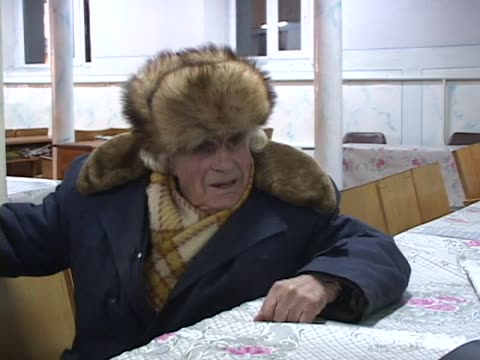
Furman speaks about his wartime army service, including Stalingrad and the Volga, where many soldiers drowned. Kerler and Lemster ask how he learned that his parents had been killed, and he explains that the Russians wrote letters while he had no one to write to. He mentions soldiers' slogans for the motherland and for Stalin, and the interviewers ask about them.
The passage turns to his parents' deaths and to soldiers' slogans for Stalin and the motherland.
Furman recalls being in hospital, where his leg was amputated, and coming to Berdychiv in 1945 to find no one. He bought an apartment, married and settled; his wife died thirteen years ago. He mentions the bombing of his evacuation train and being wounded, and says he worked as a furniture maker and did not go to synagogue. The passage ends as Kerler starts asking the Yiddish word for the cross.
Besides the return, he describes his amputation, his marriage and work, and the bombed train.
Short elicitation in which Kerler and Lemster ask for the Yiddish word for the cross and what is done when seeing it, such as spitting three times. They then ask Furman about his childhood.
Furman remembers attending a school in a small street and the terrible famine of 1933, when people fell dead from hunger. He had to leave school to work for half a kilo of bread, and Kerler asks whether Jews also died and for the Ukrainian word for the famine. He says his father was a learned man who prayed well but taught him little. He cannot recall Jewish jokes or songs and mentions only anecdotes about Hershele.
It also covers his father's learning and prayer, and Lemster's questions about jokes and songs.
Furman tells an anecdote about Hershele Ostropoler (the name is only partly clear). Hershele, struck by a drunken peasant, sends him to a merchant named Chaim, who beats him, and the peasant is then arrested.
Lemster and Kerler ask Furman for Yiddish songs, including ones his mother sang. He says his mother worked and had many children, then sings a couple of songs, one about a wedding in the barracks and a soldier's farewell, another a love song about waiting for years. The interviewers press for more and then arrange to move on to another interviewee.
Formal introduction of Soyfer. He gives his name as David Isakovich Soyfer and says he was born in 1930. He lives in Berdychiv, on a street and in a building given in Russian (Sverdlova, apartment 4). A second person asks about transport, and Kerler arranges for him to be driven.
Soyfer recalls his childhood. His mother died when he was eight, and he lived with her sister in a village not far from Zhytomyr during the famine. He gives his mother's name as Sara (?) and says he was named after his grandfather David. He lived with relatives, and his father was a shoykhet; Kerler and Lemster question how he could work in Berdychiv as one.
Soyfer discusses religious life in Berdychiv. All synagogues were closed before the war; after the war the communists were asked and a synagogue reopened within a year, though children were not allowed to attend. He recalls charity before Passover, the closing of Yiddish schools, antisemitism in Kyiv, and being evacuated.
Besides the synagogue and its children, he mentions Yiddish schools, Passover charity and antisemitism in Kyiv.
Soyfer describes being evacuated, in the Northern Caucasus with his grandmother, who was later killed by the Germans, and then to Kazakhstan, in Alma-Ata. He tells of antisemitism, being beaten, and working as a child. His uncles' fates are given, one killed in the war and one living in Moscow, and he says his grandmother had six children.
Soyfer says his grandmother Rakhl lived in a village (named as Sadyba, doubtful) near Zhytomyr, and that after his mother died he was taken to Kyiv. Kerler asks how Zhytomyr differed from Berdychiv.
Soyfer compares Berdychiv with Zhytomyr. Berdychiv was more Jewish, and Jews could live there although they were restricted in Kyiv and elsewhere. He says that Berdychiv had no pogroms of its own except one by the Poles around 1918–19, and that young Jews fought non-Jews.
Soyfer speaks about his grandmother Rukhl, who spoke Yiddish, Ukrainian, Polish and German but no Russian. In her village, non-Jews could speak Yiddish and ate at Jewish tables, including at Passover, and he recalls a related story from his father. Lemster asks about her sayings and about Christians who spoke Yiddish.
Soyfer says that his father had remarried and that he found them on his return to Berdychiv in 1945. He mentions antisemitism, Jews being mocked, and that he was in Moscow. Kerler asks questions about the family.
Besides the return to Berdychiv, it covers his father's second marriage and antisemitism.
Soyfer speaks about army service, which began in about 1950 (?), where Jews were mocked but not beaten. He was a Communist for thirty years and worked for thirty-five years. His family's apartment was taken, and he has one daughter.
Kerler elicits Yiddish words from Soyfer, such as 'sick', 'pious' and 'honest', and he explains how his old grandmother used them. He says his wife is blind and bedridden and mentions the Joint's help and the loss of savings. Lemster asks about theater after the war, and Soyfer recalls a Jewish troupe from Moscow.
The passage mixes word elicitation with his wife's illness, the Joint's help and theater after the war.
Soyfer says that after the war Jewish artists visited Berdychiv. He did not study Yiddish and read Sholem Aleichem in Russian. The interviewers ask whether he knows names of Yiddish writers and artists, then ask for songs, one of them a recruits' song.
Soyfer speaks about Berdychiv before the war. Few people had radios or electricity, many Jews were very poor, and his father said a herring cost a groschen. He remarks that many Jews today cannot speak Yiddish.
Soyfer and the interviewers discuss Jewish food: fish every Sabbath and a baked stuffed stomach dish, chicken soup, and the scarcity of kosher meat. They add carrot tsimes, Passover dishes, fruit brandies, and the Yiddish word for vodka, with Lemster comparing Moldova.
Soyfer says that Berdychiv has no new Jewish cemetery but an old one, that earlier Jews and non-Jews were buried together, and that the rabbi is now to be given a plot. Lemster asks about Soviet Yiddish writers.
It covers the cemetery being shared with non-Jews and the rabbi to be given a plot.
Soyfer says he does not remember Yiddish Soviet writers and read in Russian. He had heard of Polyanker, and states that the Jewish Antifascist Committee members were shot in the late 1940s.
Soyfer speaks about antisemitism in the army. Jews were mocked but not beaten, and he was asked about what Jews had done, probably the Doctors' Plot. A Belarusian colonel asked about it and he said he was glad the Jews had been released. Lemster asks about his youth, and he mentions his mother's death in Zhytomyr four days before Hanukkah.
Soyfer says his mother died in a Zhytomyr hospital when he was eight and the family grew very poor. He is asked about the Yiddish word for hospital and talks about the grave, his brother, and family members who do not look after the graves.
Soyfer talks about life today: the family's pension and income are small, he lives with his daughter, and the Joint helps them. He recalls a mother-in-law's death, lost savings, and prices, saying life was easier in the Soviet period. His daughter and wife speak some Yiddish, though at work he spoke Russian. He ends with a story about his father being questioned about the synagogue.
Soyfer tells how his father was summoned by authorities about the synagogue, probably about 1949–50. The church was closed rather than the synagogue, and Jews could pray but not bring children. The official's remark that a gentile is not a Jew is told, though the transcript is garbled at places.
Soyfer speaks about relations with non-Jewish coworkers and neighbors. They lived peacefully, worked and ate together, and helped one another with burials. He says antisemitism came mainly from educated people. Kerler thanks him and the interview ends.