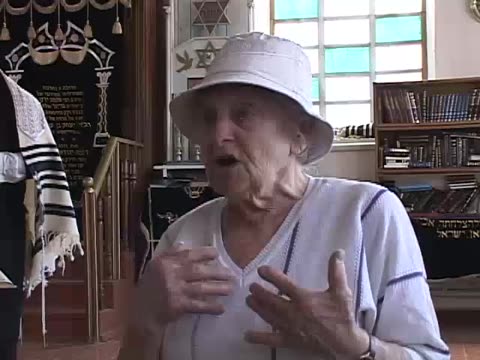
Berzon gives her name, her father's name and her maiden and married surnames, and says she was born in 1926 in Berdychiv. She tells about her father, who came from a town in Poland (name garbled), where her grandfather was a rabbi, and how he was captured as a soldier and stayed in Berdychiv. Her mother was from Zhytomyr and was brought up with a brother who went to America. She mentions her siblings: a brother killed in the war and another who died in Russia, and that her father made sieves with her mother's help.
Includes the sieve-making trade and the grandfather's rabbinical status, which the catalogue label does not mention.
Answers questions on the Jewish population of Berdychiv before the war. She states that Jews were a very large percentage of the town, with the figure corrected in conversation, and that the Jewish schools were closed in the late 1930s.
Berzon says she attended a Jewish school for four years, then a Polish school after both were closed, and completed seven grades before the war. She worked during the war to earn money. She tells which subjects were taught in Yiddish and which in Ukrainian and Russian, and says Jewish history was not taught.
She speaks about Jewish neighbours who were arrested and killed under Stalin, including a pious watchmaker who was sent to Siberia in 1937 and rehabilitated after his death. The passage opens with a part of Kerler's question that is lost in the transcript.
Concerns Stalin-era repression of neighbours rather than cultural life as such.
Berzon describes holidays at home before the war, especially the Passover seder led by her father with the whole family, and the four questions asked by the youngest. She says the family did not learn all the prayers. Her grandmother kept strict kashrut, and the household did not eat pork. She adds that after the war her mother prayed with other women in a place near the synagogue.
Berzon says she prays in Yiddish, not Hebrew, for her family and for Israel, and quotes the sense of her prayer. Kerler asks whether her grandparents told her about the history of the town. She answers about her father's family in Poland.
She recalls the arrival of refugees from her father's town in Poland to Berdychiv in 1939, seen from her window, while her father's parents and brothers stayed there and perished. She tells about a photograph of relatives that her granddaughter took to America, and about her three grandchildren there.
Adds the photograph taken to America and her relatives' fate.
Berzon talks about which languages the family spoke after the war: Yiddish with her mother and mother-in-law, Yiddish and Russian with the children. She says her daughter speaks Yiddish well, has visited her children in America three times and lights Sabbath candles. Kerler then asks about Jewish school and literature.
Berzon says she still reads in Yiddish and answers questions about the literature taught in the Jewish school: Sholem Aleichem, Mendele and Khasrilevke. She says poems and songs were not taught. Her husband is said to remember some Yiddish songs, and the talk then turns to a camera operator and to Purim.
Berzon says the family celebrated Purim, Shavuot, Passover and other holidays at home, and that she went to synagogue after her mother died. She gives her father's birth year and death in 1946 and speaks again about his trade as sieve-maker and his brothers' printing works in Poland.
Berzon speaks about hardship before the war and the 1933 famine, when her father swelled with hunger and she herself fell from a third floor. She tells about the family's evacuation, hunger on the road, and her brother, a gifted student who had one weak lung and worked in evacuation. He later went to the army and disappeared, and the family learned of his fate only through a letter. She also tells how a book collection was hidden, and where the family lived in Berdychiv.
Adds the 1933 famine, evacuation and the brother's disappearance in the army.
Berzon talks about her childhood neighbourhood and her friends, mostly Jewish, in Berdychiv. She tells about a non-Jewish relative by marriage who spoke Yiddish and went to cheder with Jewish boys, and who later lost an eye in the war. He suspected that doctors wanted to remove his eye because he was not a Jew. She also describes his Jewish friends.
Adds the Yiddish-speaking non-Jew at cheder and his wartime wound.
Berzon tells of a mixed marriage in the family, and says that before the war a Jewish child did not marry a non-Jew. She says the couple's children were taught Yiddish by the rabbi's wife and went to synagogue. Kerler asks about other non-Jews who speak Yiddish, and she mentions antisemitism among the young.
Berzon speaks about antisemitism and mixed marriages, citing a newspaper figure on the share of mixed marriages in Israel. She says there were good non-Jews who rescued Jews in the war. She remembers childhood relations with a Ukrainian neighbour who fed her borscht and gave her radish on bread, while her own home was kosher.
Adds the neighbour's food and the contemporary remarks on Israel.
Berzon says she did not hear of an anti-religion campaign in the Jewish school. She repeats her mother's stories that someone went to cheder, where the teacher beat unwilling children, and that he attended cheder before school. She says she knew the late Skoblitski(?), who also told of cheder.
Berzon speaks about Lipe, who ran the synagogue, and his sons. She says there were many synagogues, about thirty, in Berdychiv before the revolution, and that one reopened after the war. Kerler asks about the Berdychiv rebbe Levi Yitskhok and his grave. She says older people knew where the tsadik lies.
Includes the Berdychiv rebbe's grave and the synagogue after the war.
Semyon Berzon gives his father's name as Leyzer, born in 1887, and his own birth year as 1923. He says he worked until 1975, among other things as retoucher and photographer, and also at a cinema and a hairdresser. His mother Khane Lipshe was a cook and later sewed at a factory. Both parents were born in Berdychiv. He says he did not go to cheder but attended a Jewish school for seven years and then a Russian one, and cannot recall songs from school.
Adds the later career, cinema and hairdresser jobs.
Semyon Berzon recites a humorous Yiddish song about a rabbi, his goat and his wife and the faith of simple people who send the rabbi gifts. Kerler has him repeat it slowly line by line, asks the meaning of words such as lotkes (pancakes), and reads back what he wrote. Berzon says he learned it as a boy in the town and adds a short riddle-like song of opposites.