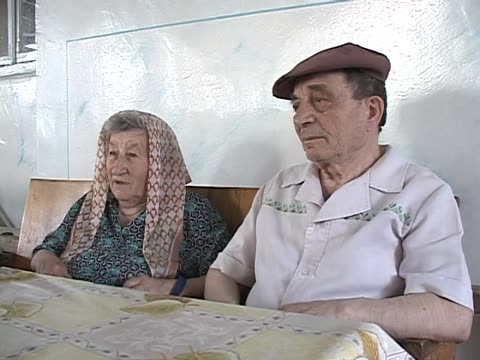
The interviewee talks about her daughter and two grandchildren in America, who are not yet able to visit. Kerler and the interviewee compare distances in America and Ukraine and discuss the poor economic situation and prices in Ukraine today.
Also covers the economy in Ukraine and distances in America.
The interviewee tells of the war, in which she lost her father, mother and a young sister, and says some forty family members were killed. She speaks of her anger at God over the passing years and of her husband's help.
Adds her feelings toward God and the passing of time.
Kerler asks about Yiddish songs from before the war. Vaisman recalls that prewar life was hard: he was a child when his father died, and his mother, with a disabled sister, worked in a factory. Another voice adds that in her own home they lived well.
Adds the question about Yiddish songs and the mother's factory work.
The interviewee describes her prewar life as comfortable. She speaks of a relative's education, including institutes and a yeshiva in Warsaw, and says Hitler started on the Jews.
Adds the relative's education and a remark about Hitler.
The speakers discuss the German occupation. Some say wealthy people stayed in Berdychiv and thought gold would protect them, but the Germans took their money and killed them. Vaisman tells of evacuation and army service from 1943 to 1946, and the woman recalls her trip to Kharkiv with her mother at the start of the war and her father's Jewishness.
Adds Kharkiv and the comment about the wealthy remaining.
The interviewee tells of Jewish holidays kept at home and her father's knowledge of Jewish history, while Soviet rules kept them from synagogue. Asked about Purim, she says it was celebrated at home but there was no Purim play.
Adds the Purim question and her father's learning.
The interviewee tells of her schooling: her father sent her to a Russian school because Yiddish schools were expected to close. The speakers recall that Berdychiv was a Jewish town with over thirty thousand Jews, about seventy percent, and that a few Jewish schools existed. Today one sees almost no Jews on the street.
Adds Jewish population figures and the present-day absence of Jews.
The speakers describe Berdychiv today as a small town, with only some hundreds of Jews left, many having emigrated. Kerler asks whether they studied in cheder or Yiddish school and whether they read Yiddish books and newspapers.
Kerler asks about Yiddish literature in school. The speakers mention reading Sholem Aleichem and say Yiddish literature was little taught, only Sholem Aleichem and Mendele being allowed. Kerler also asks about writers from Berdychiv, including Vasily Grossman.
Adds the questions about Yiddish writers from Berdychiv.
The speakers recall that they knew little of Jewishness or the Berdychiv rebbe's grave, and compare the Soviet period with today, saying clothes are plentiful but money is lacking and pensions are small. They also talk about relatives in America and Israel, dental costs and the present situation in Ukraine and Israel.
Adds the rebbe's grave, relatives abroad and dental costs.
On arrival in Tulchyn, Kerler introduces Lemster as a Yiddish poet and Shveibish discusses potential interviewees, including a woman who was in Pechora and others whom she no longer recalls, and visits to them.
Adds names of possible interviewees and the mention of Pechora.
Kerler and Shveibish discuss the word for a holiday, with Shveibish describing how they say it, and then consider potential interviewees, one a Pechora survivor from Bratslav. They exchange family names, and Shveibish says she can't read Russian well and explains the choice of Tulchyn for lodging.
Adds the holiday terminology and the surnames discussion.
Shveibish, who works for the Jewish old people's home in Vinnytsia, tells how she was deported to Pechora as a child, and says over sixty thousand lie there. She describes the monument, the fence she rebuilt with help from Vinnytsia, the Hesed and her family, and its upkeep. Lemster says he is from Bessarabia.
Adds the fence repair and the upkeep, and Lemster's origin.
The group drives to Kogan's apartment, with talk in Russian and Yiddish about directions and about homes in the centre of town; Shveibish describes the town and where the apartment is.
Kogan speaks a poem about Deborah, the shochet's wife in the Bershad ghetto, and tells how many Jews were killed there. Kerler asks who Deborah was. He tells of his Bershad origins, the poems he wrote, and being taken into the army at seventeen.
Adds the poem recital and the explanation of Deborah's identity.
Kogan and Kerler discuss Deborah and her husband Gedalye, the cantor at the High Holidays; Kogan tells of refugees from Bessarabia, Bukovina and Hungary in the ghetto, and of Romanians murdering Jews in a pit near Bershad and forcing a German to dig it.
Kogan tells of the Jewish field in Bershad created with help from America, with a caretaker and a monument, and his last visit in 2003. He talks about his health and thanks the visitors, and Lemster asks him to say more.
Adds the Jewish field in Bershad and Kogan's health.
Kogan speaks of finishing seven classes in a Yiddish school in Bershad, of his teachers, and says that neither he nor his wife is from Tulchyn; she was from Zhabokrych (?).
Kogan tells how his wife survived hiding in a cellar in the war, and returns to his school years, where Russian, Ukrainian and German were taught, and of the Yiddish-speaking youth circle. He names the school director and a brother who later lived in America.
Adds the wife's survival in a cellar and the school director.
Kogan speaks of his brother, his service reaching Berlin, and a manuscript of poems that someone took and may have taken to Israel. Kerler asks about the title and a classmate named Zitser.
Kogan answers Kerler's questions on the poems in the manuscript and on the shochet Gedalye Shulman's family. He describes the Romanians driving Jews to Pishchanka, his escape from the ghetto with Israel Zitser's help, and hiding in an attic.