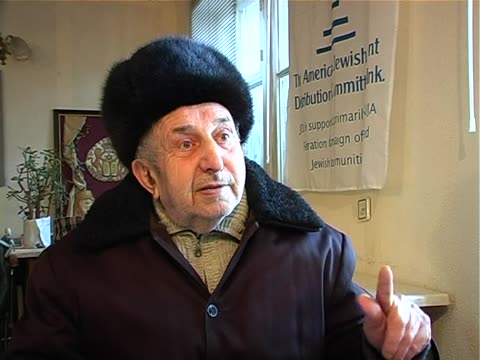
Opening exchange in which the participants mention names and where Jews live in the world, then Kerler states the date and that this is the second interview in Berdychiv. Soyfer gives his name, his Russian patronymic and his surname, and says he is a Jew.
Soyfer explains how, before the revolution, Jews were barred from living in many places and from owning land unless they had served long in the tsar's army, or converted. He gives a story of a Jewish family in a village forced out unless it converted, and speaks of the cost of gymnasium for Jews. He says Berdychiv was a place where Jews could live and mentions pogroms, emigration to America and his grandmother's languages. Kerler then asks for his birth year (1930) and he begins to speak of his mother's death.
adds a discussion of Jewish residence restrictions, gymnasium costs, pogroms and emigration
Soyfer says his mother died before the war, in the year (as heard) before Hanukkah, and that he went to live with his grandmother Rukhl, his mother's mother. His mother was Sure and his father Yitskhak a shoykhet, born in Berdychiv, whose own father was connected with the synagogue. The family was not rich; he went to school, and when the war began he was in Kyiv.
adds his naming after his paternal grandfather and the family's poverty despite his father's trade
Soyfer recounts that he fled in the war and went to the Caucasus, where Germans came and his grandmother was killed. His father was taken into the army. He says he served as a soldier and could not have killed an old person, and mentions that his wife died half a year earlier after twelve years of illness.
Soyfer talks about life today: his wife was bedridden for twelve years, his daughter cared for her, and they live on his pension. He talks about hard work, lost savings, the cost of medical treatment and an operation for his daughter, and help from the Joint and Jewish donors. In answer to Kerler, he says Yiddish was spoken at home with his wife and his daughter understands it, that there was no Yiddish school, and that his father did not teach him to pray.
adds his wife's long illness, pension and medical costs and the Joint's help
Kerler asks what Soyfer remembers of his childhood home in Berdychiv before the war. He speaks of an old house and street name, whether he can fix the year of Passover 1930, and says he was not invited to Jewish weddings. His father the shoykhet kept the holidays and the Sabbath, and the passage ends with Kerler and others commenting on reading and eyesight.
adds his father's Sabbath observance at work and his slaughtering
Soyfer says he served in the army after the war for three and a half years, in Ukraine, as the only Jew in his unit, and describes antisemitic mockery and beatings there. Asked what he found on returning to Berdychiv, he says he lived with his father and married. He then describes the postwar reopening of a synagogue by Jewish officers, praying outdoors in 1945 and a Yom Kippur in 1946, and recalls saying kaddish for his mother in 1938 in a private house minyan.
adds the reopening of a synagogue after the war and kaddish for his mother in 1938
Asked when life became easier, Soyfer says things improved economically under Brezhnev, when he could earn enough and travel. He says he worked 35 years in one place and so had enough years of service for a pension.
adds his 35 years of work and the pension it gave him
Soyfer remembers Yiddish performers who visited Berdychiv after the war, among them Clara Young, whom he could not get into the theatre to see, and the artist Epelbaum (?). He cannot sing but says there were many Yiddish songs.
Asked about Hanukkah, Soyfer speaks of holiday observance after the war, and says his father the shoykhet brought frozen kosher meat. Kerler asks about latkes, which were made of grated potatoes, and the others chat about the Yiddish way of eating.
Asked what he wants remembered about Jewish Berdychiv, Soyfer describes it as a Jewish town of honest people with Jewish trades and small prayer houses on every street, where there was no pogrom because young men defended it. He speaks of Yiddish-speaking neighbours, his grandmother in a village near Zhytomyr and the Germans' killing of Jews. Kerler thanks him and asks about his daughter's Yiddish, which Soyfer explains, and the passage ends with comments on yeshiva students and mixed Jews, and Kerler handing over project information.
adds non-Jewish Yiddish speakers, the grandmother near Zhytomyr and talk of today's yeshiva students