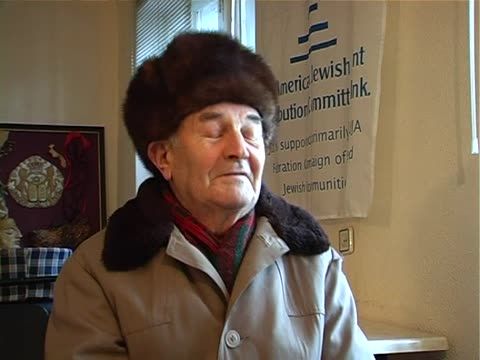
Vanshelboim briefly speaks about his life during World War II. He served in the Red Army and fought in Stalingrad. He then provides personal information.
From the machine transcript
Opening exchange: Kerler asks whether Vainshelboim was at Stalingrad. He answers that it was his brother-in-law who was there, a tank man, and that he himself was under the Germans. His name, patronymic and surname are then spelled out in Russian and Yiddish for the record, and he gives his present street address in Berdychiv.
The transcript shows the Stalingrad service was his brother-in-law's, not his own; most of the passage is the spelling of his name and address.
Vanshelboim provides personal information and talks about his family.
From the machine transcript
Vainshelboim gives his Yiddish name, Moyshe, and his father's name, Aron. He speaks about his religious father, who worked hard to support six children, and about his grandfather, who died before he was born. Kerler asks his birth year, but he is reluctant to count years. He says he escaped from the Germans.
The passage also covers his reluctance to give his age and a reflection on writing about what he lived through.
Vanshelboim briefly speaks about his life during the war, before he talks about his family. His father worked as a painter. Vanshelboim also mentions his family's fate during World War II. He grew up with two sisters and two brothers.
From the machine transcript
Vainshelboim says his father was a house painter and gives his mother's name, Faige. He names his two sisters, Polia and Tsivia, and two brothers, one young brother and one older brother who fell at the front. He says his mother and siblings were shot at an airfield, and begins to tell how the Germans entered Berdychiv in July 1941.
Besides the father's trade, the passage gives names and fates of the mother and siblings and starts the occupation account.
Vanshelboim talks about his life during the war. (See also MDV 352) In particular, he remembers the beginning of the war, when the Germans occupied Berdychiv and took the local Jewish population for forced labor. Vanshelboim also shares an episode when he watched his mother's bread in the oven, after she was taken to forced labor. Vanshelboim then talks about his family's fate during the war, as well as a mass assembly organized by one German and a few Ukrainian policemen. He describes how he escaped the assembly and reached Novosilka, where he received help from a Ukrainian family. He then continues his journey the following morning and speaks about his encounter with the brigadier Andre Tsherbatyuk who advised him to seek help with a family in the village Tirikhavaye 16:34. Vanshelboim states that he stayed with the older Christian woman Korshenyuk for one year. He then explains that four family members were recorded in Yad Vashem's registry for The Righteous Among The Nations.
From the machine transcript
Vainshelboim recounts the first days of the German occupation. His mother was taken for forced labor and left him to watch her bread in the oven; Ukrainian policemen came in and he fled. He hid with a Ukrainian man, and later learned his mother and siblings had been killed. He tells of a roundup at the airfield and how he escaped it. He reached Novosilka, where a family took him in, and an encounter with a brigadier, Andrei Shcherbatiuk, led him to an old woman named Korshenyuk in a village whose name is unclear. He stayed with her for about a year. He says four members of that family were recognised by Yad Vashem.
The transcript adds his aunt Manie and her children's fate and the further escape from the roundup, as well as the Yad Vashem medal for the rescuers.
Vanshelboim talks about interviews and German restitution. He then speaks about the remaining years of the war, during which he worked odd jobs. He also briefly addresses his school education, before he describes how he got caught by the Ukrainian police and his subsequent escape in August 1942. He then received help by Ukrainian peasants in a village, before he continued his way back to the peasants' house. On the way, he received help and worked as hireling for a Ukrainian peasant, Petrivskii.
From the machine transcript
Vainshelboim speaks about the claims made to Yad Vashem and for German pension compensation, and about the year he spent with his rescuers. He recalls working for a peasant as a farmhand and his four years of Jewish school, which let him pass as Ukrainian. He tells how he was caught by Ukrainian policemen, escaped by swimming a river in 1942, and was helped by villagers. He then worked for a peasant named Petrivskii, and tells of the three times he escaped death.
The passage covers pension and Yad Vashem paperwork and his schooling, and the escape by swimming, beyond the catalogue's outline.
Vanshelboim speaks about Ukrainian and German attitudes during World War II. He states that Ukrainian neighbors robbed Jewish homes. He then returns to his life when working as hireling in 1942. Upon the advice of neighbors and fearing that his boss may report him, Vanshelboim traveled to the Rozhys'k region (Ternopil province) and worked on a state farm among prisoners for one year, until March 1944, after the arrival of the Red Army.
From the machine transcript
Vainshelboim speaks about Ukrainian and German attitudes toward the Jews, and about neighbors taking Jewish property. He explains that in 1942 he feared his employer would betray him. On neighbors' advice he went to the Rozhysk district, where he worked on a state farm among prisoners for about a year until the Red Army arrived. He recounts the arrival of the Soviet forces at the end of 1943.
The transcript adds the fear of betrayal by his employer and the state-farm year among prisoners.
Vanshelboim speaks about his journey home in April 1944 and his work as a loader at a mill in Berdychiv before his military draft. He then talks about his liberation on December 31, 1943.
From the machine transcript
Vainshelboim describes returning to Berdychiv in 1944, working with horses and then as a loader at a mill. He says he remembers the day of liberation, 31 December 1943. He saw German prisoners being shot and soldiers dragging off their boots.
Vanshelboim speaks about his military service in Latvia for four and a half years. After his military service, Vanshelboim continued to work at a mill for 25 years, before working at a brewery for five years. He then addresses his life today and mentions how he bakes kosher bread every Friday in memory of his mother. Vainshelboim then talks about the Jewish baker Yoyne in the postwar period.
From the machine transcript
Vainshelboim states that he served in the air force in Latvia (Daugavpils) for four and a half years. He then worked 25 years at the fifth mill in Berdychiv and five years at a brewery. He says he now bakes rye bread every Friday for the synagogue. He recalls the Jewish baker Yoyne (Yulik) in the postwar period.
The transcript names the baker as Yulik, a postwar Jewish baker who lived to be about ninety, and says nothing about baking in memory of his mother.
Vanshelboim addresses his family, particularly his mother's side. She was born in Ulanov. He then remembers a family encounter after the war.
From the machine transcript
Kerler asks about family, and Vainshelboim says his mother came from Ulanov (?), and gives her name, Faige. Her older sister Perl, who had gone to America, visited him in 1961. He describes how she kissed him and mourned his murdered mother, and speaks of a family photograph and his own photograph as a soldier.
The transcript adds the visit of his aunt from America and the photographs he offers to show.
Vanshelboim speaks about his army service, which he left with the rank of first sergeant. He worked as aeroplane mechanical engineer. He then remembers how he met his wife when he lived with her family after the war for six years. They were married after his military discharge in 1954.
From the machine transcript
Vainshelboim says he finished the army as a senior sergeant and worked as an aircraft mechanic. After the war he lived for six years with his future wife's family, the Sonias (?). He fell in love with her and married her after his service; he gives her name as Sore. The catalogue says the marriage came after his discharge in 1954, but the dating in the transcript is not clear.
Vanshelboim addresses prewar Jewish life Berdychiv, particularly occupational synagogues. He then remembers the local kosher slaughter after the war. According to Vanshelboim, 60,000 Jews lived in prewar Berdychiv out of a total population of 80,000. He then speaks about prewar synagogues, before he addresses contemporary Jewish life and charity.
From the machine transcript
Asked about prewar Berdychiv, Vainshelboim recalls the small prayer houses of the individual trades. He says Berdychiv had a large Jewish population before the war, giving 80,000 inhabitants in all. He also speaks about a communal kitchen synagogue sold to a factory. He mentions the new hostel built by Pavitch, then kosher meat after the war, and says Jewish life continues today with a prayer house and charity.
The passage adds the postwar kosher meat and the hostel (guesthouse) built for visiting Jews, along with the sold communal kitchen.
Vanshelboim talks about prewar Jewish religious life and Soviet anti-religious persecution, before addressing contemporary religious life.
From the machine transcript
Vainshelboim speaks about prewar religious life and Soviet persecution: the Bolsheviks said there was no God and turned the soup-kitchen synagogue into a club. He says few Jews remain, perhaps five hundred, and the community is small. He speaks about the Chabad rabbi Moyshe, who helps bury the dead, and about the other rabbi, Shloyme.
The passage adds the two rabbis of the town today and the Chabad presence.
Vanshelboim answers questions about Jewish terminology, as well as contemporary Jewish religious life and charity. He also addresses his communal work in agriculture and involvement in the community.
From the machine transcript
Kerler asks what is meant by a good Jew, and Vainshelboim explains generosity and humanity in several languages. He speaks about the small minyan today, about donations and whether he goes to synagogue on Sabbath. He recalls his work on a collective farm and a garden, and bartering bread for milk. Some Jews call him a righteous man. The passage ends with a joke about a drink.
The transcript adds the discussion of what makes a good Jew, and his garden and farm work.
Vanshelboim addresses Jewish food customs, especially latkes. The team then concludes the interview with Vanshelboim.
From the machine transcript
Vainshelboim speaks about food: his wife's rye-flour latkes baked for the synagogue on holidays, and the potato latkes Kerler knows from Germany. Kerler thanks him and says they hope to come again; Vainshelboim asks for the interviewers' phone contact and the interview ends.