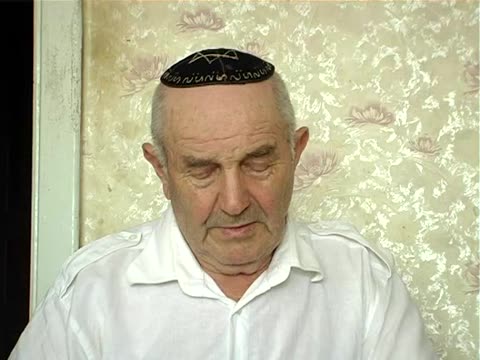
Vainshelboim narrates his escape and wandering in the countryside during the war. He swam a river, was given old clothes and food, hid in an attic and passed himself off as a non-Jew. He stayed with several peasants and farm owners, including one who sympathised with the Germans, worked as a herdsman, and later moved on after the arrival of the Red Army. Kerler asks clarifying questions. The passage ends with him living with relatives after the war and working at a mill.
Vainshelboim speaks about his army service, which lasted four and a half years and was with aviation units in the Baltic region. Kerler asks where he served and whether Sara waited for him; she did.
The catalogue label omits that Sara waited for him during his service.
Vainshelboim lists the mills and factory where he worked for decades before retiring. He suggests another elderly woman as a possible interviewee, a survivor of the war. He describes the outbreak of the war and a Berdychiv newspaper that announced Jews must register and move into a ghetto district. He mentions looting of Jewish homes.
Besides the war and newspapers, he lists his working life in mills and recommends another interviewee.
Vainshelboim tells of his mother's sister, whose two children died during the war, one of hunger in the camp. She went into the town with a child and was shot there in the 1940s. The details of names and place are unclear in the transcript. Kerler asks what she was called.
The relative is the mother's sister; her name is unclear in the transcript.
Answering Kerler, Vainshelboim explains how he learned to bake bread, having watched village women bake. He worked briefly in a bakery, and later baked at home for many years after Soviet shortages. He compares white and rye breads, and mentions that people in Israel like black bread.
The passage is mostly about his own bread-baking and bakery work.
Talk about bread and milk continues, with Sara on the phone. Visitors from America, who are recording people's stories, are mentioned. Mikhail mentions buying milk from a cow that is milked in front of him, to ensure it is kosher, and also varenyky and pelmeni.
The transcript shows talk about kosher milk and visitors from America, not only the phone call.
Sara or Mikhail phones a woman in Berdychiv to invite her to be interviewed. They explain that visitors from America are recording people's histories and offer to bring them over. They say she is aged ninety-two and likes to tell her memories. Kerler then asks about prewar memories and holiday baking and cooking.
The phone call is followed by Kerler's question about prewar holiday cooking.
Vainshelboim describes his prewar home: six children, father a painter with seasonal work, mother selling herring and oil at the market. He recalls the famine of 1933, with rumours of cannibalism and selling of human flesh, and shortage of food. He explains that collective farms were still weak and grain was exported, and recalls soup made from grain. Sara remarks that people in America should not know what they lived through.
The passage also covers his family's livelihood and the collective farms.
Vainshelboim speaks about the postwar period: his pension, a plot of collective-farm land and growing wheat and potatoes, and grinding grain at a small mill. He describes a salad. Kerler asks about a bread called malke's bread, which is not recognised. Vainshelboim lists French rolls and prewar bread prices, says no challah was baked for Sabbath and begins speaking about the Cook's synagogue.
The Cook's synagogue is introduced at the end, and prices of prewar bread are also given.
Vainshelboim describes the Cook's synagogue, where food was prepared and worshippers could eat after prayers. He recalls a club in Berdychiv in the mid-1930s where Yiddish plays were staged, including one about Sholem Aleichem (?). He says Berdychiv was a Jewish city, called a Jerusalem, with tens of thousands of Jews, and offers to switch off the camera.
The passage also mentions Jewish population figures and Yiddish theater.
Vainshelboim answers questions about relatives in Israel, including a cousin of his mother, and about people phoning and sending money from abroad. Kerler recalls the team's first visit in 2002, when there was no electricity. Vainshelboim then gives long opinions on America, wars, peace and terrorism, and mentions a man named Isaak (?) whose mother was Jewish and father Tatar, who speaks Yiddish and could be visited at the synagogue. The transcript is partly garbled.
Vainshelboim states political opinions and mentions a possible further interviewee, which the catalogue label only partly covers.
Informal talk among Kerler and the household about food and bread for the visitors, with offers of help and remarks about something tasty smeared with a spread. The recording is largely garbled and the details are unclear.
The transcript is too garbled to confirm that Mikhail prepares the food himself.
Short, fragmentary talk by Kerler, with a few words about a synagogue (shul) and giving names (Berl, Yosef). The passage is largely unintelligible and there is no clear town footage commentary in the transcript.
The transcript does not show town footage as such, only fragmentary talk.
The team enters Burmenko's flat. She first speaks Russian, and Kerler explains that they speak only Yiddish and are from Moscow and America. She says that she understands Yiddish, speaks the Yiddish of Berdychiv, and has a Jewish soul. Someone asks for a stool to translate, and Kerler and Burmenko joke about Sholem Aleichem's brother.
Kerler asks Burmenko about her childhood before the war and about the project. She says she was born in Berdychiv in the revolution year, and that her mother was also from Berdychiv. Her father Berl was a tailor who died when she was four, and her mother was named Zisl. Kerler also records her first name and patronymic and the surname Burmenko. He explains the archive of prewar Yiddish life.
The catalogue label only says biographical information; the transcript gives her parents' names and father's trade.
Burmenko says she attended the Jewish school, number four, finishing seven grades before the schools were closed. She married in 1936 (?) and by about 1937 had a son aged three and a half who was killed by Hitler. Her son was named after her father, and her daughter, now in Israel, after her mother. Asked about childhood games, she mentions hide-and-seek and says one friend was killed in the war.
Beyond the school entry, she also gives her marriage date, her son who was killed, and games.
Burmenko recalls learning the alphabet in the Yiddish school, and a little writing. Kerler asks whether she remembers songs or poems from then, but little is recalled. She mentions a friend, with garbled talk about an aerodrome.
Mikhail encourages Burmenko to talk, while she says she does not want to talk much about the war and cannot speak of it. She mentions that a film was made about her, with a cassette, for America, and that others should know what happened.
Burmenko shows letters and photographs, including material connected with Spielberg's foundation in America. She mentions a photograph from her sixteenth year, one from the war, and her age at 80 and now 92. Her sister's child was killed. She also shows a Russian-language certificate recognising the people who hid her (Gordei and Akulina (?)), with a reference to Israel. Kerler asks her to tell about the photographs.
Burmenko talks about her work as a girl at a sack factory until she married. Her mother-in-law said the husband should support the family. Her first husband, Monia, was also from Berdychiv, his family name was Furman, and his parents were Pesl and Sruliq.
Burmenko says that people who came to write a book about her thought she was Russian. She does not want to be written about, although she says the world knows of her.
Burmenko recalls her life after the war: a friend of her husband's, who had been in the army, wanted to marry her, and she married him in 1946 (?) after reluctance. He was Zalmen Mendelevich Dimant, and he died in 1948. Her son was born in 1947 and is now 62. She says she stood by the pit when people were shot, and that her mother and sister were taken.
The label is only 'Life after the war'; the transcript includes her second marriage, her second husband's name, and the shooting.
Burmenko says her mother went into the pit with two grandchildren during the war and she herself was not taken. Kerler then returns to the topic of songs from childhood in Berdychiv. The passage is short and partly garbled.
Burmenko says that her father died when she was four, that her mother was a widow, and that she had a stepfather. Kerler provides the Yiddish word for it, shtiftate. A phone call comes in. She says she lives alone, and that her daughter urges her to move to Israel but she does not want to.
The label mentions prewar life and today; the transcript shows a kinship term, the stepfather, and her refusal to emigrate.
Vainshelboim remembers Yiddish songs. He says his father played mandolin and guitar and young people gathered to sing in the happy prewar world. He recalls verses about a tailor, a shoemaker, vareniki, and a tumbalalaika-type song about a boy who cannot decide whom to marry. He says his father sang in Russian.
Vainshelboim recalls the street he lived on near the market, the courtyard with benches where young people sat, and a Yiddish- and Hebrew-speaking acquaintance named Vasilevsky (?). He says the prewar world was beautiful and the war took his best years. He then reflects on living long, the world's good and bad people, and mentions his son in the Zhytomyr region.
The label says life before the war and faith, but the transcript shows his street, an acquaintance, and general reflections.
Burmenko is back in the room, and Kerler and the household drink together and make toasts. They talk about her son, his position, and her two children, and Kerler says he had guessed it was her son at the door. The passage is largely informal.
Burmenko shows photographs of her daughter and son-in-law in Israel and of her second husband, Dimant, a specialist with machines. She says she is glad the team came, and mentions a visiting Jewish woman from America named Tani Golfeld (?), who left an address. Kerler asks for the town and writes the address down.