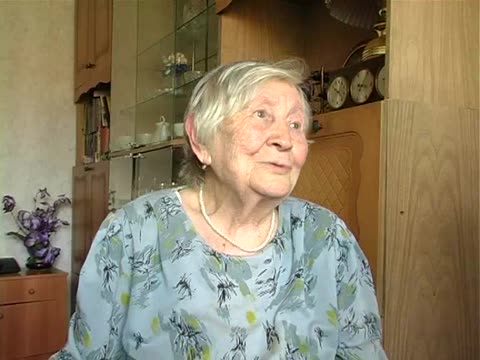
Opening talk about a woman named Goldfeld (or Goldman) from America, with discussion of the word 'gold' in Yiddish. Burmenko and a helper fuss over food being brought. Kerler then starts asking what her mother baked.
Conversation turns to the name Goldfeld/Goldman and a gift of food, as well as photographs.
Burmenko answers questions about the food her mother prepared for holidays and the Sabbath: poppy-seed cakes, oven-baked cakes, gefilte fish, stuffed chicken, and challah baked in the oven. Kerler asks her to explain a term. She says she was a careful housewife taught by her mother. Russian side talk about keys and a shop interrupts.
Gives specific dishes, including Sabbath fish and challah, and her housekeeping habits.
Talk about the custom of washing hands before eating and the blessing. Burmenko says she knows everything in Yiddish. She speaks of her husband's and her own Jewish customs, partly in Russian.
Kerler asks whether her husband spoke Yiddish, and she says he did. The name of her husband's father, Mendl, is given, and she gives Mikhail as another name.
The name given in the transcript is Mendl, not Zalmen, and Mikhail is added.
Informal conversation among Burmenko and the research team. They discuss the Americans' Yiddish and their need for interpreters. They talk about Burmenko's own Berdychiv Yiddish, her family going back generations in Berdychiv, and Kerler's own family name. Burmenko blesses the visitors with long life.
Burmenko's address and street are given for the record, followed by chat about the interviewer taking notes. The talk turns to a question for Burmenko on the best years of her life.
Burmenko says her best years were before the war and that she married at eighteen or nineteen, with a difficult father-in-law. She also speaks of her obedience as a child and of how things are different now. She mentions Germans in Berdychiv and says today's younger people do not know Jewish history.
Covers her early marriage and her views on how the young generation knows Jewish history.
The team phones an American visitor, Tanya Goldfeld (?), who had been photographed with Burmenko, and speaks to her in English and Russian. Burmenko speaks to her in Russian, gives her phone number, and the team promises to send her address. She states a proverb.
A phone call to an American visitor and a proverb are added.
Vainshelboim guides the team through Berdychiv and tells of the German occupation and the roundups and killings of Jews. He tells of the murder of 960 young men, the grave pits, and his own escape when his father was shot. His mother, sisters and brother lie in the mass grave. He also mentions a brick factory and a pit for hiding Jews, the Soviet memorials, the erection of the Star of David, and gold-seekers digging up bones.
Covers a longer tour: the mass grave, the father's shooting and escape, and Soviet memorialization.