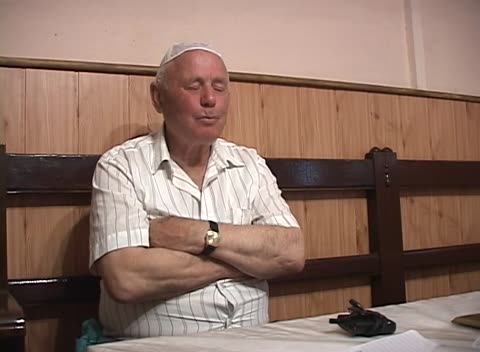
Formal introduction and family. His father's name was Shimon and his mother's name was Haydl. He grew up with five siblings; three of them were killed in Auschwitz. His sister Chane, born in 1924, moved to Israel after only spending two days in Vynohradiv after her return from the war.
From the machine transcript
Opening of the interview: Kerler gives the date and place, and they discuss the Yiddish name of Berehove. Hodinger gives his full name and says he was born in Selish in 1928. His father was Shimon and his mother Haydl (Yiddish name Velvele for himself). He lists four brothers and two sisters. Sister Chane lives in Haifa. Three siblings (including Esther and Yosele) went to Auschwitz and one brother died in a camp.
Gives birth date and siblings' names and ages.
Ghetto years and Auschwitz. Hodinger describes how the Germans forced his family into the Vynohradiv ghetto in 1944. They were then transported to Auschwitz in a railway car with eighty other prisoners. He was imprisoned in Auschwitz for three months. He was almost killed twice and convinced the Germans of his strength to work. He then talks in detail about the arrival at the gates of Auschwitz, the selection, and separation of parents from their children.
From the machine transcript
Hodinger recalls being brought into the Selish ghetto after Passover 1944, where he spent about six weeks. He describes the deportation in a cattle car with eighty people, and the selection on arrival at Auschwitz, with families separated. He says he was twice chosen for death and each time persuaded the Germans that he was healthy and strong enough to work.
Mentions the ghetto stay of about six weeks.
Forced labor. Hodinger then recalls his encounter with Josef Mengele, who did not select him for work when he was sixteen years old. He was then sent to do forced labor in concentration camps in Germany. Among other camps he spent one day in Dachau, before he was taken with a Stoertebecker to forced labor in Furstenfeldbruck. He fixed airplanes.
From the machine transcript
Hodinger speaks of Mengele, the camp doctor who sent people to work or to death, and of a second selection. He describes the hardships on his return. He was in Auschwitz about three months, then sent to camps in Germany, one day in Dachau, and then put to work at an aircraft factory.
Life after war. Hodinger discusses his return to Vynohradiv. During the first few years, he only met his uncle who got married after the war. After twenty years living in an apartment, he moved away to build his own house.
From the machine transcript
Hodinger describes his return to Selish, where he found almost no one. His sister Chane and brother Hersh stayed only a few days before leaving for Israel. He stayed with his uncle, who married. He lived in rented quarters for twenty years, then bought an old house in another part of town and rebuilt it. He talks about being alone since his wife died.
Adds his current loneliness after his wife's death.
Family. The conversation turns to family. He raised a stepdaughter, who worked at a doctor's office.
From the machine transcript
Hodinger says he has a daughter, not his own but raised by him, who lives in the area and worked in a doctor's office. Kerler then asks when he went into the army.
Mentions a stepdaughter living nearby.
Postwar Red Army service. Between 1949 and 1953 he served in the labor battalion that worked in Byelorussia with 3000 people. He then moved to Vladivostok.
From the machine transcript
Hodinger describes his service in a labor battalion after the war, with about three thousand men from Transcarpathia sent to Belarus. He then went to the Soviet Far East. He mentions a few Jews serving alongside him.
Mentions other Jewish soldiers.
Life after army service. He discusses his life after his military service. He worked odd jobs, such as ironing for a tailor and helping out at an electricity factory.
From the machine transcript
Hodinger describes his hard life after leaving the army: odd jobs with an electrician and at a factory. Later he and his wife bought and built a house. He mentions that his sister Chane, aged about 83, is in Israel and had heart surgery, but he cannot visit her.
Family. The conversation returns to his family, in particular his sister in Israel and contemporary life.
From the machine transcript
Hodinger talks about his sister in Israel and his nephews, saying he has nowhere to go and is alone. Kerler asks how often visitors from abroad come.
Visitors from America and life today. After the war, a lot of visitors came to Berehove, especially from America. After his military service, he met an old friend from Vynohradiv, who offered him to sell ice-cream. Hodinger and his wife sold ice-cream for thirty years.
From the machine transcript
Hodinger says many visitors came after the war, then discusses working years. He worked at a furniture factory for five years. An acquaintance from Selish then offered him a job selling ice-cream, which he and his wife did for thirty years. He speaks of his small pension and his health.
Adds his pension and health.
Prewar life in Selish and family. He discusses prewar Jewish Vynohradiv: there were five synagogues in Selish. His father worked in a mill, carrying sacks of flour; he also worked as a porter, carrying luggage for travelers at the railway station. His father was born in Ilnytsya and his mother was born in Pryslip.
From the machine transcript
Hodinger discusses Selish before the war. Munkács Jews are nicknamed 'onion Jews'. Selish was a small town with five synagogues. His family was poor: his father hauled sacks at a mill, and he carried luggage for travelers at the station. His father came from Ilnytsya and his mother from Pryslip (?). The house was of earth and unlit. He also recalls hardships in the camp and a beating under Hungarian rule.
Adds poverty, house details, and the question of whether Ilnytsya is in Czechia.
Rebbe of Spinka
From the machine transcript
Kerler asks about the Rebbe of Spinka. Hodinger says the rebbe has many grandchildren in America.
Family. Hodinger discusses his grandfather Berl, who farmed land in Ilnytsya and owned horses.
From the machine transcript
Hodinger describes his paternal grandfather Berl in Ilnytsya, who had fields, an orchard and a pair of horses and worked them himself. He recalls visiting him at Passover. He says the grandfather was not rich, and that his own mother kept house for six children.
Purim shpiels. Hodinger recites three Purim shpiels in quick succession, then repeats them slower.
From the machine transcript
Hodinger says he learned three Purim plays in Selish and recites them. Kerler asks him to repeat them slowly line by line, to write them down and to explain unfamiliar words, such as those for the rebbe's gabbai and for a Purim gift.
Adds Kerler's line-by-line elicitation of the words.
Memorial. The camera cuts to outside footage and Hodinger reads in Hungarian, Russian, and Prof. Kerler reads in Hebrew a plaque in commemoration of the victims of the crematorium in 1944 in Berehove, where 7000 Jews were killed. The plaque, originally housed in the synagogue, was put on the outside wall of the synagogue and was put there by an American philanthropist.
From the machine transcript
Outside the synagogue, Kerler reads the Hungarian, Russian and Hebrew inscription on the plaque commemorating Jews murdered in 1944. Hodinger says he can read some Hebrew. They discuss who put the plaque up and when, noting it could not be displayed in Soviet times. Kerler asks about synagogues in Berehove.
The reading is mostly by Kerler, and the plaque's history is discussed.
Prewar and postwar Jewish Berehove. Between two and three thousand Jews returned after the war, but the majority of those who returned then left for Israel and America. There was still an active Jewish community in Berehove after the war, including a kosher butcher, and a number a Jewish businesses.
From the machine transcript
Hodinger says that of seven thousand Jews of Berehove, two to three thousand came back after the war. Many then left for America and Hungary. After the war there was still a shochet, a mikveh and Jewish shops and tradesmen. Kerler asks how he learned Yiddish in Selish.
Education. He attended religious school (cheder) when he was six years old, until the age of 15. He also attended Czech and Hungarian schools.
From the machine transcript
Hodinger says he attended cheder from age six to fifteen, as well as the Czech and Hungarian schools, with one melamed and no talmud torah. He then returns to his father's hard labor and describes carrying luggage for travelers at the station.
Entering the synagogue. The team enters the synagogue with Hodinger, and continues the formal interview.
From the machine transcript
At the synagogue, Kerler recites the Purim-play lines himself while the interview resumes.
Purim shpiels. Hodinger continues to recite the lyrics of the Purim shpiels, and sings several more. In prewar Vynohradiv, he would put on a mask while performing Purim shpiels.
From the machine transcript
Seated, Hodinger repeats the Purim plays more slowly at Kerler's request, with Kerler asking the meaning of phrases. Hodinger explains that he performed alone in a mask.
Adds the mask and Kerler's explanation requests.
Weddings and religious life today. They then discuss weddings and religious life today. Hodinger frequently leads services.
From the machine transcript
Lemster and Kerler talk with Hodinger about practical arrangements and about weddings. He says he walks around town, rests at home and could offer wine. He recalls Selish weddings from his childhood.
Adds arrangements and wine.
Postwar wedding and Yiddish songs. They discuss weddings in postwar Bereshove, and Hodinger sings several well-known Yiddish songs, including "Mayn shtetele Belz". They then further discuss Purim shpiels.
From the machine transcript
Hodinger recalls a wedding just after he returned from the camp and then staying with his uncle in Ilnytsya. He sings Yiddish songs including 'Mayn shtetele Belz', and a Hasidic or Zionist tune. Lemster and Kerler ask where he learned the Purim play and whether he played it alone. He says he learned it before the war and performed it alone.
Postwar life and army. Hodinger briefly discusses life in the Soviet army, after being freed from the lager.
From the machine transcript
Hodinger says he was freed from the camp in 1945, after a year in the camp, and served in the Red Army for four and a half years as a driver and builder. He says army work was hard. He mentions a Jewish colonel.
Adds the army details.
Prewar Jewish life and life today. Hodinger briefly addresses prewar Jewish life and speaking Yiddish in Berehove. He then talks about his life today: he has a vineyard, and makes his own wine.
From the machine transcript
Hodinger answers questions about Yiddish in the cheder and at home, and says he speaks five languages. Lemster and Kerler arrange to go out, and Hodinger says he is in his eighties. He says he has an orchard with nut, apple and plum trees and a good well, and makes his own wine. They end by asking for one more song.
Adds languages, age, orchard and arrangements.