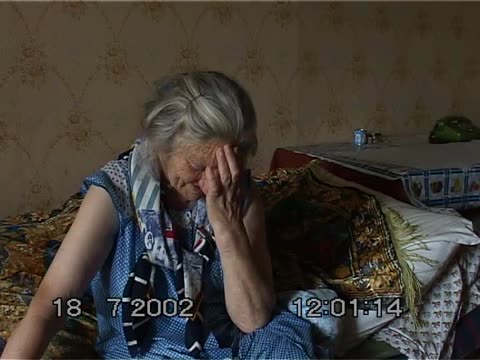
Bershad', Ukraine3 May 1903 (the catalogue's date for this tape is a placeholder)Interviewed by Dov-Ber Kerler, Dovid Katz, Jeffrey VeidlingerPart 2 of 339 min · 12 passages
Kozak sings a Yiddish song about an orphan child in poverty who has no shoes, and the poor mother's sacrifice. Kerler then asks about Hanukkah songs and songs mixing Yiddish and Russian. Kozak says she knows songs in both languages and mentions a Russian-language song.
Kerler's questions about Hanukkah and mixed Yiddish-Russian songs
Kozak briefly recites a bilingual rhyme (a Yiddish-Russian song) set in Odessa. She answers Kerler's questions about how a kind of pastry (varnitshkes, name uncertain) was made. She then describes her mother's gefilte fish in detail: ground fish with onions, boiled for two hours, with pepper and little sugar, not a sweet version. She also mentions holiday dishes such as horseradish, stuffed fish and kezelekh.
Kozak addresses prewar cultural life in Bershad, particularly Yiddish theater performances. She then touches upon her life in evacuation during World War II.
Kozak recalls a Yiddish theater troupe from Belz (?) that visited Bershad' before the war, performing plays in the synagogue hall; she does not recall plays or songs. She then speaks of evacuation, with hardship and lack of Passover observance, and a cooking-pot story.
Answering Kerler's questions about prewar holiday customs at home, Kozak recalls Hanukkah (candles, grandmother's gelt, no memory of the dreydl), Shavuot (cheese-filled pastries) and Purim (hamentashn). Near the end she offers to show photographs.
Kerler asks about prewar Bershad' and the local rabbi. Kozak names him as Yankl Lipman(?), a rabbi rather than a rebbe, with a fine beard. She says his second wife's daughter lived in Odessa, that he died around 1958, and gives her own parents' death years.
Kerler works through the dialectological questionnaire with Kozak: Russian prompts to render in Yiddish (illness, bed, crying, 'good day', 'thank you', cold, gentile, peasant, vineyard), words for non-Jews, and Lithuanian Jews. She also talks about Passover dishes (kezelekh, fish with horseradish) and about separating dishes for Passover. The recording captures many uncertain items.
Kozak shows Kerler a vessel from the old synagogue that she took home for safekeeping so that it would not be stolen, and discusses what it is made of and its name, 'kurt'(?). Kerler then asks the Russian terms for it (kruzhka, kvarta) and moves on to the questionnaire.
Kerler continues the questionnaire with Kozak: verbs for plastering or decorating a house, a grand house (moyer or tsimer), words for a rich man (gvir), breathing, 'came from another town', 'book', mouse/mice, groats, dove and bouillon with kneydlekh.
Kozak briefly describes making mandlekh (soup nuts), baked in the oven and served in soup, before questionnaire items on the word for a deaf person continue.
Kozak speaks about folk and healing customs before the war. She then continues to answer dialectological questions from the AHEYM Yiddish linguistic questionnaire.
Kozak speaks about folk and healing customs: going to a female healer, cupping glasses (bankes), and a spell against illness. Kerler asks whether she remembers an incantation (the three-women rhyme), which she does not. Questionnaire items on time and place words follow.
Kozak speaks about prewar Tisha B'Av celebrations and answers dialectological questions from the AHEYM Yiddish linguistic questionnaire. She also talks about prewar religious life and her family.
Kozak describes children throwing burrs at one another on Tisha B'Av as a game, then answers questionnaire items (face, grown together, tooth, ten). Asked about rabbi versus rebbe, she does not know, and says her grandfather was a pious man who died in 1924 (?), a story her mother used to tell.
Kozak says what was baked and eaten for Sabbath: challah, a good soup and tsimes, and not chopped fish. Kerler then asks for songs; Kozak and a second voice give a few lines of wedding songs (Itsik's marriage, the in-laws, a bad daughter-in-law).