Bershad', Ukraine4 May 1903 (the catalogue's date for this tape is a placeholder)Interviewed by Dov-Ber Kerler, Jeffrey VeidlingerPart 3 of 337 min · 14 passages
Conversation among Kerler and the local hosts about the region's small towns, Jewish cemeteries and a rebbe's grave, and the many Hasidim once in Bershad. Kerler explains that the team is recording for an archive. He asks to be taken to a household where a husband and wife still live. Kerler also speaks Russian by phone to someone named Yuzik (?) Moiseevich, asking whether the visiting scholars may call on him.
Includes a Russian phone call arranging a visit and talk of Hasidim, which the catalogue sentence does not mention.
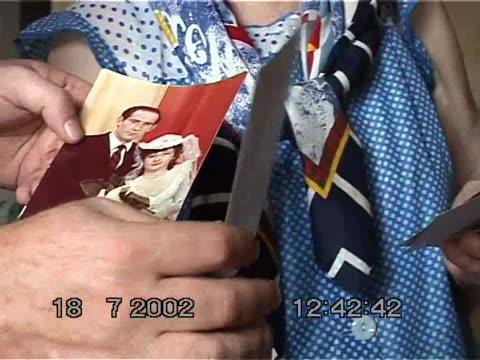
Kerler and the woman look at family photographs. She identifies a son abroad (in Germany), a daughter-in-law and the children, and mentions her marriage in the late 1950s (?). They also look at a photograph from a prayer group. The hosts and the team exchange thanks.
Also includes a photograph of a minyan and a son living in Germany.
The team moves outside and continues to chat with Kozak and Vygodner. They discuss contemporary Jewish life. Kozak then talks about her family. They then discuss the contemporary local community and Kozak's life today.
The group moves toward and into the old synagogue and talks about its roofless state, the need for money to repair it, and Jewish life in town today. There is an offer of food, and talk of costs and travel to the old synagogue. A Russian aside explains that the team should only interview people who spoke Yiddish from childhood, and Kerler asks to be taken to such a person. Mostly informal talk with hosts.
Covers the synagogue's condition and a Russian aside about finding a good Yiddish speaker.
Kozak speaks about her life during World War II and describes her evacuation. She states that her family evacuated on foot for two hundred kilometers, and eventually reached Central Asia. Kozak also recalls her return to Bershad.
She recalls the start of the war: a month in town, then bombing, evacuation and a long stay of a year away, and a return to Bershad in March 1944 with no house left. Kerler asks about a dialect word for 'back' or 'returned' and whether the speakers know it.
A woman, Bershadskaya, joins the talk. They discuss where the team has been traveling from (Uman and another town), how the place names are said in Yiddish, and the fact that she speaks Yiddish and Ukrainian. She speaks of religion, the synagogue and how older people go there. There is talk of terror attacks in Tel Aviv, and the surname Bershadskaya. Kerler mentions an actress called Bershadskaya who left for Israel and a family named Kazakov who emigrated.
Covers place-name pronunciation, Tel Aviv attacks and the emigrant Kazakov family.
Bershadskaya addresses prewar Jewish life in Bershad and also talks about her family. She raised a son. She then speaks about her education and work. Bershadskaya attended a Russian secondary school and worked as teacher at a Ukrainian school. She also speaks about her life before the war.
Bershadskaya says Bershad was a purely Jewish town and that few young Jews remain. She speaks about a son of about 40 who works at a factory and knows no Yiddish. She attended a Russian school and later worked at a Ukrainian school, though she understands Yiddish from home. She also mentions living in Chernyatka.
Bershadskaya talks about her life during the war. She was imprisoned in the Bershad ghetto. Kozak and Bershadskaya remember violence and beatings in the ghetto.
Bershadskaya recalls the Bershad ghetto, where it lay, and the night killings of people accused of being partisans. She describes being bombed and thrown down while running. Kerler arranges an interview with her later. She gives her name as Elizaveta Konstantinovna, with the Yiddish name Leyke.
Includes her given names and the arrangement of an interview.
The team greets Gisia Leiderman at her apartment. Kerler introduces himself, the cameraman and Yosef (probably the other interviewer). He asks her to tell her recollections in Yiddish, and she says she has forgotten much.
Leiderman talks about her life before the war. She attended a Ukrainian school. She also mentions that she spent the war years in evacuation. Leierman then provides personal information.
Leiderman says she speaks Yiddish but cannot read or write it, attended a Ukrainian school and was evacuated during the war. Kerler asks her patronymic and puts the consent and recording formalities, including the date of 18 July 2002. He explains that the interview is for the archive and asks for her address.
Includes the consent and recording formalities, and the date.
Leiderman provides personal information and speaks about her family. Her father was also born in Bershad and worked as a fur and leather worker. Leiderman grew up with one sister and one brother that lives in Israel.
Leiderman gives her name and says she was born in Bershad in 1924 and lived there until the war. Her father, Melekh Brunfman, was a furrier who sewed felt, her mother Mariam kept house and raised the children, and her sister Etl has died. Her brother David lives in Israel.
Asked about her childhood, Leiderman says she does not remember which school she attended, only a later technical college. She remembers no friends and does not recall details of prewar Bershad. Kerler gives an example from his own mother's recollections.
Leiderman says that her parents went to the synagogue on holidays. Her mother prepared gefilte fish for the Sabbath, and she answers Kerler's detailed questions about the stuffing, the salt, pepper and onions, and whether it was sweet or peppery. There was no heating on the Sabbath. She cannot give the Yiddish for a certain word.
Includes her description of the fish stuffing and spices.
Leiderman cannot recall her father's travels. She says Passover was kept at home, with matzo, kugel and pancakes, but she does not remember the Haggadah, the four questions or the stories. Kerler then announces a set of Russian words for her to translate into Yiddish.
Includes the Passover recollections and Kerler's introduction to a translation questionnaire.