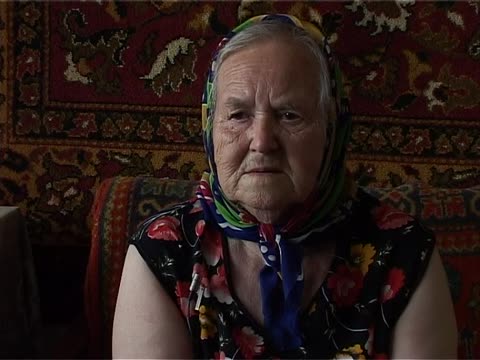
Bershad', Ukraine5 May 1903 (the catalogue's date for this tape is a placeholder)Interviewed by Dov-Ber Kerler, Jeffrey VeidlingerPart 2 of 239 min · 6 passages
Leiderman answers dialectological questions from Kerler. Items include body and household words, a child's crying, verb forms, adjectives and comparatives, words for people and for luck, time adverbs, and the pronunciation of 'thousand'. She says she does not recall some words and is asked what her mother said. At the end Kerler asks whether she lived in Bershad' until the war.
Leiderman speaks about her experiences during World War II. She evacuated to the Urals. After the war, she returned to Bershad. Leiderman continues to answer dialectological questions from the AHEYM Yiddish linguistic questionnaire.
Leiderman says she was evacuated to the Urals, to a place whose name is unclear (Izhevsk?), and returned to Bershad' after the war. She was about seventeen when the war began. She then answers many more questionnaire items: words for non-Jews, a gravestone, Hanukkah latkes and the dreidel, Purim pastry, Sabbath bread, 'rabbi' and plurals, tefillin, and other words and phrases. She says her parents were from Bershad'. She recalls her father laying tefillin only vaguely.
The catalogue lists only the evacuation and return; the transcript also shows questions on Hanukkah and Purim food, rabbis and tefillin, and her parents' origin.
The team concludes the interview with Leiderman and then camera then cuts to an informal chat with Kozak and Vygodner. They discuss religious and prayer customs.
After the interview with Leiderman ends, an informal conversation follows with local people. They discuss Hebrew prayer, the blessing over bread, candle blessings and the four questions of Passover. They say Passover was kept in Yiddish in many Bershad' families. Much of the speech is hard to follow.
The team briefly interviews an unidentified passer-by from Bratslav. He talks about contemporary religious life in Bratslav. They then talk about the contemporary community.
Kerler talks with a man, said to be from Bratslav, about how his parents and grandparents spoke Yiddish, and about a coppersmith in Bratslav whom the team visited. The man says he was an editor of a Yiddish paper. They also discuss Yiddish-speakers in Ukraine today, then travel plans and logistics. The speech is largely garbled, and the catalogue's talk of contemporary religious life is not clear in the transcript.
The transcript shows more talk about the Yiddish of Bratslav and the team's travel plans than about religious life.
The interview with Bershadskaya begins. Her Yiddish name and her father's name are established, and Kerler gives the date and place of the interview, in Bershad'. Her Russian name is given as Elizaveta Konstantinovna Bershad'skaya.
Bershadskaya provides personal information and talks about the location of her home village Chernyatka. Her family moved to Bershad when she was thirteen years old. Bershadskaya talks about her family. Her father was also born in Chernyatka and was a barber. According to Bershadskaya, between fifteen and twenty Jewish families lived in Chernyatka. Bershadskaya's mother was born in Bershad.
Bershadskaya says she was born in Chernyatka, in the Dzhulinka (Zhulynka?) district, on the far side of the Bug, and gives its Yiddish and Russian names. She was born in 1927 and lived there until the late 1930s. Her father was born there too and was a barber; her mother, Khave, was from Bershad'. She says only about twenty Jewish families lived in Chernyatka.
The transcript adds the father's patronymic and the mother's name as Khave Bentsins (?), and says the family had a time in Chernyatka before the war.