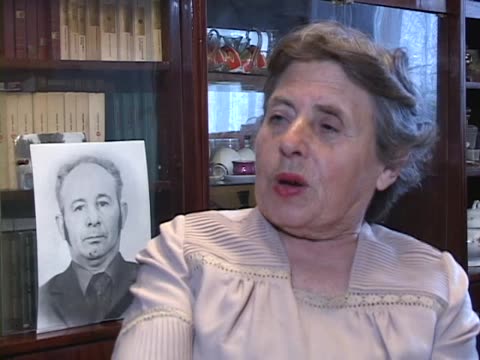
The formal interview with Gvinter begins. She provides personal information and discusses her family. Gvinter explains that for work reasons her passports writes 1928. Her father passed way during the Great Hunger in 1933.
Kerler announces the date and place of the interview. Gvinter gives personal and family information: her father's two brothers in Washington and a relative there named Oister, and the naming of a relative Igor. She says she was born in 1930 but her passport gives 1928 because documents were lost and her mother resisted the change. Her father Yankl died in the famine of 1933, aged 38. A family album with photographs from America was lost in the Dnieper during evacuation, and her mother, Sharke, died in 1977.
Gives the relatives in Washington, the lost album and her mother's death; the passport-year explanation is more detailed here.
Gvinter says her mother Sharke was a daughter of Khayim, after whom she is herself named (?). She tells of her grandfather, who lived a very long life (an age of about 115 is mentioned). He hid in a concealed hiding place and was finally killed by Petliurists, and the hiding place was found afterwards. The transcript does not show the father's trade.
The transcript shows the grandfather's killing by Petliurists and his hiding place; it does not mention the father's trade.
Gvinter speaks about her life during World War II. She also speaks about her family. She was imprisoned in the Pechera concentration camp in 1943. Gvinter explains that the camp was first under German and then under Romanian occupation. She then briefly describes the living conditions in the camp. Before her deportation to Pechera, Gvinter lived in the basement of a synagogue in the Bershad ghetto. She recalls refugees from the region, who stayed at their house, as well as describes the encounter with a partisan.
Gvinter recalls the war years: at the age of about twelve (?) she was taken to Pechera in 1943, first under the Germans and then under the Romanians. She tells how she bought potatoes from peasants, passing as a non-Jewish girl, and sold them at the Jewish market. A partisan came to the family, who lived in the basement under the synagogue, and refugees from the area were brought in and many died. She also mentions an older sister who left in the 1941 evacuation, her mother's relatives, and money sent from America.
Adds the potato trading disguised as a non-Jew, the refugees in the house and the relatives abroad.
Gvinter talks about her life before the war and discusses her family. She attended a Yiddish school for two years. Gvinter's older sister died at on the front. She then addresses praying customs and briefly returns to her camp experiences, as well as her return after the war.
Asked about life before the war, Gvinter says she attended a Yiddish school up to the second class and that life was good. Her older sister fell at the front. She says her mother knew how to pray and taught her morning and evening prayers. She returns briefly to her three months in the camp and to the family's living quarters beside the synagogue. Her husband and others in the room add comments about the building.
Adds the details of the mother's teaching of prayers and the dwelling next to the synagogue.
Her husband (S4) and others speak about the women's synagogue and the people who lived behind it. Asked how she and her husband met, Gvinter says they were neighbours; she was a seamstress and he a shoemaker (?). She talks about sewing for others in the early years and then breaks off into her camp experience and being wounded.
The husband seems to be a shoemaker, not a tailor, in the transcript.
Gvinter returns to her experiences in the Pechera concentration camp, as well as her escape. Specifically, she recalls a family who was murdered. Gvinter was injured in 1943. She describes how she returned home and met her sick mother.
Gvinter returns to the Pechera shooting and describes seeing a man named Max from Chernivtsi and his wife, who carried their six-year-old son, being murdered. She says she escaped in 1943 and was taken in and cleaned of blood by a peasant woman whose husband was a commandant. She was passed on by partisans from town to town through Tulchyn and back to Bershad'.
Adds the story of Max's family and the details of her rescue by peasants and partisans.
Gvinter sings the Yiddish song "Afn yidishn beys oylem" (in the Jewish cemetery), which was sung by the family in Pechera. The song is about the Jewish suffering in the camp.
At Kerler's request Gvinter sings a Yiddish song about the Jewish cemetery and the sufferings of Jews under the Germans, which she links to the people she saw killed at Pechera. She then recalls the farewells at the pit.
Gvinter talks about her life in the Bershad ghetto at the beginning of the war. She also mentions the Jewish police and recalls how a bomb destroying her house. Gvinter then addresses her encounter with a partisan. She also recalled the hanging of partisans. Gvinter then describes how she was deported to the Pechera camp, dressed in peasant clothing.
Kerler asks her to set the events in order. Gvinter recalls the ghetto at the start of the war, the police and robbing by them, a bomb that fell on the family house, and a partisan (named Volodya?) who helped with bread and asked her to carry leaflets. She also remembers the partisans hanged along the bridge. She describes how she was taken to Pechera and was hit, with a black car and the camp journey.
Adds the leaflet and glue tasks for the partisan, the hangings and a discussion of whether there was a Jewish police.
Gvinter speaks about her life in the Pechera camp. She describes how she was buried alive in a mass grave, after German executions. She then talks about her and her mother's lives toward the end of the war. Gvinter also mentions her war medals and lists local partisans.
Gvinter describes Pechera after her first account: the camp passed from Romanian to German control, two pits were shot out, and she lay among the buried but survived. Her mother, who washed the dead to find food, hid her. Kerler checks who was responsible for the killings. She mentions her war medal and lists local partisans, including Yashe Talis, and talks about people from the partisan list. She says she tells this so that children should know what she endured.
Adds the partisan names, the order of Romanian and German control, and the medals.
Gvinter sings another song from the war period: "Vinter teg" (winter days). She then returns to her life during the war, including observing forced labor and bombing.
Gvinter sings a song about winter days and a camp, repeating the first part at Kerler's request. She says it matters that children and grandchildren know about the pits, the forced labor carrying stones, and the starvation. Kerler asks about partisan detachments in the area. Gvinter names Yashe Talis as the leader, and a woman in the room mentions the ghetto.
Gives the repeated song text and the discussion of passing the memory on.
Gvinter shows a photograph of herself in war military regalia. She then speaks about her life after the war, when she lived underneath the synagogue. Gvinter worked in an artel and her mother was a pastry cook.
After a brief exchange about photographs, Gvinter describes life after the war. The family lived in the synagogue building; her sister was killed and her mother was young. She began working before she was fourteen and worked in an artel. Her mother baked for weddings, as her grandmother and great-grandmother had, and she herself can bake too.
Kerler recalls a pastry Gvinter once gave the team and she gives the recipe for strudel (the Bershad' kind): a dough made with many eggs, a sugar syrup, nuts and raisins. The participants then discuss the words for raisins in Yiddish and Russian, and what grows in Bershad' (a tree).