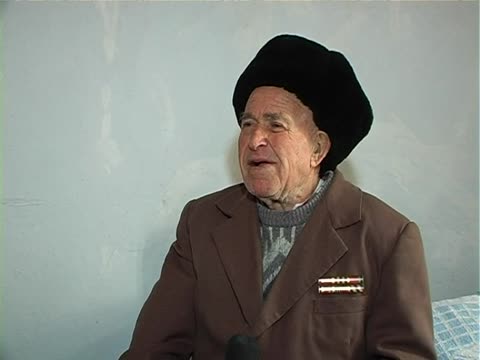
Sklyarskiy shows his documents and talks about his status as a partisan and war invalid, with a utility benefit that reduces his electricity charges. Kerler asks when his sister took him, and Sklyarskiy says he recovered in the Lipovets district. His sister was an officer in a field hospital, and he travelled with the hospital. Kerler also asks about the person who shot at him.
The transcript shows the discussion of benefits and documents, and his rescue by his sister.
Sklyarskiy speaks about his first injury, shot by the Ukrainian police officer in Zhornyshche. He then returns to his dream in the fields, as well as describes the help he received from Ukrainian locals.
Sklyarskiy speaks of the German officer and the shooting after his flight, then of a dream in which a person told him to run into the field and not the forest. He tells how two men who joined the partisans hid in a secret hiding place near the pit where Jews were shot. He mentions help from local people and the driving of Jews on foot and in carts, and begins to speak about the ghetto. Parts of this are unclear.
The transcript shows the hiding place near the killing pit and the two brothers who helped, rather than only the shooting.
Sklyarskiy addresses Jewish life in the Bershad ghetto during the war. Sklyarskiy then returns to his and his family's life at the beginning of the war in May 1941. He was a forced laborer and built roads.
Sklyarskiy speaks in Russian and Yiddish about the Bershad' ghetto, the Romanian zone, and the killings elsewhere. He recalls working on roads from 1941 with the police chief named Zavalinskiy (?), and the way the forced labourers were treated. Kerler asks when the Germans entered; he answers that it was at the start of the war. Kerler then asks him to talk about life after the war.
Sklyarskiy speaks about his life, including work, after World War II. He took courses on accountancy in Vinnytsya for six months and worked in several towns, including Bershad.
Sklyarskiy says that after the war he studied accounting for six months in Vinnytsya and was then sent to work in bookkeeping, in Bershad' among other places. Kerler asks whether someone had asked him to record what he went through, and then asks about the best times of his life.
Sklyarskiy recalls his best moments during his life after the war. He also addresses his family and remembers the moment when his daughter passed away.
Sklyarskiy speaks of the better years after the war, his marriage and the birth of his children. He tells of his daughter, who lived in the Donbas, and her sudden death after a visit to a doctor, and of how he and his sons learned of it by phone. He also mentions her husband, a worker, and his father-in-law, who died at about fifty-four.
The transcript shows details of the daughter's death and of her husband and his father.
Sklyarskiy addresses postwar Jewish life in Bershad. He recalls synagogue services. Sklyarskiy then mentions his traditional wedding in Bershad in 1951. He then returns to his family.
Answering Kerler's questions about postwar Bershad', Sklyarskiy says the synagogue was used and many Jews attended, and that Yiddish was spoken in the streets. He says he was married in Bershad' with Jewish music and klezmer, and that kosher meat could be bought. Kerler then asks about his granddaughter Lena in Israel and begins asking for an address for correspondence.
The transcript also shows his granddaughter in Israel and Kerler's request for an address.
Sklyarskiy and Kerler, with S2's help, go through letters and addresses, a postal code and a house number. Kerler asks whether Veidlinger, a historian, may write about him in English and he in Yiddish, and Sklyarskiy agrees. Kerler asks where the toilet is. Sklyarskiy mentions Ivanky as a village in the Lipovets district.
Sklyarskiy speaks about the village of Ivanky, where people were shot, and about a visit there about ten years earlier. He shows letters and talks about his granddaughter Lena, who recorded an interview with his wife. Kerler asks about Lena's surname and city in Israel, where she studied at a university, and about a number abroad.
The transcript shows the Ivanky killing site and the granddaughter's interview with his wife.
Sklyarskiy speaks about his family and again about the dream in which he was told to run to the field. He mentions his wife's fasting and illness near the end of her life and the interview his granddaughter made with her. Kerler arranges to photograph him with those present, and there is talk of his writing. A garbled recogniser loop appears in this part.
The transcript shows his wife's fasting and the arrangements for a photograph.
The team finishes the official part of the interview with Sklyarskiy and he speaks about contemporary, including Jewish, life. Sklyarskiy also speaks about life during the postwar Soviet period, as well as local geography.
Sklyarskiy and Kerler finish the formal interview and he speaks of today's life, the market and the neighbours. He recalls a Jewish couple, and a pious man who prayed, and says that few Jews and some non-Jews still speak Yiddish in Bershad'. They discuss the cost of dental care and the polyclinic. He returns to the story of the two hiding places and to the geography of Ivanky and Lipovets. Kerler thanks him and offers blessings.
The transcript shows talk of Yiddish speakers today, medical costs and the Lipovets district, and the return to the hiding story.
Sklyarskiy speaks in Russian about his father, who before his death wanted to see his son, and about walking from Lipovets to Ivanky, with a mention of a stepmother or an aunt (?). Kerler and the others then thank him and the interview ends.