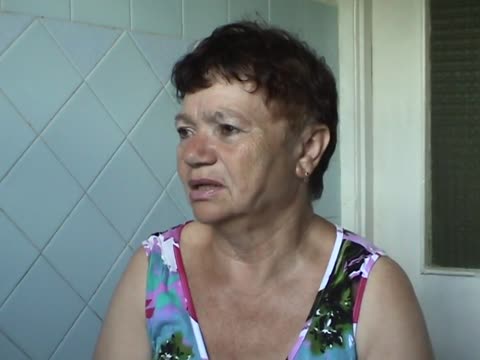
This recording is a continuation of a formal interview with Frida Moiseyevna Pustilnik. (Part 2 of 3. See MDV 390 and Accession # 09-010.05-F MDV 388 Berehove collection). Pustilnik discusses her agricultural work and food customs. She then talks about her life during World War II. She recalls how her mother told her about help she received from a German soldier in the Pechera camp. Pustilnik, Frida Moiseyevna. Interviewed by Dov-Ber Kerler. 6/8/2007. Ukraine, L'vivs'ka Oblast', Boryslav.
From the machine transcript
Kerler recalls what was grown and eaten (wheat, peaches, maize porridge), and Pustilnik then speaks about her mother in the war, in the Pechera camp. A German soldier there helped them with food, and Kerler explains that the Romanians were the camp's masters. She then turns to the family's return after the war to a looted house, with a mother who was ill for years.
The passage starts with food and agricultural questions, then focuses on the German soldier and the postwar return.
Pustilnik talks about her life after the war. She returned with five siblings and her mother. She explains how she and her siblings sold items to support the family. Pustilnik moved to Boryslav in 1956 and lived at her maternal uncle's home. After she graduated from a technical institute, she worked at a sewing factory. Before Pustilnik moved to Boryslav, she worked on a kolkhoz in Yire 4:50. Pustilnik, Frida Moiseyevna. Interviewed by Dov-Ber Kerler. 6/8/2007. Ukraine, L'vivs'ka Oblast', Boryslav.
From the machine transcript
Pustilnik describes the family's hardship after the war. As small children they sold items at the market, and she later trained at a technical college and worked in a sewing factory. She worked on the kolkhoz, took a passport and moved to Boryslav, where she lived in private lodgings. She mentions that her husband was from Yire and was crippled in a car accident.
Besides the move to Boryslav and the factory, she speaks of her husband's accident and of medals she was denied because she was Jewish.
Pustilnik speaks about her family. A few of her siblings live in Israel. She also addresses the fate of her only sibling who did not survive the war. Pustilnik, Frida Moiseyevna. Interviewed by Dov-Ber Kerler. 6/8/2007. Ukraine, L'vivs'ka Oblast', Boryslav.
From the machine transcript
Pustilnik names her siblings and says there were eight children before the war and six after. She gives their approximate birth years, and a few siblings live in Israel (Haifa among the places mentioned). One sister, Yeyde (?), was caught after hiding and killed, and Pustilnik describes the mother's cooking in the camp, with the boy who cried from hunger now living in Israel. Kerler asks about the river and the camp near Pechera.
The catalogue says one sibling did not survive; the transcript also shows the names and birth years of the others, and that the mother cooked in the camp.
Pustilnik talks about her life in the Pechera camp, as well as the march to Pechera. She also addresses contemporary Jewish life. Pustilnik, Frida Moiseyevna. Interviewed by Dov-Ber Kerler. 6/8/2007. Ukraine, L'vivs'ka Oblast', Boryslav.
From the machine transcript
Pustilnik describes the march on foot to the Pechera camp, where those who could not walk were shot. She mentions a small book of Jewish survivors, and Kerler notes that he has recorded people in Tulchyn who were in the camp. She tells how the pregnant mother and small children escaped from a Gentile who had been paid in wheat to take them. The father was in the Red Army, and the passage ends with the mother pregnant in 1942.
Along with the camp and march, the passage covers a book of survivors, Jews still in Tulchyn, and a Gentile who betrayed the family.
Pustilnik talks about her family's life after the war. She recalls how her mother protected her children and herself from soldiers' assault and rape. Her father died during the war. Pustilnik explains how her family made a living. Pustilnik, Frida Moiseyevna. Interviewed by Dov-Ber Kerler. 6/8/2007. Ukraine, L'vivs'ka Oblast', Boryslav.
From the machine transcript
Pustilnik tells how the family slept on straw after the war and how Soviet soldiers threatened them, and how her mother shielded the children by lying over them. Her father, who never returned from the war, is known only through documents. A sister in Malyn (?) was unable to obtain the pension due to the family because of the father's death, and the pension was taken by a brother. Kerler asks what language they speak among themselves, and she answers that they speak Yiddish at home and the language of non-Jews outside.
The pension dispute and the language of the family are not in the catalogue sentence.
Pustilnik talks about her family. She raised a son and a daughter. Pustilnik, Frida Moiseyevna. Interviewed by Dov-Ber Kerler. 6/8/2007. Ukraine, L'vivs'ka Oblast', Boryslav.
From the machine transcript
Pustilnik says her daughter speaks Yiddish and wants to go to Israel, while her son has lived in Israel for eighteen years and has forgotten the language. She never saw her father or a photograph of him; she mentions an aunt, Tabe, who helped them after the war, and describes her maternal grandfather Avrom, whose surname is unclear (Pleyder (?)), who worked in a kolkhoz. She says she studied in the village school and did well in mathematics.
The passage also covers language in the family, the grandfather who worked in the kolkhoz, and her own schooling.
Pustilnik talks about her life after the war. She attended a Ukrainian school and worked on the Lenin kolkhoz in Yire. According to her, it was a Jewish-Ukrainian kolkhoz. Her family moved from Yire to Yampil after the war. Pustilnik remembers a non-Jewish woman who spoke Yiddish to her. Pustilnik, Frida Moiseyevna. Interviewed by Dov-Ber Kerler. 6/8/2007. Ukraine, L'vivs'ka Oblast', Boryslav.
From the machine transcript
Pustilnik says she went to a village school in winter and worked on the kolkhoz in summer. Kerler establishes that the Lenin kolkhoz in Yire (?) was Jewish, and that in Yampil the kolkhoz was named after Molotov. She says the family moved to Yampil after the war, and recalls a non-Jewish woman who spoke Yiddish well. She then describes how, on arriving in Boryslav, no one helped her and she lodged in private rooms.
The passage also covers a Yiddish-speaking neighbour and the move to Boryslav.
Pustilnik talks about her life in Boryslav. Pustilnik, Frida Moiseyevna. Interviewed by Dov-Ber Kerler. 6/8/2007. Ukraine, L'vivs'ka Oblast', Boryslav.
From the machine transcript
Pustilnik talks briefly about her life in Boryslav, saying they cook Jewish food, with fish on Fridays. Kerler then asks about Jews who prayed in the camp.
Pustilnik speaks about her life in the Pechera camp. In particular, she recalls Jews who prayed. Pustilnik then talks about her family and addresses the persecution of someone in Israel who supported the Romanians during the war. Her sister moved to Israel in 1949. Pustilnik, Frida Moiseyevna. Interviewed by Dov-Ber Kerler. 6/8/2007. Ukraine, L'vivs'ka Oblast', Boryslav.
From the machine transcript
Pustilnik tells of Jews who prayed in the camp, and discusses the mezuzah on the door and her mother's and grandparents' ability to read Yiddish. She describes a brother in the ghetto and then the army, and the Weissmann family. A man called Pavel, who was reportedly friendly with the Romanians, was recognised and killed in Israel, and Kerler asks about the reason. She also mentions a sister who lived on a rich kolkhoz, and Kerler asks about the Razkin family (?).
Besides prayer in the camp, the passage covers a brother in the ghetto, the Weissmann family and a man killed in Israel.
Pustilnik talks about her family. Pustilnik, Frida Moiseyevna. Interviewed by Dov-Ber Kerler. 6/8/2007. Ukraine, L'vivs'ka Oblast', Boryslav.
From the machine transcript
Pustilnik describes her grandparents' house and her grandmother's many children. One was killed in the war, and the others survived, including three daughters. Kerler asks whether her mother sang Yiddish songs and whether she knows old songs.
Pustilnik recites a Yiddish song about a groom finding his right match. She then recites the song "Papirosn" (cigarettes). Pustilnik, Frida Moiseyevna. Interviewed by Dov-Ber Kerler. 6/8/2007. Ukraine, L'vivs'ka Oblast', Boryslav.
From the machine transcript
Pustilnik recites, with Kerler prompting, a Yiddish song about a groom who wants to test his bride and a ladder, and says she cannot remember the rest. She then recites parts of "Papirosn" about a child selling cigarettes in the ghetto, with an orphan in the story; large parts are garbled.
Pustilnik talks about life today, as well as her family. She then recites again the song about the groom. Pustilnik, Frida Moiseyevna. Interviewed by Dov-Ber Kerler. 6/8/2007. Ukraine, L'vivs'ka Oblast', Boryslav.
From the machine transcript
Pustilnik talks about life today, saying there are no Jews left and no one to speak to. Her brother and sisters call from Israel and speak Yiddish, and she says she supports her son's children there. She says people were afraid to circumcise under the Soviets, and that she recites the groom song again without completing it. Kerler talks about the archive and about Yiddish speakers in Drohobych (?).
The passage also covers fear of circumcision in Soviet times, calls from Israel, and Yiddish speakers in Drohobych (?).
Pustilnik briefly answers questions about cultural terminology and discusses folk customs. She also talks about her family's life after the war and recalls the great poverty her family endured. Pustilnik, Frida Moiseyevna. Interviewed by Dov-Ber Kerler. 6/8/2007. Ukraine, L'vivs'ka Oblast', Boryslav.
From the machine transcript
Pustilnik is asked what "mame-loshn" means. She recalls hunger after the war, with her mother walking on foot from Yampil to Malyn to buy soap and matches, and the children sold things at the market for bread. She remembers her sister's death in the cart.
The passage also contains a question about the term mame-loshn and a custom involving an egg in a glass.
Pustilnik talks about her family, in particular how she met her husband. She also remembers her wedding. Pustilnik, Frida Moiseyevna. Interviewed by Dov-Ber Kerler. 6/8/2007. Ukraine, L'vivs'ka Oblast', Boryslav.
From the machine transcript
Pustilnik tells how she met her husband, a handsome tall man from Yire (?), and gives the names of the brothers, who had the surname Volkovich. His mother had died in the ghetto, and a sister of Pustilnik who was a nurse had been his friend, after which she was matched with Pustilnik. The passage ends in the middle of the wedding story.
The catalogue mentions the wedding; the transcript ends before the wedding is described.
Pustilnik speaks about her life after the war and family. Pustilnik, Frida Moiseyevna. Interviewed by Dov-Ber Kerler. 6/8/2007. Ukraine, L'vivs'ka Oblast', Boryslav.
Pustilnik explains how to make wine. She then talks about Jewish life today. Pustilnik, Frida Moiseyevna. Interviewed by Dov-Ber Kerler. 6/8/2007. Ukraine, L'vivs'ka Oblast', Boryslav.
Pustilnik speaks about food customs. She describes how her mother prepared gefilte fish. Pustilnik, Frida Moiseyevna. Interviewed by Dov-Ber Kerler. 6/8/2007. Ukraine, L'vivs'ka Oblast', Boryslav.