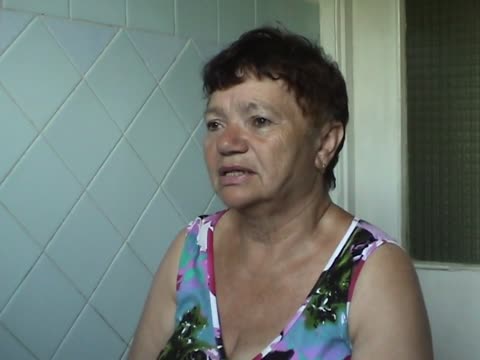
Pustilnik speaks about life today. She then recalls episodes from her family's life after the war, as well as about the support they received from the kolkhoz. Pustilnik, Frida Moiseyevna. Interviewed by Dov-Ber Kerler. 6/8/2007. Ukraine, L'vivs'ka Oblast', Boryslav.
Opens with chat about the distance to Chicago, America and Israel. Pustilnik answers questions about candle-blessing at home and Soviet-era restrictions on religion. She recalls the family's hardship during and after the war, when they lived in Yampil (?) and her mother went to relatives in a village. She says the kolkhoz helped with bread and other food. She then talks about a grandson and his young family who are out of work.
Opens with talk of America and Israel and Soviet-era restrictions on candle blessing, and covers the grandson's unemployment.
Pustilnik speaks about observing customs and holiday celebration after the war. She bakes her own matzo. She then addresses weddings. Pustilnik, Frida Moiseyevna. Interviewed by Dov-Ber Kerler. 6/8/2007. Ukraine, L'vivs'ka Oblast', Boryslav.
Answers Kerler's questions about Jewish observance after the war. She mentions the memorial-day custom, a lamp burning day and night, and not knowing where her father lies. Of Purim there is little; for Passover she bakes her own matzo at home. She describes Jewish weddings after the war, with Yiddish music and songs, a wedding entertainer (?), and her grandson's groom's cap.
Also covers her father's death and unknown grave, and Yiddish music and songs at weddings.
Answers Kerler's questions about cultural terminology. She is asked about a dybbuk and a golem, and says she did not know the first. She gives words for funeral, cemetery and holy place. Kerler checks whether the words are Jewish or non-Jewish usage.
Answers questions from the dialectological questionnaire, with Kerler and, later, Lemster. Items include greetings and farewells, a sentence about whether someone will come, breathing, being ill, missing someone, running away, and terms for honest, believer, Christian and peasant. Near the end Lemster asks about a river and the Dniester (?), and she mentions that her trip to Israel was arranged through her role in an association of former child prisoners.
Pustilnik talks about regional geography and towns she passed through on the way to the Pechera camp. She also speaks about life today and her travels to Israel. She lived there and worked as a massage therapist. Pustilnik, Frida Moiseyevna. Interviewed by Dov-Ber Kerler. 6/8/2007. Ukraine, L'vivs'ka Oblast', Boryslav.
Talks with Lemster and Kerler about places she was taken to during the war, including Berlovka (?), and about now living in Boryslav with no one to talk Yiddish with. She mentions her poverty, her marriage in 1960 (?), and her two children, a daughter nearby and a son in Israel. She describes the son's family and his three children, a trip to Israel, and her work there as a massage therapist. She also says she took a grandson to a synagogue. The questioning then turns to a rabbi in her home village.
Adds her postwar marriage and children, the grandchildren, and a rabbi in her home village; the camp route is not clear.
Pustilnik speaks about her family's life after the war in her home village Yire. In particular, she shares an episode about her mother's encounter with a rabbi. Pustilnik, Frida Moiseyevna. Interviewed by Dov-Ber Kerler. 6/8/2007. Ukraine, L'vivs'ka Oblast', Boryslav.
Talks about the postwar family in her home village and about a rabbi there. She tells of her mother's encounter with the rabbi, set around a sister studying in Odessa and a relative. She describes her mother baking bread and praying while baking, and her brother cutting wood. Lemster and Kerler then ask about the words for room and house.
Ends with a short elicitation of the words for room and house.