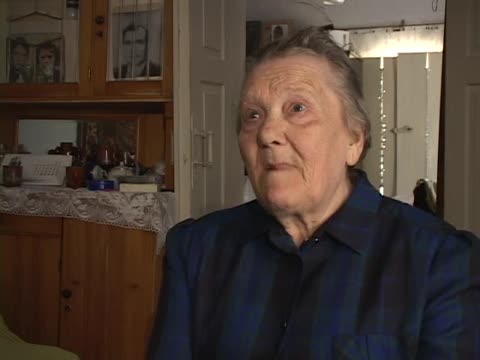
Kerler returns to Sabbath at home and asks about a Sabbath dish. The interviewee does not know the term, and they try to establish what was cooked, with beans mentioned. She also speaks briefly about her late husband.
The interviewee mentions a childhood friend who later went to America and visited her. Kerler asks what games they played and what the word for a doll is in Yiddish; she says the Russian word is not Yiddish and discusses other terms.
She recalls the arrival of the Germans, who collected money, gold and clothing from Jewish homes, and then the Romanians, who fenced off a square by the school as a ghetto, six years long. She describes a woman accused of being a partisan because of a grenade and shot, and the memorial later built on the square from the bones.
Adds the woman accused of being a partisan and the postwar memorial.
After the war she finished seven grades, then studied three years at a technical school in Moldova and worked there. She married in Sharhorod with a Jewish wedding, in 1958.
She says Yiddish was still spoken in Dzhurin after the war and life was hard; her mother was left alone with three children. Her father died at the front, and the family learned of it later; she describes the circumstances of the grave and annual visits.
The catalogue says the father was injured and visited in hospital; the transcript points to his death at the front and a grave visited yearly.
She answers whether Jewish religious life continued after the war: the synagogue became a factory and people met in private houses in Sharhorod for the High Holy Days, which Dzhurin did not have. Kerler asks about Nemyriv too, where there were many Jews but no synagogue.
The interviewee describes the Dzhurin synagogue (large windows, white stones, women seated) as Kerler asks about its appearance, then Katz invites her to recall early childhood. She sings a little of a lullaby, says her mother could read Yiddish and wrote to relatives in America, and recalls a parable of a rich and a poor brother.
Covers the lullaby, her mother's letters from America and the parable, beyond story telling in general.
She explains the family went to Sharhorod for Passover to celebrate with her husband's parents and brothers, and the discussion turns to the names of the grandparents, including the grandmother's Yiddish name. Kerler asks about the husband's father's name and birthplace.
Kerler asks what she wants future generations to remember; she wants people to help each other and live in peace without war. She recalls what helped during the war (giving away belongings for bread, a woman who gave bread) and her mother's work, and her brothers' later careers.
She speaks about life today: her son and daughter, a grandson working abroad, and grandchildren. Katz asks about the future of Jews in Dzhurin and Nemyriv; she says only a few remain and expects nothing, and describes being the only Jewish pupil in school and technical school.
Adds her descendants and the small number of Jews.
Asked for a Yiddish word for a gravestone, she gives it and says her grandfather's stone in Dzhurin has Yiddish writing. After the war the family brought a rabbi to read it, but no one in Dzhurin now can.
Concluding exchange: Katz encourages her to think of good things, and she speaks of her health and children. She laments that there are few Jews left and that a Jewish match for a widowed relative would be hard to find.
Camera footage as the team looks for the Gellers' house, with a passerby giving directions in Russian and Yiddish (streets named after Marx and Engels) and the team commenting in the car. The speech is mostly Russian, garbled and unclear.
The team meets the Gellers at their home and introduces themselves and the project, asking for an interview in Yiddish. Katz and Kerler ask where they were born, David in Zhmerynka and Sofia in Bratslav, and what the Hasidim of Bratslav were called.
The team greets the Gellers outside their house before the formal interview, with introductions of those present, birthplaces (Zhmerynka, Bratslav) and the Bratslav Hasidim question.
Kerler records the date and Geller provides personal information: Sofia gives her family name Dikerman and birth in April 1929, and David's birth in May 1929. David then begins to speak about Zhmerynka as a railway junction and a Jewish town, while Sofia and Kerler chat about the archive.
Geller talks about prewar Jewish life in Zhmerynka. He recalls leisure activities in town. David then addresses his family's life at the beginning of the war, when they evacuated. His father was a barber and a communist, according to David. David describes his evacuation in a heated goods train toward Tashkent, Uzbekistan, traveling for one month. David continues that they evacuated further to Samarqand Shahri, where he worked on a kolkhoz in the Panjakent region.
Geller recalls Zhmerynka's many Jews and evening strolls on the main street, then the start of the war: his father, a barber and communist, was evacuated with others by train. They traveled a month in freight cars to Tashkent, then on to Samarkand and a kolkhoz in the Panjakent district (?).
Geller describes the living conditions at the kolkhoz. He also speaks about his family. Geller's father was drafted in 1942. According to Geller, his mother was pregnant and she gave birth in Zhambyl Qalasy, Kazakhstan. Geller's mother passed away in Samarqand Shahri and he and his two brothers had to take care of themselves; Geller explains.
Geller describes the kolkhoz housing, a cotton storehouse where families slept on the ground, and his father's army call-up in 1942. His mother, pregnant, gave birth in Dzhambul; she died in Samarkand and was buried in a mass pit, leaving three orphan sons.
Geller talks about his life in evacuation, after his mother passed away. Geller's maternal aunt took care of his infant brother in Shymkent, Kazakhstan. Geller continues that he began a turner apprenticeship at a factory teaching facility (Fe'Ze'O - фабричное заводское обучение), before he worked a factory in Shymkent. Geller then explains that he moved to his father, who lived in Türkmenbaşy (formerly known as Krasnovodsk). Geller worked at a cafeteria there.
Geller tells how an aunt took the infant brother, and he trained as a turner at a factory school in Chimkent and worked at a plant, receiving bread rations. His father, a worker in a labor army and later at a port, took him to Krasnovodsk, where he worked in a cafeteria.
Geller speaks about his siblings' life during the war, as well as his life in Türkmenbaşy. Geller's father was drafted for the second time. He then describes his return home to Zhmerynka, via Baku (Azerbaijan), after the war ended.
Geller speaks about his brothers (Velvl in the army, the youngest, Moshe, with aunts) and his father's second army call-up, which left him alone. He returns to Zhmerynka from Turkmenistan via Baku on 9 May 1945 and finds aunts there, then leaves for Kyiv in 1947.
Geller speaks about his life after the war. He left Zhmerynka for Kyiv in 1947 and attended again the Fe'Ze'O. He was drafted for military service in 1950 and served until 1953. Geller then speaks about his service in the Primorsky territory.
Geller says he studied again at the factory school in Kyiv to be a turner, and was drafted in 1950 and sent by freight train for a month to the Primorsky region near Vladivostok.