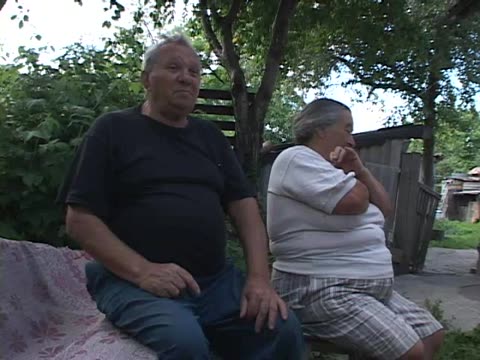
David talks about his family. They raised two daughters, who live in Moscow. David then addresses his life during World War II, particularly how his family evacuated.
Geller answers that their daughters are content. Kerler then asks how the evacuation from Zhmerynka was organised. The speaker, who was twelve, recalls loading belongings, leaving most things behind, and travelling in heated freight wagons. Katz begins asking how it was decided that Geller should go into the army, and Kyiv is mentioned.
The transcript shows no mention here of Moscow; the passage is chiefly Kerler's questions on how the evacuation was organised.
David speaks about the moment when he volunteered for military draft. He then describes the work tasks in the army, as well as in his profession as turner.
Geller explains that he had a four-year deferment from mobilisation. He pressed the authorities to take him, and then worked for a month in Kyiv on bricks. Back in Bratslav, already married, he found work as a turner at night because electricity was supplied only at night. Kerler closes by turning to postwar antisemitism.
David and Sofia discuss postwar antisemitism, before addressing the contemporary Jewish press. They then address the period of the Doctor's Plot in 1952-53.
The Gellers discuss antisemitism after the war. One says he never heard a slur in Central Asia, where Uzbeks were friendly. They reject the claim that Jews did not fight at the front, and compare the antisemitism of today with the past. They also discuss the Jewish press and the Doctors' Plot of 1952–53, when small towns were not affected. The speaker labels are uncertain in places.
Also covers the Jewish press and the Doctors' Plot period, with Kerler's questions.
Sofia speaks about her life today and the relationship with her non-Jewish neighbors. She discusses her childhood memories of Jewish Bratslav and her family. Sofia's father was a coachman. She also mentions her mother's observance.
Sofia describes how few Jews live in Bratslav today and that there is no militia or police presence. Asked by Kerler what she remembers of old Bratslav, she says she was born into a drayman's family. Her mother kept the home and lit Sabbath candles, and her grandfather, a melamed, was killed in the pogroms of 1918. The war began when she was twelve, and her father had a wagon with two horses.
Adds the grandfather's death in the 1918 pogroms and the family's wagon and horses.
Sofia talks about her life during World War II and describes her family's evacuation toward Lugansk, as well as settling down at a kolkhoz. Sofial then addresses her life and work on the kolkhoz until December 1941. They then evacuated further to Tashkent, Uzbekistan, from where they moved to a kolkhoz at the Kamashi station in Kaskadarya Province, Uzbekistan. Sofia explains how her mother arranged transportation for her children to a nearby town to escape the hunger on the kolkhoz.
Sofia tells how her family left Bratslav on the father's horse wagon. The journey took six weeks, with the parents, siblings and a brother's wife, to the Luhansk area of the Donbas, where they worked on a kolkhoz. In December 1941 they travelled by freight train to Tashkent, then to a kolkhoz near the Iranian border in Kashkadarya oblast. There her mother took the hungry children to a nearby town. Her parents' names are given as Avrom Elye and Kheyke, and a brother is Leyb.
Sofia speaks about her family, before she addresses prewar Jewish life and religion in Bratslav. She also speaks about the fate of the local Jews during the war. Sofia then recalls her mother's praying customs.
Sofia gives her mother's and father's birth decades. She says that before the war over five thousand Jews lived in Bratslav and that most perished in the camps, while local policemen plundered Jewish houses. She recalls five synagogues, one with a mikveh. Asked by Katz about Bratslav Hasidim, she says she remembers none, though Nakhman and Nosn are mentioned. She also recalls her mother praying in Hebrew and telling stories at home in Yiddish.
Sofia addresses her family's return to Bratslav in 1944 and their life after the war. She grew up with five siblings. Sofia then returns to prewar Jewish life and culture. She recalls traditional weddings.
Sofia says the family returned to Bratslav in August 1944. She finds life just after the war better than today, because people then got on with each other. She describes prewar Bratslav as a Jewish town in which Jews married only Jews, and says that over two thousand Jews lived there after the war. She recalls Jewish weddings with Yiddish songs, dancing and music, and laments that today's young people marry out, including her granddaughters.
Sofia cannot recall Yiddish songs, saying decades of pressure made them forget. Katz and Kerler prompt her, and she and others sing fragments of 'Itsik hot shoyn khasene gehat' and 'Lomir zikh tsekushn'. She talks about her family: her daughters live in Moscow, a granddaughter studies there, and an aunt sang Yiddish songs. They now speak Russian at home. She says that Yiddish was her parents' language and that her older brother finished six years of Jewish school before the war, while she attended a non-Jewish school. Kerler also asks about Nemirov and a saying about it.
Beyond the song fragments, adds her family in Moscow, language at home, Jewish versus state schooling and the Nemirov saying.
Sofia speaks about postwar Jewish life in the region. She returns to her wedding in 1953, as well as addresses her life today. Sofia then speaks about her family.
Sofia describes Bratslav weddings after the war, such as her own, where all 150 guests were Jews. She says Jews are few now and that singing in Yiddish is possible only at home. Kerler asks what song was sung at her wedding. She lists the long lives of her parents and an uncle and mentions a 'Jewish field'. Katz comments, and Uman is mentioned.
The Gellers speak about the Bratslav Hasidim who now visit the town from America and Israel and who are not descended from local people. Katz asks who they are. Kerler mentions an Israeli youth of Moroccan parentage who speaks fine Yiddish. A story follows about visitors the husband guided towards Nemirov, one of them on a motorcycle. Katz then moves on to prewar food.
Sofia addresses prewar holiday food customs, particularly on Passover. They also discuss Passover, as well as the contemporary community. Sofia and David also speak about Yiddish dialects and Hasidism.
Sofia describes Passover before the war. Her mother baked three pud of matzo for a family with six children, and the chametz was removed from the house and sold. A discussion follows of the contemporary Jewish community, a clever man, and the few remaining Jews and non-Jews. Katz asks whether Bratslav Jews were called 'Bratslaver' or 'Breslover' and about the tsadik Nakhman and Nosn, and whether she heard Hasidic stories. The group then chat about the ages of the interviewers. The passage ends with a wedding klezmer, a caller and table dancing, and Kerler asks how the 'sher' dance went.
Adds the pronunciation of 'Bratslaver', Nakhman and Nosn, interviewers' ages, and wedding music.
Sofia and a second voice explain how the 'sher' was danced, in a set of four couples. A woman sings and others join in, giving the words of 'Lomir zikh iberbetn', a song of making up after a quarrel. The conversation then turns to the interviewers' meal of varenikes at the restaurant, and to Nemirov vodka.
Adds the explanation of the sher dance and the talk about lunch and Nemirov vodka.
Sofia speaks about her life today and family. Her sister lives in Israel. They then answer dialectological questions from the AHEYM Yiddish linguistic questionnaire.
Geller and others discuss whether to emigrate to Israel, where Sofia's sister lives, or move to Moscow, as the children ask. They also mention Moscow and Vilnius as cities. Kerler then asks dialectological questions about how a few short words are said in Yiddish. The items include a word for 'door', and the transcript is too poor to say more.
Adds the talk about moving to Israel or Moscow and the dialect-question items.
Sofia and David speak about Sabbath food customs at home before the war. Sofia also describes other holiday dishes and shares baking recipes (e.g. strudel).
Kerler asks about Sabbath food. Sofia and David speak of the Sabbath cholent, which was cooked in the baker's oven. They compare chopped fish with gefilte fish, and the Yom Kippur kreplekh. Sofia explains how her own strudel and honey-baked sweets differ from the version of Kerler's mother, who was from Kremenets. They also discuss the Yiddish word for oil.
Adds fish dishes, Yom Kippur kreplekh and the dialect word for oil.
Sofia talks about her family, specifically her grandmother. David then explains how he learned Yiddish after the war. Sofia then speaks about the beginning of the war, the day her family evacuated. Sofia describes how her parents had to let go of their animals.
Sofia says her father's mother was a Lithuanian Jewish woman who died in 1939, and Katz asks what her Yiddish was like. They discuss differences between towns' Yiddish and how David, who knew no Yiddish after the war, learned it from his in-laws. Sofia says her mother kept turkeys, geese and ducks but no goats, and describes the family leaving the animals loose on the day of the evacuation. The conversation ends with Katz and Sofia naming Bratslav families now in America, including Feldman and Levine.
Adds the evacuation-day scene with the animals and names of relatives in America.