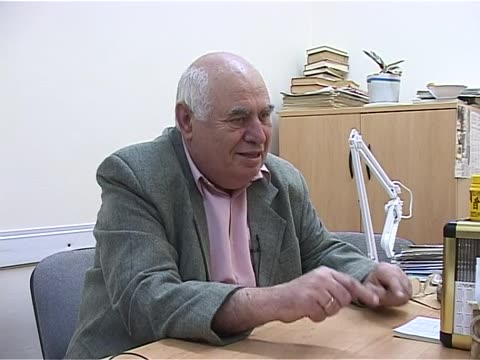
Kleiman introduces the Hesed Shushana of Chernivtsi, a local philanthropic organization that serves some thousand Jews with material aid, food, medical help and repairs. He describes its kindergarten, clubs, the Mazl-tov programme for mothers with small children, and a Sunday club for three generations, financed by the Joint. He also tells of Chernivtsi as a formerly Jewish city with Jewish-built buildings, Jewish parties and visits by Zionist leaders.
describes specific Hesed programs (kindergarten, clubs, Joint funding) and prewar Zionist visits
Kleiman gives personal details: born in 1931 in Vadrashkov in Bessarabia, full name Shaya Davidovich Kleiman, and his surname was once Kleinman, changed during the war years. He gives his Chernivtsi address and telephone and postal codes, which Kerler asks him to say in Yiddish. He also gives the Yiddish term for the in-laws' relationship.
gives his address and phone number and a kinship term
Kleiman talks about Jewish life and childhood memories before the war in his hometown Vadrashkov. He attended a Romanian school. His parents hired a private religious tutor, who taught Kleiman in the afternoons. He describes the studies with the tutor. According to Kleiman, he was fairly well-versed in religious texts at the age of nine. Kleiman recalls how he learned Yiddish from a Communist newspaper, “Der veg” (the path).
Kleiman recalls Vadrashkov as a town of a couple of thousand Jews with many rabbis. He attended a Romanian school and also studied in the afternoons with a private tutor, learning Hebrew, Humash and modern Hebrew. Yiddish was spoken at home and in the street but not formally taught; he improved his Yiddish reading a Communist newspaper. He recalls young people's games and singing and a neighbouring family who all perished, and mentions the Soviet takeover of 1940 and the start of the war.
Kleiman talks about his life during the war. He explains how fourteen of his relatives from Vadrashkov were forced to stay in the ghetto. Only he and his parents returned home after the war. They moved to Chernivtsi in 1946. Kleiman states that forty distant relatives, including his sister, were killed during the war.
Kleiman tells that fourteen relatives from his family circle were in the ghetto and that many other relatives were killed, some forty in all. His sister Beyle was also killed. After the war the family lived in Chernivtsi from 1946.
Kleiman says his parents are buried in Chernivtsi's old Jewish cemetery, which is neglected. He describes the city's prominent Jews: Jewish mayors, a doctor-mayor who built the tram and the railway station, and the large Reform synagogue (now a cinema). He also mentions restrictions on Jews in Russia and Romania's reimposition of them after 1918.
names prominent Jewish figures and the history of restrictions
Kleiman talks about his life after the war. He studied mathematics at the Chernivtsi University. He taught at various schools for forty-five years in Ukraine and Moldova. He then talks about Jewish life in postwar Chernivtsi. Kleiman states that the Soviet government permitted one active synagogue.
Kleiman studied mathematics at Chernivtsi University and taught for 45 years, in Moldova (Edinet) and in Chernivtsi; his wife is also a mathematician and they have no children. He describes the remnants of Jewish life in Edinet and in postwar Chernivtsi, where Soviet policy left only one synagogue. Kerler then discusses a younger religious man he hoped to interview and explains a term for twilight.
includes Edinet and the single permitted synagogue, plus Kerler's aside about a mnemonic finger method and a religious man
Kleiman talks about his family. He tells the story about how his paternal grandfather married his grandmother, who was his niece. His mother’s maiden name was Utshitel. Her mother’s brother immigrated to Palestine in the 1930s. His father was a shopkeeper before and worked in a shop after the war.
Kleiman talks about his family: his naming after his grandfather and sister's after his grandmother, his father David son of Yeshaye, and the story of his grandfather marrying a niece (his brother's stepdaughter), apparently after a quarrel over kashrut. He gives his mother's name Golde, her father Tevye (?), her family name Utshitel, her brother's emigration to Palestine, and her role as housewife. His father was a shopkeeper before the war and worked in a shop afterwards, and Kerler asks which words were used.
includes the grandparents' marriage story and the maternal uncle in Haifa
Kleiman talks about his father’s religiosity and discusses prewar holiday celebrations at home, in particular Passover and Purim. He recalls that he joined his father to go to the rebbe during holidays. Kleiman discusses prewar Jewish life in Vadrashkov, including Yiddish culture and political organizations. He then talks prewar weddings.
Kleiman describes his father as an honest, pious man who prayed daily, and recalls the Sabbath, Yom Kippur, Passover preparations and food such as gefilte fish, and Purim customs. He remembers going with his father to the rebbe on holidays and the rebbes and dayan of Vadrashkov. He also covers the Jewish centre of the town, trades, reading, visiting theatre troupes, political groups, Hebrew learning and weddings with the chuppah by the house and the badkhn.
covers the rebbe's court, theater troupes, political groups and wedding customs in addition to holidays
Kleiman answers Kerler's dialectological questions on how words are said in Vadrashkov Yiddish. Items include a dybbuk and being stubborn, body and household words (belly, house, hide, mouse, window pane, blue), adverbs of time and nearness, the verbs for being ill, escaping, breathing and building, and a sentence-based question on 'from where'. They also discuss variants such as alle and eyle.