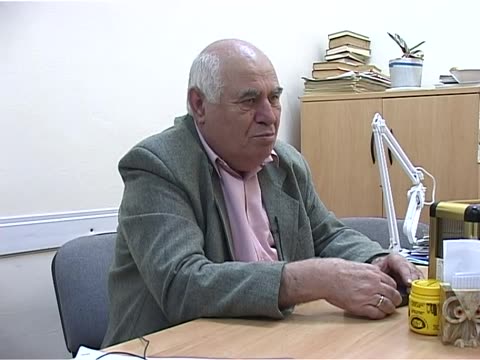
Kleiman answers a number of dialectological questions from the AHEYM Yiddish questionnaire. Kleiman briefly talks about the history and language of Bessarabian Jews. The second part of the tape includes town footage of Chernivtsi.
Kleiman answers Kerler's dialectological questions: words for thousand and vodka, forms for grandmother and parents, the word for roof, some Ukrainian loans (well, rag, flower) and Hebrew-derived words. He also gives sentence and grammar items, including number expressions, phrases for please, and plurals. At the start Kerler says that people he interviews remember little, and Kleiman briefly talks about the history and language of Bessarabian Jews, who came from Ukrainian territory, and about Bukovina and Romanian influence.
Kleiman's account of the Bessarabian Jewish population and of Romanian influence on Yiddish.
The camera collects town footage and Kleiman gives a tour of the former Jewish neighborhood, headed towards the plaque of the Yiddish writer Moyshe Altman.
Kleiman and Kerler walk through the former Jewish quarter of Chernivtsi. Kleiman recalls a street where rich Jews lived and people strolled before the war. They look for memorial plaques, including one to the Yiddish writer Moyshe Altman, and talk about a former prayer house now used for other purposes. Directions and arrangements for a visit to the synagogue are partly in Russian.
Kleiman's memories of the street and arrangements for a synagogue visit.
The third part of the tape is a formal interview with Riva Fridrikhovna Gimelbrandt, born 1932 in Chernivtsi. Gimelbrandt, nee Margulis, provides personal information and talks about her family. Her father was born in Sadgora and worked as a tailor. Her mother, born in Vyzhnytsya, was a tailor as well. Gimelbrandt mentions that her grandfather Yisrol sewed suits for the rebbe of Vyzhnytsya.
Gimelbrandt, born in 1932 in Chernivtsi, gives personal information and talks about her parents. Her father, Margulis (Simkhe, called Fridl), was a tailor born in Sadgora and raised among Hasidim, and her mother, Leah, was also a tailor, born in Vyzhnytsya. Her grandfather Yisrol sewed uniforms for the rebbe of Vyzhnytsya, and she names her grandmother. The start of the passage still carries the end of Kleiman's part.
The names of her grandmother and the family surname, partly garbled.
Gimelbrandt discusses her childhood memories. She mentions holiday celebrations, in particular Purim and Passover. Gimelbrandt finished one year at a Yiddish school. She grew up with a sister and a brother, who attended religious school (cheder) and lives in Israel. Gimelbrandt remembers how her non-Jewish friends, who spoke Yiddish, celebrated Purim with her before the war. She then describes food customs for Sabbath, Shavuot, and Passover.
Gimelbrandt recalls her prewar childhood: Purim with dancing, collecting money and wooden noisemakers, Hanukkah, and Passover seders at which her father had her brother ask the four questions. She finished one year at a Yiddish school; her brother attended cheder. Non-Jewish friends who spoke Yiddish joined the holidays. She describes Sabbath, Shavuot, Hanukkah and Passover food (challah, kugel, tatsh, cheese pastries, latkes). She names the street where her family lived, with a synagogue next door where her father led prayers.
Gimelbrandt talks about her father Simkhe Fridl, who lost his parents at the age of four. Gimelbrandt explains that her father was raised within the Hasidic community in Sadgora. Her father’s sister was adopted by relatives, who lived in America. Simkhe Fridl lived in a tailor’s home and worked for him, which financed his religious school (cheder) education. He was drafted into the Red Army in 1941. Gimelbrandt then talks about her mother, who grew up within the Hasidic community in Vyzhnytsya. She also explains her grandfather’s work as a tailor for the rebbe of Vyzhnytsya. Gimelbrandt recalls how her mother would tell stories about the good deeds of the Vyzhnytsya rebbe.
Gimelbrandt tells how her father lost his parents at four, his sister was taken to America, and he grew up with a tailor, working there so that he could attend cheder. He was taken to the front in 1941 and returned badly injured. She recalls her mother's upbringing in Vyzhnytsya among Hasidim, where Yiddish was the only language she spoke, and her grandfather who sewed uniforms for the Vyzhnytsya rebbe. Her mother used to tell of the rebbe's good deeds. Local non-Jews sought his advice and spoke Yiddish.
Her father's postwar illness and death date, and her mother's immersion in a Yiddish-speaking world.
Gimelbrandt talks about her family’s life in 1944, when they returned to Chernivtsi. She explains how her mother hid in a basement, because of the fear to be taken to the gulag in the Donbas region. Gimelbrandt talks about her life during the war. She describes how the Romanians forced her family into the small synagogue in the late fall of 1941, where they had to stay for six weeks in terrible hygienic conditions. Gimelbrandt remembers how her non-Jewish friends helped her out with food. After six weeks, Gimelbrandt continues, her family was taken to the railway station and forced into freight cars, headed to the Transnistria region. According to her, they traveled for roughly twelve hours in an overcrowded car and stopped at the River Dniester. The Romanians forced them over the bridge toward Mohyliv-Podilskyy and checked everybody for valuables, before sending people into a school for disinfection. Gimelbrandt remembers her mother taking off clothes from corpses for her children. From the school in Mohyliv-Podilskyy, her family had to walk twenty-five kilometers in snow to Slidy. She remembers how she bid farewell to her mother, who carried her two year-old sister, ten kilometers before Slidy. Gimelbrandt could not continue walking and stayed behind in the snowy fields. She was rescued by a non-Jew, who took her to his house in Slidy on a horse. As soon as the non-Jewish man found out that it was a felony to hide Jews, he smuggled Gimelbrandt into the Slidy ghetto, formerly a pig farm near Slidy. There she was reunited with her family. Gimelbrandt describes the horrific life in the ghetto with beatings and barely any food.
Gimelbrandt recalls that her mother returned to Chernivtsi in 1944 and hid in a cellar for fear of roundups. She describes the war: in autumn 1941 the Jews were forced into the small synagogue for six weeks, then packed into freight cars to the Dniester and over a bridge to Mohyliv, where the Romanians searched them. After a school for disinfection they marched in the snow to Slidy. Exhausted, she was left in the fields and rescued by a non-Jew, who took her to Slidy and then to the ghetto camp on a former pig farm, where she rejoined her family.
Details of the postwar return and the camp commanders.